
Problem Introduction
TLS configuration weaknesses such as deprecated protocols (TLS 1.0/1.1), weak cipher suites (e.g., RC4, 3DES), and invalid certificates rarely cause full application outages. As a result, web applications often remain operational while secretly exposing the organization to intercept and downgrade attacks. Manual security reviews fail to catch continuous configuration drift caused by application or infrastructure updates, necessitating automated, regular scans.
How GRiPO Helps You in This Situation
GRiPO converts manual TLS auditing into an automated pipeline that tests domain endpoints on port 443, collects handshake telemetry, and checks findings against strict security policies. It automates handshake testing across all TLS versions, parses certificates, classifies issues into PASS, WARNING, or FAIL statuses, and dispatches an email report directly to security teams.
GRiPO Solution
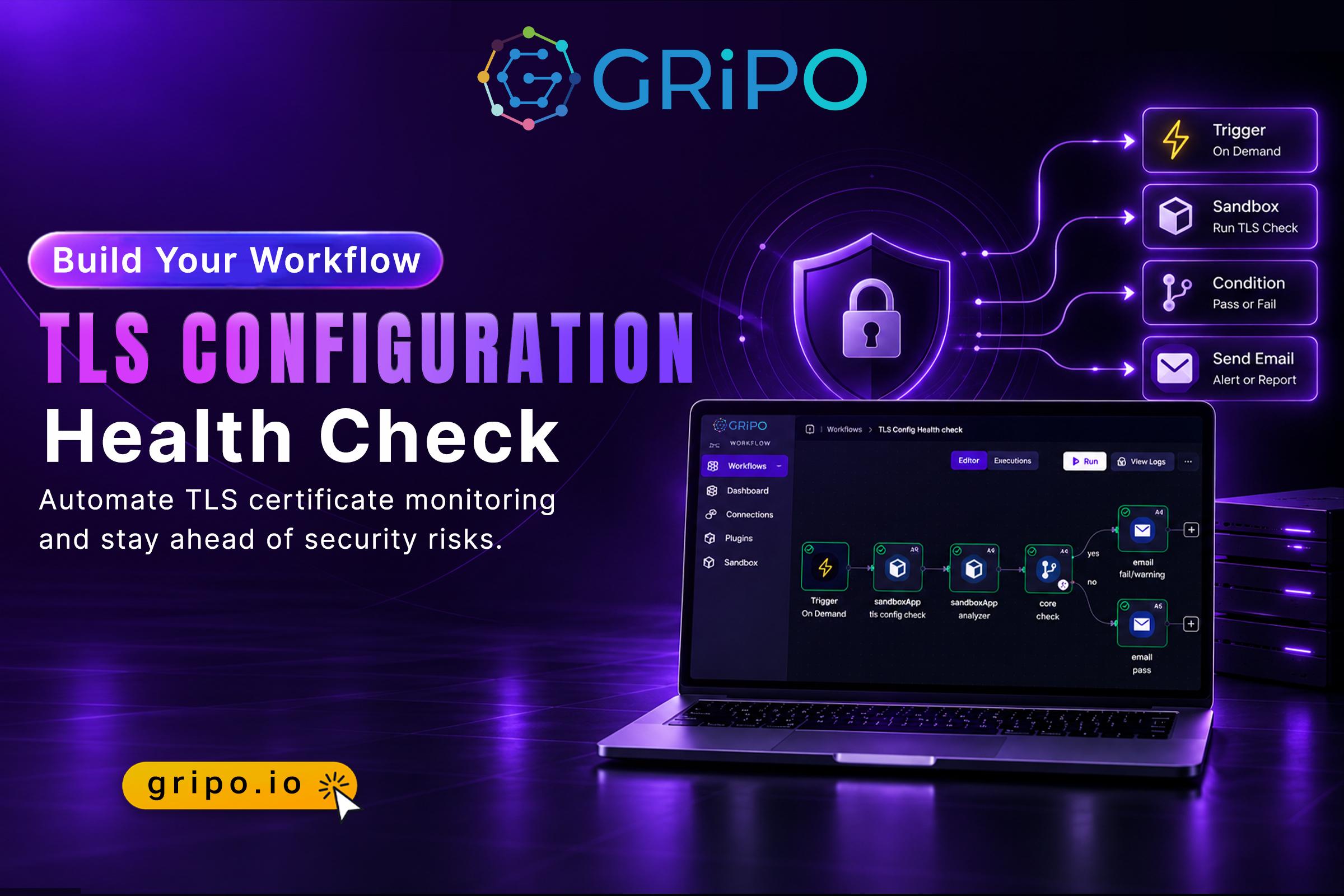
The TLS Configuration Health Check isolates raw network execution from security policy evaluation. Node A1 performs individual handshakes for TLS 1.0–1.3 and collects certificate metrics. Node A2 evaluates the raw telemetry against security rules to categorize the risk level. Node A3 routes execution based on the final status to Node A4 to trigger targeted email notifications.
| Rule / Condition | Status | Severity | Action Required |
| TLS 1.0 or 1.1 Supported | FAIL | HIGH | Immediately disable deprecated protocols. |
| Weak/Deprecated Cipher Detected | FAIL | HIGH | Remove ciphers using RC4, 3DES, DES, NULL, MD5, etc. |
| Invalid Certificate or Hostname Mismatch | FAIL | HIGH | Re-issue or fix certificate configuration. |
| TLS 1.2 Available, TLS 1.3 Unavailable | WARNING | MEDIUM | Enable TLS 1.3 for modern security hardening. |
| TLS 1.2 + TLS 1.3 Enabled (No Weak Ciphers) | PASS | LOW | No action required; configuration is secure. |
Automated TLS Configuration Monitoring
The workflow executes automatically via a Daily Trigger or on-demand during development. If an infrastructure change accidentally re-enables a deprecated protocol or allows an expired certificate, the scan detects the status change and sends an immediate alert to maintain continuous compliance.