
Problem Introduction
Web applications exposed to the internet often lack proper HTTP security headers, leaving them vulnerable to attacks like XSS, clickjacking, protocol downgrades, and MIME-type sniffing. Because a website can return a 200 OK status while completely missing critical defense headers, standard uptime checks fail to detect these security gaps. Manual inspection using command-line tools is inefficient across multiple applications, creating a need for automated header verification.
How GRiPO Helps You in This Situation
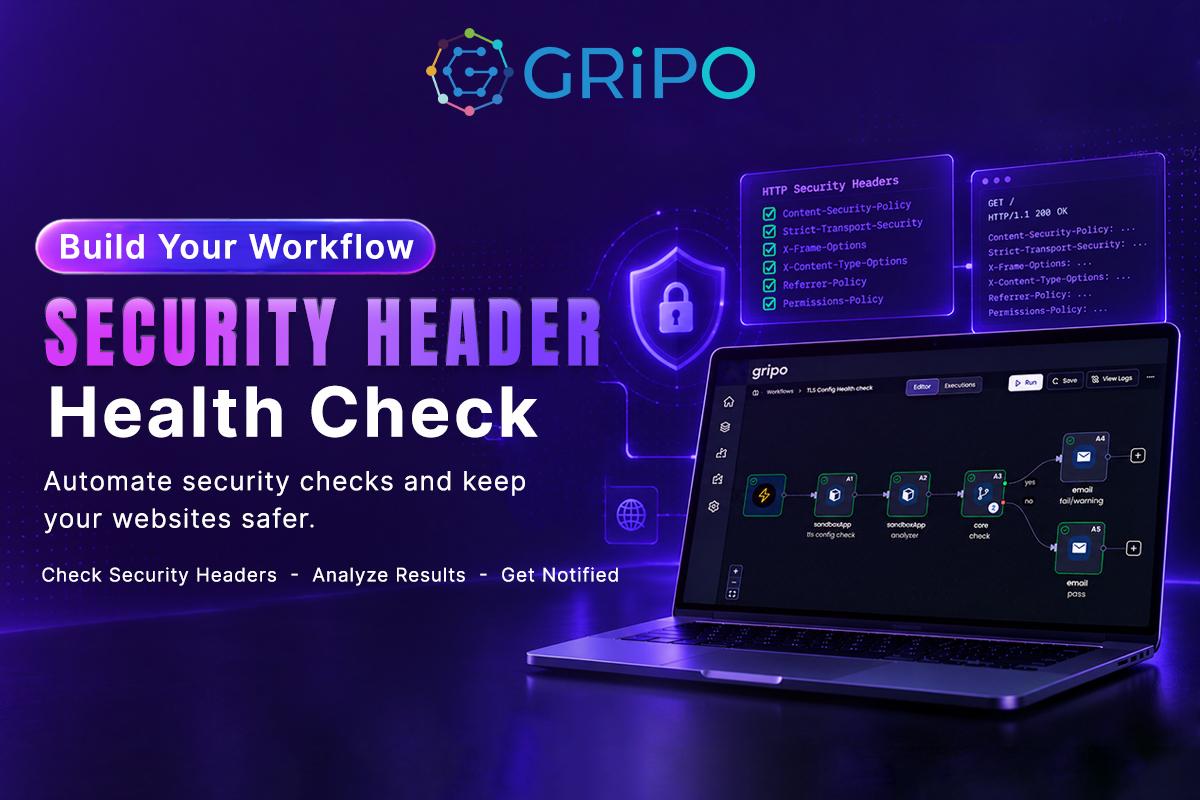
GRiPO automates HTTP header inspections by requesting a target URL, fetching its HTTP headers, comparing them against predefined security policies, and classifying each control as PASS, WARNING, or FAIL. This transforms manual audits into an automated process that can be triggered on-demand during testing or scheduled daily for continuous monitoring.
GRiPO Solution
The GRiPO Security Header Health Check inspects six vital controls:
HSTS, CSP, X-Frame-Options, X-Content-Type-Options, Referrer-Policy, and Permissions-Policy.
The workflow decodes collected headers, checks them against risk thresholds, calculates the overall security status (defaulting to FAIL or WARNING if any rule fails), and automatically routes findings to the security team.
| Security Header | Purpose |
| Strict-Transport-Security (HSTS) | Enforces HTTPS connections. |
| Content-Security-Policy (CSP) | Restricts browser resource execution to prevent XSS. |
| X-Frame-Options | Protects against clickjacking. |
| X-Content-Type-Options | Prevents MIME-type sniffing. |
| Referrer-Policy | Controls referrer information leakage. |
| Permissions-Policy | Restricts browser feature capabilities (e.g., camera, microphone). |
Automated Security Header Health Check
The workflow runs using an On Demand Trigger during development or via a Daily Schedule Trigger in production. If a deployment accidentally removes a critical header (such as CSP), the automated scan flags the configuration drift and sends an email report.