
Problem Introduction
Domain names are the foundation of every online service, but they are only valid for a fixed registration period and must be renewed before they expire. If a domain expires unexpectedly, the website, email, and any dependent services go offline immediately, often with no warning to end users. Because domain renewal dates are set once a year or longer and easy to lose track of across dozens of registrars and TLDs, manual monitoring is unreliable and a single missed renewal can cause major business disruption. Teams also need alerts to reflect actual urgency, since a domain expiring in 3 days is a very different situation from one expiring in 25, without exposing internal lookup infrastructure or registrant data in the process.
How GRiPO Helps You in This Situation
GRiPO helps DevOps and platform teams automate domain expiry monitoring with severity-aware alerting, without relying on manual registrar checks. Using GRiPO’s visual workflow builder, teams can create an automated workflow that connects scheduled triggers, sandboxed code execution, tiered conditional logic, and separate email notifications for critical versus warning states. The domain to monitor is supplied as a workflow input rather than hardcoded, so the same workflow can be safely reused as a template across teams and environments. During development, the workflow can be tested using an On Demand Trigger, allowing engineers to run it instantly and verify the results before switching to a scheduled trigger for continuous monitoring.
GRiPO Solution
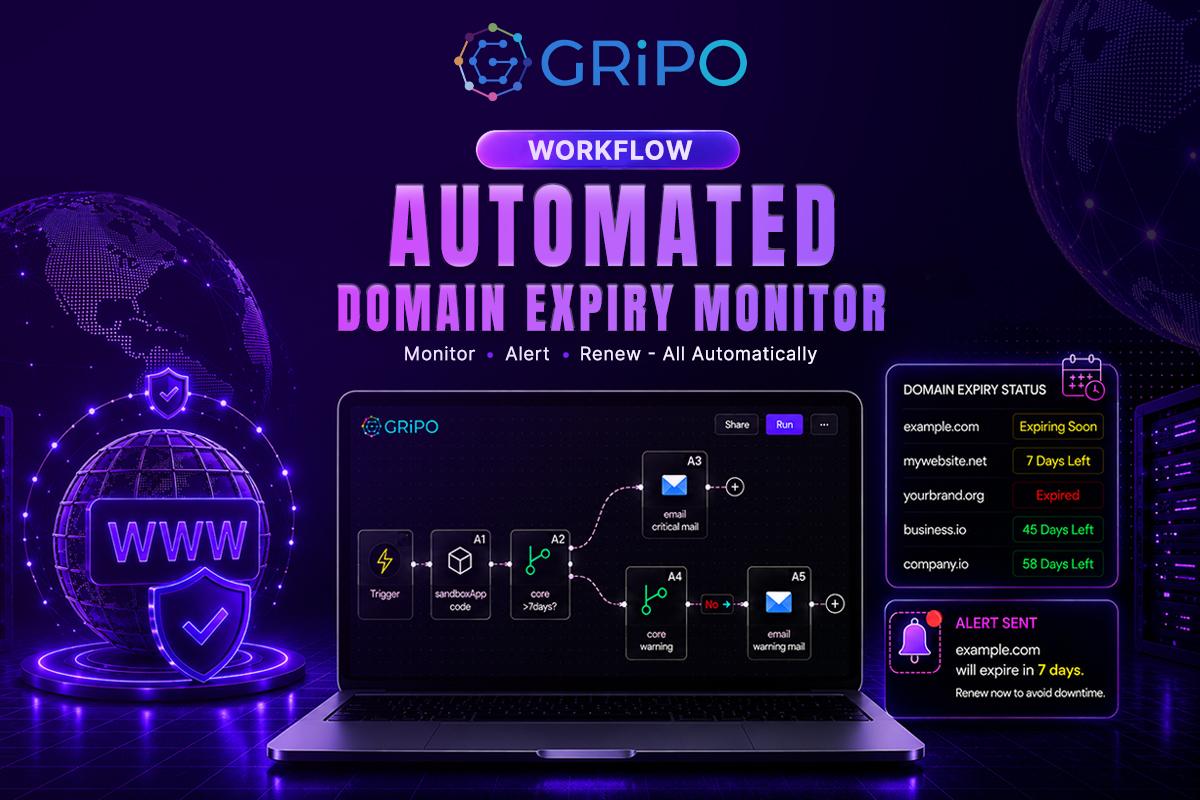
With GRiPO, you can build a Domain Expiry Monitor that automatically looks up a configured domain’s registration data and calculates the exact number of days remaining until expiry. The domain-lookup Python code runs inside a secure Python Sandbox, keeping execution isolated from the rest of your environment. It validates the domain input before making any network call, queries RDAP first with an automatic WHOIS fallback for full TLD coverage, enforces strict timeouts and response-size limits on every external lookup, and only ever extracts the expiry date. Raw registry responses are never logged, stored, or passed downstream. From there, the workflow branches on urgency. A first condition checks whether 7 days or fewer remain and, if true, sends a Critical Alert Email demanding immediate renewal. If not, a second condition checks whether 30 days or fewer remain and, if true, sends a Warning Alert Email flagging that renewal attention is required. If neither condition is met, the domain is healthy and the workflow completes with no notification sent. Each alert tier routes to its own email node, so recipients only ever receive the notification level relevant to the actual urgency, ensuring critical and warning alerts are never mixed into the same message or thread.
Automated Domain Expiry Monitoring
Once the workflow has been tested successfully, replace the On Demand Trigger with a Schedule Trigger set to run every 24 hours. GRiPO will then automatically check the domain’s registration status daily and notify the appropriate team with the correct severity, critical or warning, only when action is actually required. Recipients for both the critical and warning emails should be bound through GRiPO’s configuration or secrets rather than typed directly into the nodes, keeping the exported workflow safe to share as a reusable template. This approach reduces manual monitoring, helps prevent unexpected domain expiration and downtime, and provides a reusable, severity-tiered automation pattern that can be extended to monitor multiple domains and other infrastructure assets, with no sensitive data leakage risk to end users who adopt it.