
Problem Introduction
Misconfigured S3 buckets can expose sensitive data and create serious security risks. Cloud storage security requires reviewing bucket configurations, access policies, permissions, and public access settings. Checking these manually is time-consuming, and without a consistent assessment process, important risks may go unnoticed, making it harder to prioritize and respond.
How GRiPO Helps You in This Situation
The challenge isn’t having different tools, it’s getting them to work together. When the output of one system has to feed another for analysis, action, or AI insights, teams end up moving data manually, maintaining custom scripts, or building complex ETL pipelines. GRiPO Flow connects these tools into a single workflow where data, insights, AI analysis, and actions flow between systems automatically.
GRiPO Solution
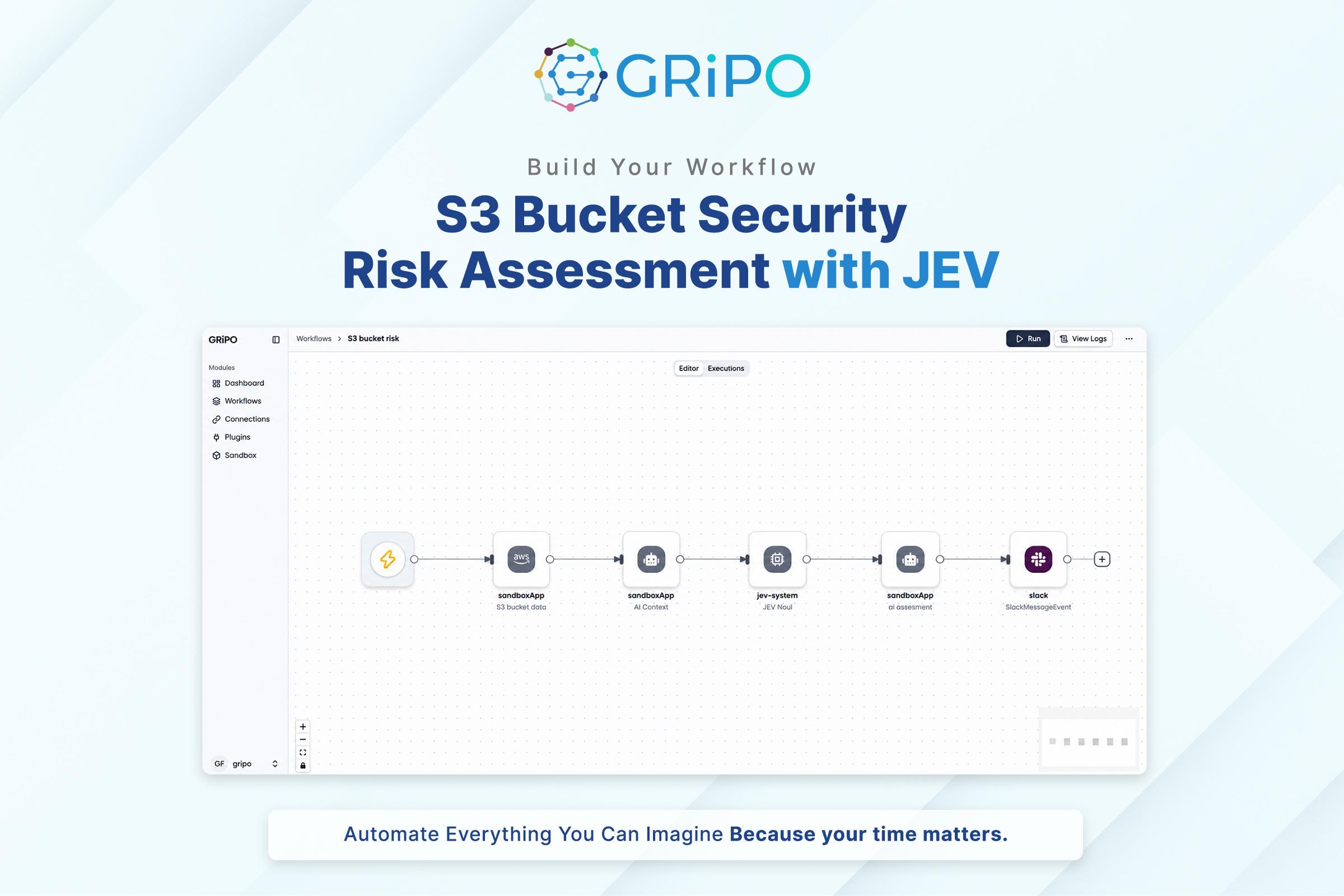
Jev is a System One model designed to make fast, structured decisions. Instead of generating text, it returns a defined decision that can be used directly for routing and automated actions. GRiPO supports jev as a plugin. In this workflow:
- On-Demand Trigger: runs the assessment whenever the team needs to evaluate a bucket’s security configuration.
- S3 Bucket Data: collects bucket security information, including available configuration and access-related details.
- AI Context: organizes the collected information into a structured context for jev.
- jev Noul: receives the context and instructions and makes a structured decision.
- AI Assessment: uses jev’s decision and the security evidence to generate a structured report covering findings, risk score, missing configuration evidence, and areas requiring analyst attention.
- Slack Message Event: sends the assessment to the configured Slack channel.
Automated S3 Bucket Security Risk Assessment
The workflow runs on demand. It collects S3 bucket security data, prepares the AI context, uses jev to make a structured decision, generates an AI security assessment, and sends it to Slack. In the example run, the report confirms public access is blocked and AES256 encryption is enabled, while versioning and logging are disabled. It also shows the risk score, missing evidence, and areas requiring attention.