
Problem Introduction
In active development environments, pull requests (PRs) are continuously submitted for features, bug fixes, and security patches. As repository count and team sizes scale, PRs frequently sit unreviewed for days. This creates release bottlenecks and severe security risks—unreviewed PRs containing critical security fixes or sensitive auth changes remain stuck without visibility. Because GitHub lacks built-in proactive escalation for aging PRs, teams must manually audit open PRs across multiple repositories, an inefficient process where high-risk changes are easily overlooked.
How GRiPO Helps You in This Situation
GRiPO transforms manual GitHub pull request audits into an automated monitoring pipeline. Operating on a scheduled daily trigger or on-demand execution, GRiPO fetches open PRs, calculates their age, evaluates their review status via the GitHub CLI, and cross-references PR labels against predefined security policies. It prioritizes stale PRs carrying team-defined security tags and dispatches actionable alert emails directly to maintainers, ensuring critical reviews are never missed.
GRiPO Solution
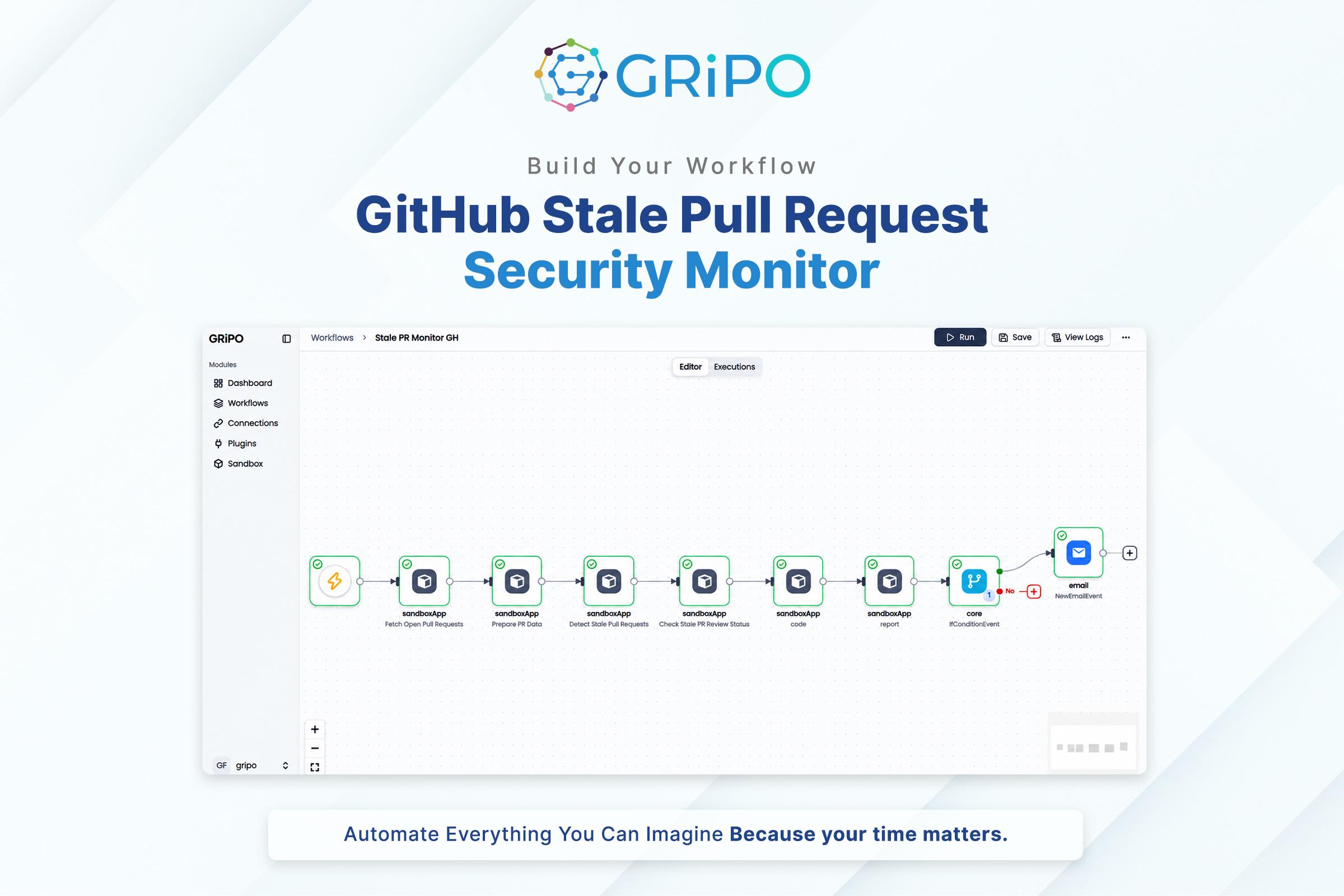
The GitHub Stale Pull Request Security Monitor identifies unreviewed PRs exceeding a defined age threshold (e.g., 3 days) and prioritizes those labeled as security-sensitive. The workflow uses a multi-stage architecture: Node A1 pulls raw PR data, Node A2 filters for stale PRs, Node A3 checks review status, Node A4 assigns security severity based on repository labels, Node A5 formats human-readable alert payloads, Node A6 evaluates whether alerts are required, and Node A7 dispatches the alert email.
Automated GitHub Stale PR Security Monitor
The workflow executes automatically via a Daily Trigger across target public or private repositories using authenticated GitHub CLI parameters ({{input.owner}}/{{input.repo}}). By continuously surfacing unreviewed, high-risk code changes, it eliminates manual audit overhead and prevents security fixes from stalling in the development pipeline.