
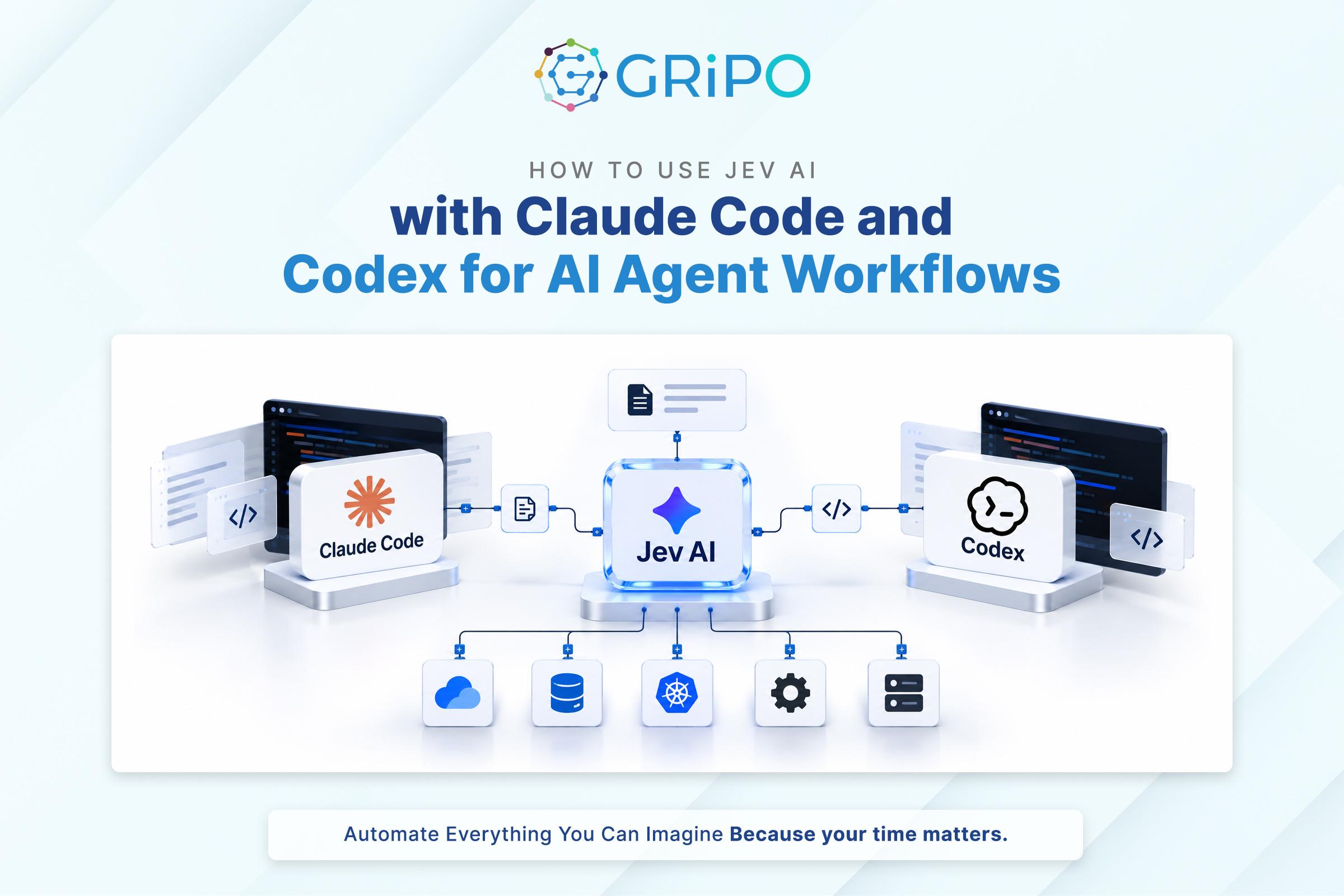
Jev AI with Claude Code and Codex can help engineering teams build more efficient AI agent workflows. AI coding agents are getting very good at doing work. Tools like Claude Code and Codex can inspect repositories, analyze code, execute commands, and handle complex software engineering tasks. Give Claude Code a repository, and it can inspect files, reason about changes, write code, execute commands, and help move a task toward completion. Codex can play a similar role in software engineering workflows. But there’s an interesting limitation hiding inside these increasingly capable agents: not every decision requires a generative model.
An agent may spend a large model call deciding something surprisingly small, such as whether a test failure looks like a real regression, whether a pull request should require security review, which workflow should handle a request, whether a deployment is safe to continue, or whether an issue should go to the infrastructure team. It may also need to determine whether a change contains a database migration or whether human approval is required. The actual answer may be a simple yes, no, category, score, or route.
That’s where Jev AI becomes interesting. Jev is designed as a decision model rather than a conversational model. You provide application state and typed questions, and it returns structured decisions with probability information. Its documented primitives include Choice, Score, and Noul—a probability that a statement is true. Jev AI documentation
That creates a useful architecture:
Claude Code or Codex reasons and executes. Jev evaluates bounded decisions. The workflow determines what happens next.
This distinction matters because the goal isn’t to replace Claude Code or Codex with Jev. Instead, it’s to give coding agents a specialized decision layer for the many small judgments that occur around larger AI-driven tasks.
What Is Jev AI?
Jev is a System One decision model from TypeSafe AI. Instead of generating a paragraph, Jev takes application state and answers predefined questions about that state, returning structured outputs rather than open-ended responses. The official documentation describes three main question types:
| Jev type | What it does | Example |
|---|---|---|
| Noul | Estimates whether a statement is true | “Does this PR require security review?” |
| Choice | Selects from predefined options | “Which team should handle this incident?” |
| Score | Places something on an ordered scale | “How risky is this deployment?” |
That makes Jev fundamentally different from a general-purpose coding model. Claude Code or Codex might explain why a deployment appears risky, while Jev can answer a narrower question such as deployment_risk = high or security_review_required = 0.94. The application can then use that result to determine what happens next, based on its workflow and decision rules.
This is the key architectural distinction between generative AI and a decision model.
Generative AI
Context
   ↓
  LLM
   ↓
Generated reasoning / code / explanation
   ↓
Application interprets result
Jev
Application State
   ↓
Typed Question
   ↓
  Jev
   ↓
Structured Decision
   ↓
Workflow Branch
Jev isn’t intended to replace the generative model. Instead, it gives developers another primitive to use when an application needs a bounded decision rather than generated language.
Why Put Jev Inside an AI Agent Workflow?
A coding agent makes dozens of decisions while working, and while some require deeper reasoning, others involve straightforward, well-defined judgments. Consider a DevOps agent investigating a failed deployment. It might need to read deployment logs, inspect the Kubernetes configuration, compare the current version with the previous release, determine whether the failure is infrastructure-related, decide whether rollback is appropriate, notify the right team, and execute remediation. A generative model is useful for investigating the failure, interpreting evidence, and identifying potential causes, but certain decisions within this process can be expressed much more precisely.
For example, does the evidence indicate that this deployment should be rolled back? This is a bounded decision. Rather than generating a three-paragraph explanation that the application must interpret, the workflow can use a structured result to determine which branch to follow.
Deployment State
       ↓
      Jev
       ↓
Rollback Required?
       ↓
    Yes / No
       ↓
Workflow Branch
This creates a clear separation of responsibilities: the agent handles reasoning and execution, Jev handles bounded judgment, and the workflow handles orchestration and policy. Such separation can make complex AI automation easier to understand, test, and maintain, particularly when multiple agents and operational systems must work together. For production environments, the decision should still be evaluated against reliable evidence and explicit safety policies, with human approval where required before high-impact actions such as a rollback.
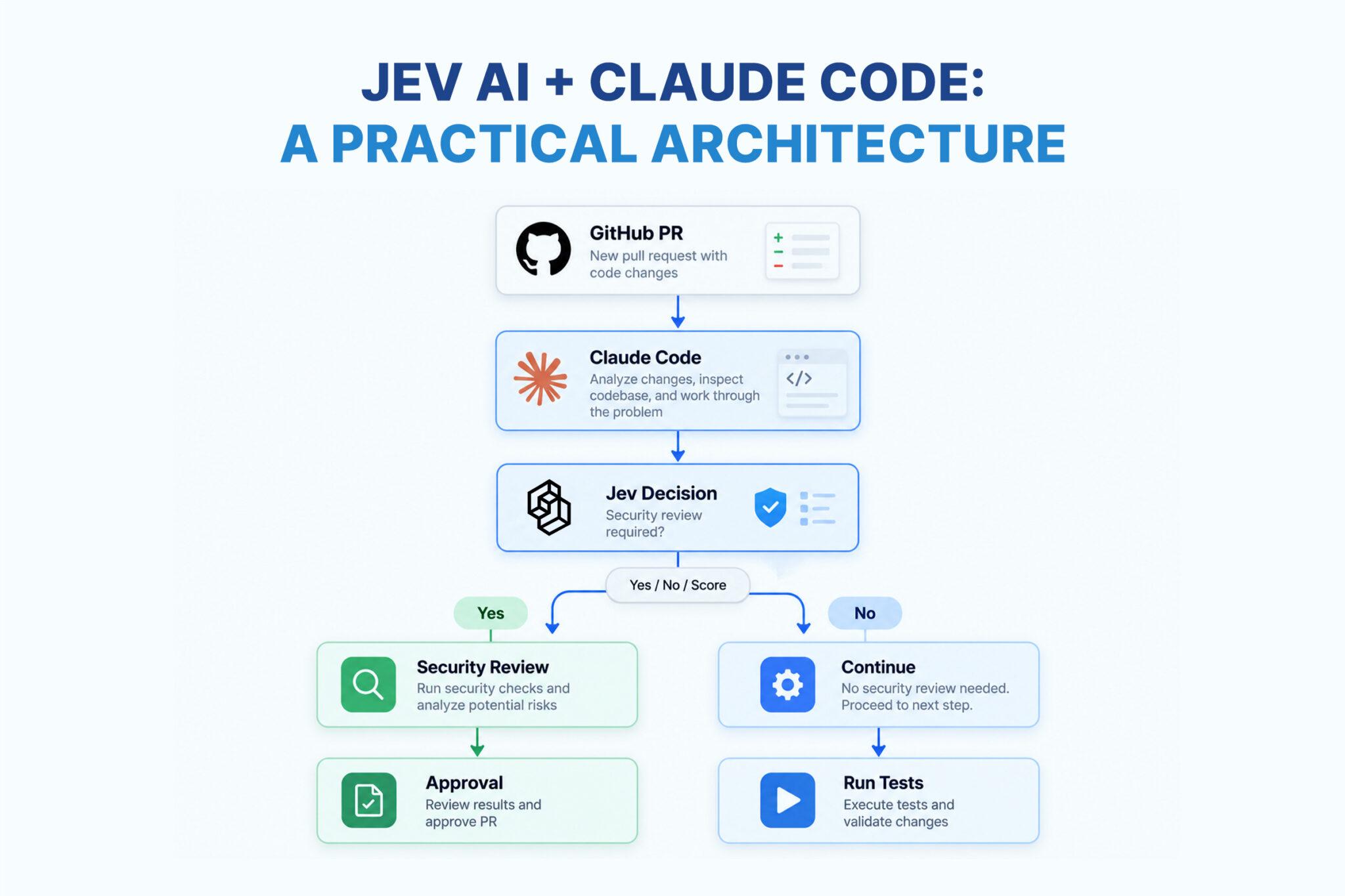
Jev AI + Claude Code: A Practical Architecture
Claude Code is designed for software engineering tasks in which an agent needs to inspect a codebase, modify files, execute commands, and work through a multi-step problem. Jev can sit alongside that process as a specialized decision layer, evaluating predefined questions and returning structured results that guide the next step in the workflow.
A simplified architecture looks like this:
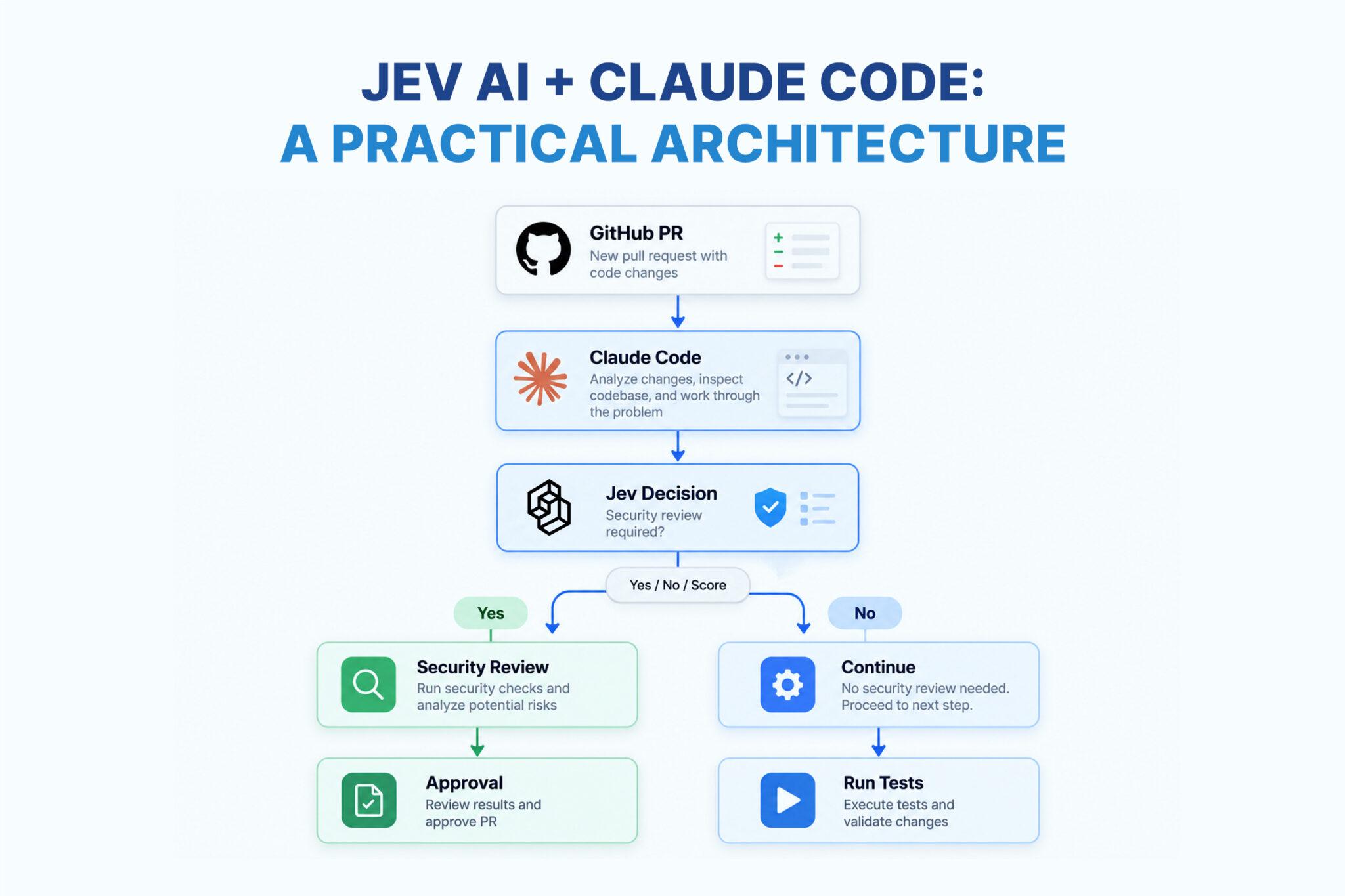
Claude Code doesn’t need to become a decision model, and Jev doesn’t need to become a coding agent. Each component performs the task it’s designed for: Claude Code analyzes and modifies the codebase, Jev evaluates a bounded decision, and the surrounding workflow determines the next action.
Example: Using Jev to Review a Pull Request
Imagine Claude Code has analyzed a pull request and produced the following summary: the changes modify authentication middleware, add OAuth callback handling, update session validation, affect 17 files, and introduce 42 tests, with no database migrations or infrastructure changes. Claude Code can explain these changes in detail, but the workflow may need a much simpler answer to one specific question: does this pull request require security review?
This is where Jev can evaluate the pull request state against a predefined question and return a structured decision.
State: Pull request summary and relevant diff information.
Question: Does this change require security review?
Illustrative result: Yes
Illustrative probability: 0.96
The workflow can then use the result to determine the next step:
                 Jev
                  ↓
       Security Review Required?
              /       \
            Yes        No
             ↓          ↓
      Create Review   Continue CI
             ↓
      Notify Security
The important part is that Jev isn’t responsible for enforcing the policy. The application or workflow should define how the result is interpreted, including any decision thresholds, approval requirements, and escalation rules. For example, a workflow might require security review when the decision meets a configured confidence threshold, while also applying mandatory review rules to changes affecting authentication or authorization.
This keeps policy enforcement explicit and auditable rather than hiding it inside an AI-generated response. The probability shown above is illustrative, not a measured Jev result, and should not be treated as a guarantee of correctness. For security-sensitive workflows, validate the model against representative pull requests and retain deterministic rules for mandatory review requirements.
Jev AI + Codex for Automated Coding Workflows
The same pattern applies to Codex. A coding agent may generate a patch, run tests, inspect failures, and iterate through multiple changes. At certain points, the surrounding workflow needs a clear decision, such as whether the generated change should be sent for human review. Instead of asking a generative model to return a sentence such as, “I think this change probably deserves review because…”, developers can define a structured decision that the application can evaluate directly.
Generated Diff
      ↓
     Jev
      ↓
Review Required?
      ↓
   Yes / No
      ↓
   Workflow
The same approach can be extended to evaluate several questions against the same state: Does the change modify authentication? Does it modify infrastructure or database schemas? Does it introduce a new dependency? Does it require security review? Jev supports multiple typed questions against the same state, making this pattern useful when an application needs several bounded judgments about one piece of context. Jev AI on Hugging Face
The workflow can then combine those results into a structured representation, such as Authentication Changed = Yes, Infrastructure Changed = No, Database Changed = No, and Security Review = Yes. This is easier for automation code to consume than a long natural-language response, allowing the application to route the change for review, trigger additional checks, or continue the pipeline according to its configured rules.
Claude Code and Codex Should Still Do the Heavy Reasoning
This distinction is important because you shouldn’t use Jev simply because it’s new. There are many tasks where a generative model is clearly the better choice. Use Claude Code or Codex when the system needs to write or explain code, refactor an application, diagnose a complicated failure, generate documentation, develop a multi-step implementation plan, understand an unfamiliar architecture, modify several files, or execute an iterative coding task. These are reasoning and generation problems that benefit from a model capable of working through complex context and producing detailed outputs.
Jev is better suited to the narrower decisions surrounding those tasks, where the application needs a structured answer to a predefined question rather than a full explanation. A practical architecture combines both approaches, allowing the coding agent to handle the main task and call Jev when a specific decision is needed.
             Application State
                     ↓
          ┌─────────────────────┐
          │  Claude Code/Codex  │
          │                     │
          │ Reason • Plan • Act│
          └──────────┬──────────┘
                     ↓
              Decision Needed
                     ↓
                  Jev AI
                     ↓
            Structured Decision
                     ↓
              Workflow / Policy
                     ↓
              Next Agent Action
The generative model isn’t replaced; instead, the architecture becomes more specialized. Each component handles the type of task it is designed for, while the surrounding workflow controls how decisions translate into actions.
Five Useful Jev AI Agent Patterns
1. Routing
One of the simplest applications of Jev is deciding which agent or workflow should handle a task. Imagine an incoming engineering request: “The production API is returning intermittent 503 responses after the latest deployment.” Jev could classify the request into predefined routes such as Infrastructure, Application, Security, Database, or Observability, allowing the workflow to send the task to the appropriate specialized agent.
Incoming Incident
       ↓
      Jev
       ↓
 Classification
       ↓
┌──────┼──────┬──────┐
↓      ↓      ↓      ↓
Infra  App    Sec    DB
Agent  Agent  Agent  Agent
This approach becomes particularly useful when an organization operates multiple specialized AI agents and needs a consistent way to route incoming requests without relying on a separate generative response for every routing decision.
2. Risk Scoring
Not every action needs a simple yes-or-no answer. Some workflows require a risk level, such as Low, Medium, High, or Critical. A deployment agent could provide Jev with relevant state, including the files changed, services affected, infrastructure modifications, database migrations, authentication changes, test results, and deployment history. Jev can then evaluate that information against a defined rubric and return a structured risk assessment.
The workflow can use the result to determine the appropriate level of control:
Low Risk       → Automatic deployment
Medium Risk    → Additional validation
High Risk      → Human approval
Critical Risk  → Block deployment
This is a useful example of how a decision model can sit between AI reasoning and operational policy. The risk categories and resulting actions should be explicitly defined by the organization rather than left to the model to determine independently.
3. Validation
AI agents can generate code that looks correct but still requires validation. Suppose Codex generates a Terraform change. A workflow can first run the change through established validation tools, including Terraform plan evaluation, security scanning, and policy checks, before asking Jev to evaluate the accumulated evidence against a bounded question: Is the evidence consistent with elevated deployment risk?
Terraform Plan
      ↓
 Security Scan
      ↓
  Policy Check
      ↓
      Jev
      ↓
Is Deployment Safe?
Jev isn’t replacing Terraform validation or security scanners. Instead, it evaluates the available evidence when the workflow needs a bounded judgment. That’s an important distinction: AI decisions should complement deterministic controls, not replace them. For exact requirements such as “Production deployments must never use an unapproved AWS region,” use deterministic policy enforcement. For a judgment such as “Does the evidence indicate elevated deployment risk?”, a decision model may be appropriate as an additional evaluation layer.
4. Test Failure Triage
A CI pipeline might produce hundreds of test failures, and asking a coding agent to investigate every failure individually can consume unnecessary time and resources. A more efficient approach is to collect the test results, use Jev to classify the failures into predefined categories, and send the cases that require deeper investigation to Claude Code or Codex.
CI Results
    ↓
Collect Test Failures
    ↓
Jev Classification
    ↓
┌────────────────┬─────────────┬─────────────┐
│ Real Failure   │ Flaky Test  │ Environment │
└────────────────┴─────────────┴─────────────┘
          ↓
   Claude Code / Codex
          ↓
 Detailed Investigation
In this architecture, Jev performs the initial classification, while the coding agent investigates the underlying causes and proposes fixes. Because misclassifying a genuine regression as a flaky test can hide a production defect, the workflow should validate classifications against test history and other evidence, escalating uncertain or high-impact cases when necessary. The central principle is simple: use a decision layer to identify where deeper reasoning is needed, rather than treating every case as an equally complex investigation.
5. Human Approval Gates
AI automation shouldn’t mean removing humans from every important decision. In many enterprise environments, the appropriate architecture combines automated analysis with explicit approval gates, particularly for production infrastructure changes, security-sensitive operations, and actions with significant business impact. An AI agent could prepare a production infrastructure change, while Jev evaluates whether the available information indicates that the change belongs to a high-risk category.
AI Agent
    ↓
Jev Decision
    ↓
Risk / Policy Evaluation
    ↓
Human Approval
    ↓
Execution
For example, if a change is classified as high risk, the workflow could create a Jira approval request, notify the responsible engineer through Slack, and wait for an explicit decision before continuing or rejecting the change.
High Risk
    ↓
Create Jira Approval
    ↓
Notify Slack
    ↓
Wait for Engineer
    ↓
Continue / Reject
This creates a controlled bridge between autonomous AI and human governance. Jev contributes a structured decision, while the workflow enforces approval requirements, records the outcome, and controls whether execution is permitted.
Combining Jev With AI Agents in GRiPO Workflows
This architecture becomes especially interesting when the decision layer is connected to a broader workflow automation platform. A platform such as GRiPO can provide the execution and orchestration layer around these models, connecting code execution, AI-driven analysis, structured decisions, and downstream actions in a single workflow.
For example, a GitHub event could trigger a GRiPO workflow that launches Claude Code or Codex inside a sandbox, analyzes the code changes, passes the relevant state to Jev for a bounded decision, and branches according to the result. The workflow could then route the change for security review, trigger additional testing, request human approval, or proceed toward deployment, depending on the configured rules.
GitHub
   ↓
GRiPO Workflow
   ↓
Claude Code / Codex Sandbox
   ↓
Code Analysis
   ↓
Jev Decision
   ↓
Workflow Branch
   ├── Security Review
   ├── Additional Testing
   ├── Human Approval
   └── Deployment
The sandbox is important because coding agents may need to execute real commands while working on a task. Claude Code or Codex could operate inside an isolated environment where they can clone repositories, run tests, install dependencies, execute scripts, analyze infrastructure code, run Terraform commands, and inspect Kubernetes manifests. The workflow then controls what happens after execution, including how results are evaluated, which integrations are invoked, and whether additional approval is required.
This architecture separates responsibilities into distinct layers. Layer 1 — Execution: The coding agent works inside an isolated sandbox to inspect code, run commands, and produce results. Layer 2 — Decision: Jev evaluates bounded questions about the resulting state and returns structured decisions.
Layer 3 — Orchestration: The workflow determines the next action, including routing, approval, API calls, and execution of subsequent steps.
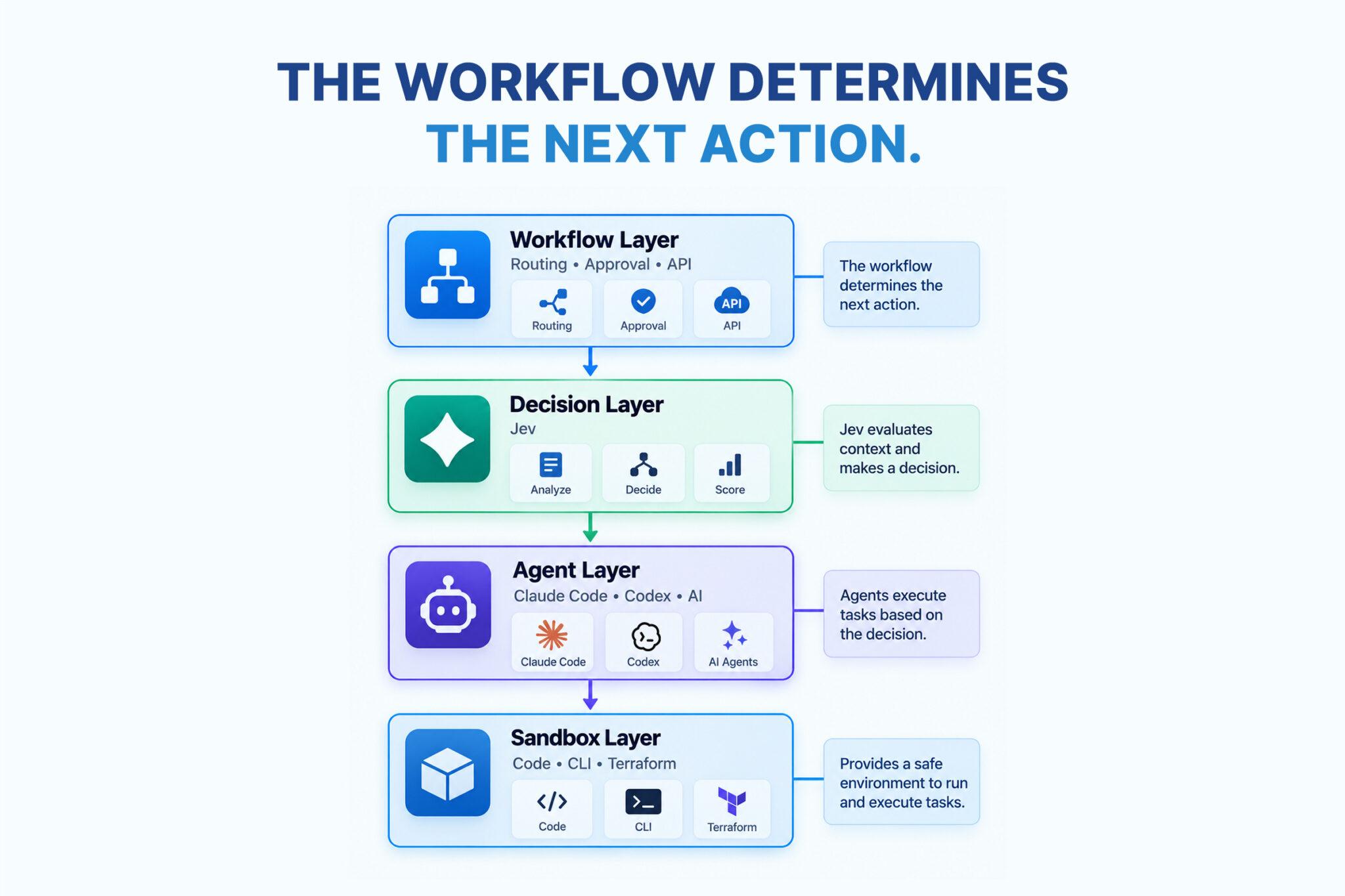
That separation is useful because each layer has a different responsibility: the sandbox provides an isolated execution environment, the agent performs the engineering work, Jev evaluates specific decisions, and the workflow coordinates the overall process. Together, these components can make AI-driven engineering workflows easier to control, integrate, and audit.
Why This Architecture Is Better Than One Giant AI Agent
It’s tempting to build one autonomous agent and give it access to everything. That approach can work for prototypes, but it becomes harder to govern as the system grows and moves into enterprise environments. A single agent with broad permissions must understand the request, decide what to do, determine whether the action is safe, choose the appropriate tools, execute commands, interpret results, decide whether to continue, and recognize when human approval is necessary. Combining all these responsibilities in one component makes the system more difficult to test, control, and audit.
A layered architecture distributes those responsibilities across specialized components, each with a clearly defined role.
| Responsibility | Best-fit component |
|---|---|
| Generate code | Claude Code / Codex |
| Explain a failure | Claude Code / Codex |
| Execute commands | Sandbox |
| Classify state | Jev |
| Score risk | Jev |
| Enforce exact policy | Deterministic code |
| Route workflow | Workflow engine |
| Require approval | Workflow / human |
| Connect external systems | Plugins / APIs |
The result is an architecture that is easier to test, observe, and maintain. It also makes responsibilities clearer, allowing teams to apply appropriate permissions, validation, and approval requirements at each stage instead of relying on a single agent to manage every decision and action.
Jev Is Not a Replacement for Deterministic Rules Either
There’s another important boundary to consider: a decision model shouldn’t replace a rule when the requirement is exact. Suppose your organization requires every production deployment to have an approved change ticket. That’s a deterministic requirement, so there is no need to involve an AI model. The application can check the approval status directly and enforce the rule:
if change_ticket_approved:
    continue_deployment()
else:
    block_deployment()
Jev becomes more useful when the question requires judgment rather than a straightforward check. For example, does the available deployment evidence indicate elevated operational risk? Answering this question may involve evaluating multiple signals, including recent failed deployments, large configuration changes, database modifications, missing test coverage, unusual traffic patterns, and recent incidents.
A decision model can evaluate those signals against a defined question, while deterministic code continues to enforce hard constraints. The workflow can then combine the model’s assessment with explicit policy rules to determine whether to proceed, run additional checks, or request human approval. This combination is much stronger than expecting a single technology to solve every problem: deterministic code enforces requirements that must never be violated, while decision models help evaluate situations that require a more nuanced judgment.
Building a Reliable Jev + Claude Code + Codex Workflow
When designing this type of system, keep the architecture disciplined and begin with the decision you need to make, rather than looking for places to introduce a new model.
Step 1: Identify the Decision
Don’t start by asking, “Where can we use Jev?” Instead, ask, “Which decision is currently expensive, inconsistent, or difficult to automate?” Good candidates have a clearly defined output that the application or workflow can act on.
Step 2: Define the State
Give Jev the information it actually needs to evaluate the question. For a deployment decision, that might include the deployment version, changed files, test results, security findings, infrastructure changes, recent deployment history, and current service health. Avoid dumping irrelevant context into every decision; effective automation depends on preparing relevant, reliable state.
Step 3: Define the Question
Keep the decision narrow and specific. A question such as “What do you think about this deployment?” is too broad because it doesn’t define the expected output. A more useful question is “Does this deployment require human approval?” The latter has a clear output that the workflow can consume.
Step 4: Define the Workflow Response
A decision has little value if nothing happens afterward. Define the action associated with each possible result. For example, if approval is required, the workflow can create an approval request, notify the responsible engineer, and wait for a decision. If approval isn’t required, it can continue the deployment, provided all mandatory validation and policy checks have passed.
Approval Required = Yes
        ↓
Create Approval Request
        ↓
Notify Engineer
        ↓
Wait for Decision
Approval Required = No
↓
Verify Mandatory Checks
↓
Continue DeploymentStep 5: Add a Fallback
Never assume an AI decision is automatically correct. Define what happens when confidence is low, required state is missing, the service is unavailable, the result conflicts with deterministic policy, or the decision requires human judgment. For high-impact operations, the safest fallback is often escalation rather than autonomous execution. Explicit fallback behavior helps keep the workflow predictable even when the decision layer cannot provide a reliable answer.
Security Considerations
Connecting AI agents to decision models doesn’t eliminate security concerns; it introduces additional workflow boundaries that need to be secured. Organizations should address these risks through explicit access controls, isolation, auditability, and deterministic safeguards.
Least-Privilege Access
Claude Code, Codex, Jev, plugins, and workflow components should receive only the permissions required for their specific responsibilities. For example, an agent analyzing a pull request shouldn’t automatically have permission to modify production infrastructure or approve its own changes.
Secret Management
Don’t hard-code API keys or other credentials into prompts or repositories. Use a secure secret-management mechanism, and expose credentials only to the workflow stage that needs them. This reduces unnecessary exposure if an agent, plugin, or execution environment behaves unexpectedly.
Sandbox Isolation
Run coding agents inside isolated environments when they need terminal access, package installation, infrastructure tools, or repository execution. Apply appropriate filesystem and network restrictions, resource limits, and temporary workspace controls to reduce the potential impact of unsafe commands or unintended changes.
Auditability
Maintain records of the key events and decisions throughout the workflow, including:
- Agent execution and commands.
- Decision inputs and outputs.
- Workflow branches and routing decisions.
- Human approvals and rejections.
- External actions and their outcomes.
These records help teams investigate failures, review unexpected behavior, and demonstrate how an automated action was authorized.
Deterministic Guardrails
Keep mandatory security and compliance requirements outside the AI decision layer wherever possible. An AI model can assess evidence and recommend that a deployment is safe, but infrastructure policies and access controls should still prevent unauthorized production deployments. A model’s recommendation should never override a mandatory security rule or bypass a required approval.
The Bigger Idea: AI Agents Need a Decision Architecture
The interesting part of Jev isn’t simply that it’s another AI model; the bigger idea is architectural. AI systems don’t have to rely on one model for everything. A mature agent platform can combine different components based on the type of work being performed, allowing each component to handle the responsibilities it is best suited for.
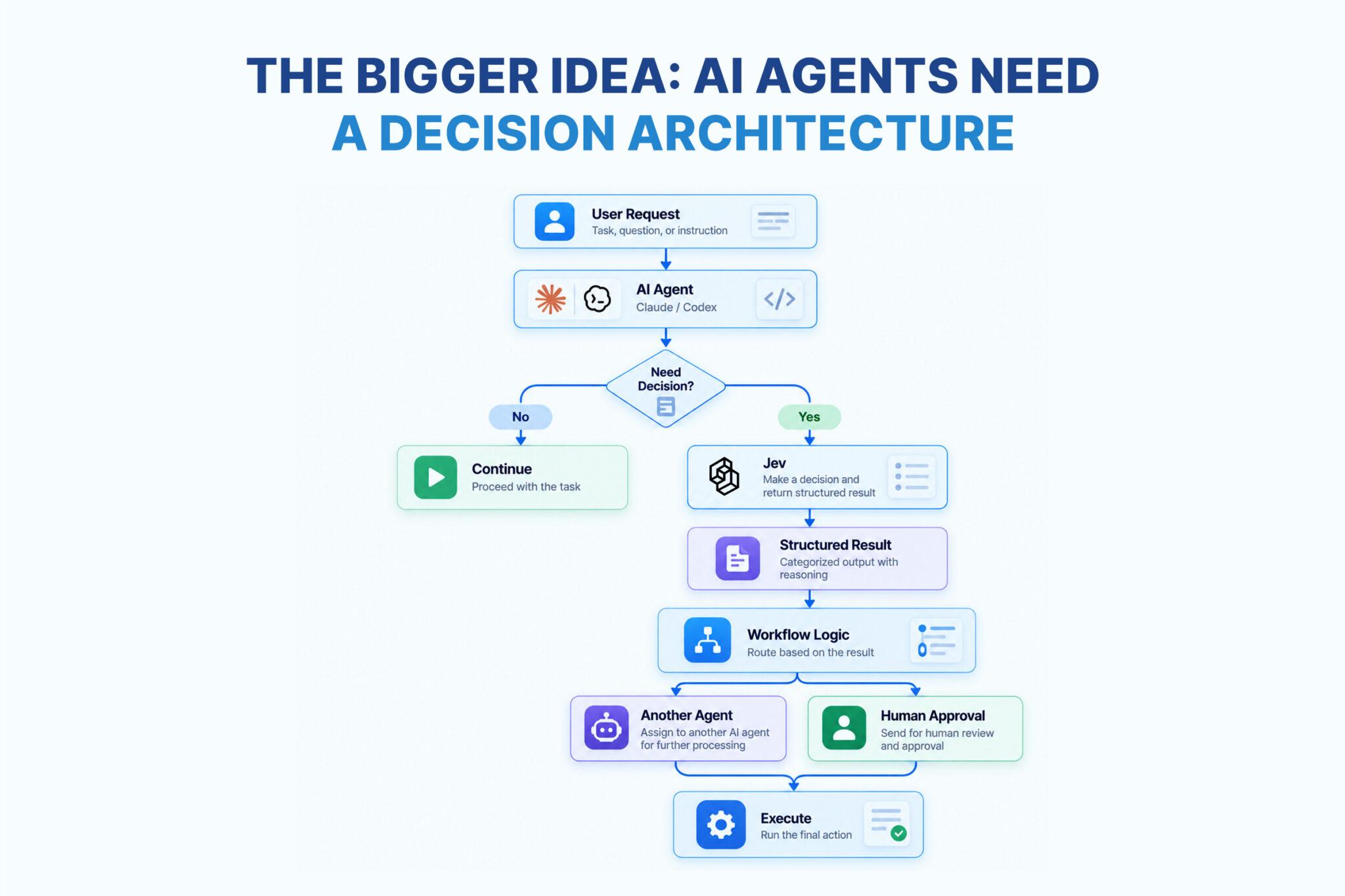
This approach makes AI automation less dependent on a single general-purpose model. Claude Code and Codex can focus on coding and reasoning, Jev can evaluate bounded decisions, sandboxed environments can provide isolated execution, and workflow automation can connect these components and control what happens next.
Together, these capabilities provide a more flexible foundation for enterprise AI, where specialized models, secure execution environments, and explicit workflow controls work together rather than relying on one general-purpose agent to handle every task.
Where GRiPO Fits
GRiPO is particularly relevant when this architecture needs to move from an experiment into an operational workflow. Instead of manually connecting an AI agent to a decision API and writing custom orchestration around every step, teams can build workflows in which agents, sandboxes, decision points, and external services work together as reusable components.
A practical GRiPO workflow could look like this:
The advantage isn’t simply having access to multiple AI models; it’s being able to connect their capabilities into controlled workflows. GRiPO’s sandbox execution provides an isolated environment for agents such as Claude Code or Codex, while its workflow automation layer can connect those executions with decision points, plugins, approval steps, and enterprise services.
This makes the agent part of an operational system rather than an isolated chatbot session. Teams can coordinate execution, evaluate results, apply approval requirements, and trigger subsequent actions through a connected workflow, with security controls and policy enforcement defined for each stage.
Practical Use Cases for Jev AI + Coding Agents
The same pattern can be applied well beyond pull requests. By combining coding agents, Jev’s structured decision capabilities, and workflow automation, engineering teams can introduce decision points across DevOps, security, incident response, FinOps, and CI/CD pipelines.
DevOps
Question: Should this infrastructure change require approval? A coding agent such as Claude Code or Codex analyzes the Terraform configuration and relevant changes, while Jev evaluates the available evidence against the defined decision. The workflow then routes high-risk changes for approval before allowing execution to proceed.
Security
Question: Does this change introduce a security-sensitive modification? An agent reviews the diff and gathers relevant context, Jev evaluates the evidence, and the workflow sends qualifying changes to the security team for review.
Incident Response
Question: Does this incident require escalation? An agent investigates logs and service state, Jev evaluates the available evidence against the incident-severity criteria, and the workflow routes critical incidents to the appropriate escalation path.
FinOps
Question: Does this cloud resource appear to represent abnormal spend? An agent collects billing data and infrastructure context, Jev classifies the situation, and the workflow opens an investigation or notifies the FinOps team when further action is warranted.
CI/CD
Question: Is this test failure likely to be a genuine regression? An agent collects test output and relevant code context, Jev classifies the failure, and the workflow determines whether to retry the test, initiate a deeper investigation, or block the pipeline pending further validation.
Key Takeaways
Jev AI, Claude Code, and Codex solve different parts of an AI engineering problem. Claude Code and Codex are useful when a system needs to reason through complex tasks, generate code, inspect repositories, and execute multi-step coding workflows. Jev AI is designed for bounded, structured decisions such as classification, routing, scoring, and evaluating whether a statement is likely to be true. Jev AI documentation Sandbox environments provide controlled execution for agents that need access to code, terminals, dependencies, or infrastructure tools, while workflow automation connects these components and determines what happens next.
The resulting architecture is more flexible than asking one AI model to handle every responsibility:
AI Agent
   ↓
Sandbox
   ↓
Jev Decision
   ↓
Workflow
   ↓
Another Agent / Tool / Human
   ↓
Controlled Execution
The real opportunity isn’t replacing LLM-based coding agents. It’s giving them the right supporting components so that complex reasoning, structured decisions, secure execution, and workflow orchestration work together as part of a controlled engineering system.
FAQ Section
What is Jev AI?
Jev AI is a decision model designed to evaluate application state against typed questions and return structured decisions rather than generated conversational text. Its documented question types include Choice, Score, and Noul. Jev AI
Can Jev AI work with Claude Code?
Yes. Jev can be used as a decision layer alongside Claude Code. Claude Code can handle code analysis, generation, and execution while Jev evaluates bounded decisions that the surrounding workflow needs.
Can Jev AI work with Codex?
Yes. Codex can perform coding and reasoning tasks while Jev handles structured decisions such as classification, risk scoring, validation, and workflow routing.
Does Jev AI replace Claude Code or Codex?
No. The technologies serve different purposes. Claude Code and Codex are suited to generative coding and reasoning tasks, while Jev is designed for bounded decisions.
What decisions can Jev make in an AI agent workflow?
Common examples include routing, classification, scoring, validation, triage, and yes/no judgments. The exact decision should be defined by the application rather than left as an open-ended request.
Can Jev AI decide whether a pull request needs security review?
Yes, this is a useful workflow pattern. Relevant pull-request state can be evaluated against a bounded question such as whether security review is required, with the resulting decision used to branch the workflow.
Should Jev replace deterministic security rules?
No. Exact security and compliance requirements should generally remain deterministic. Jev is better suited to bounded judgments where the available evidence requires interpretation.
How can Jev help AI coding agents?
It can provide a specialized decision layer for tasks such as test triage, routing, risk scoring, validation, and approval decisions, allowing the coding agent to focus on deeper reasoning and execution.
Why use a sandbox with Claude Code or Codex?
A sandbox limits the environment in which an AI coding agent can execute commands, access files, install dependencies, or interact with infrastructure. This can reduce the impact of mistakes and excessive permissions.
Can multiple AI agents use Jev in the same workflow?
Yes. A workflow can route different tasks through Claude Code, Codex, or other agents while using Jev for common decision points such as classification, risk assessment, and routing.
Where does workflow automation fit into a Jev architecture?
Workflow automation connects the components. It can trigger agents, collect their outputs, send relevant state to Jev, evaluate the resulting decision, and determine whether to continue, escalate, request approval, or execute another action.
Can GRiPO connect AI agents and decision models?
GRiPO can be used as the orchestration layer for workflows involving isolated agent execution, AI agents, integrations, and conditional workflow steps. This makes it possible to build multi-stage automation rather than treating each AI agent as an isolated tool.