
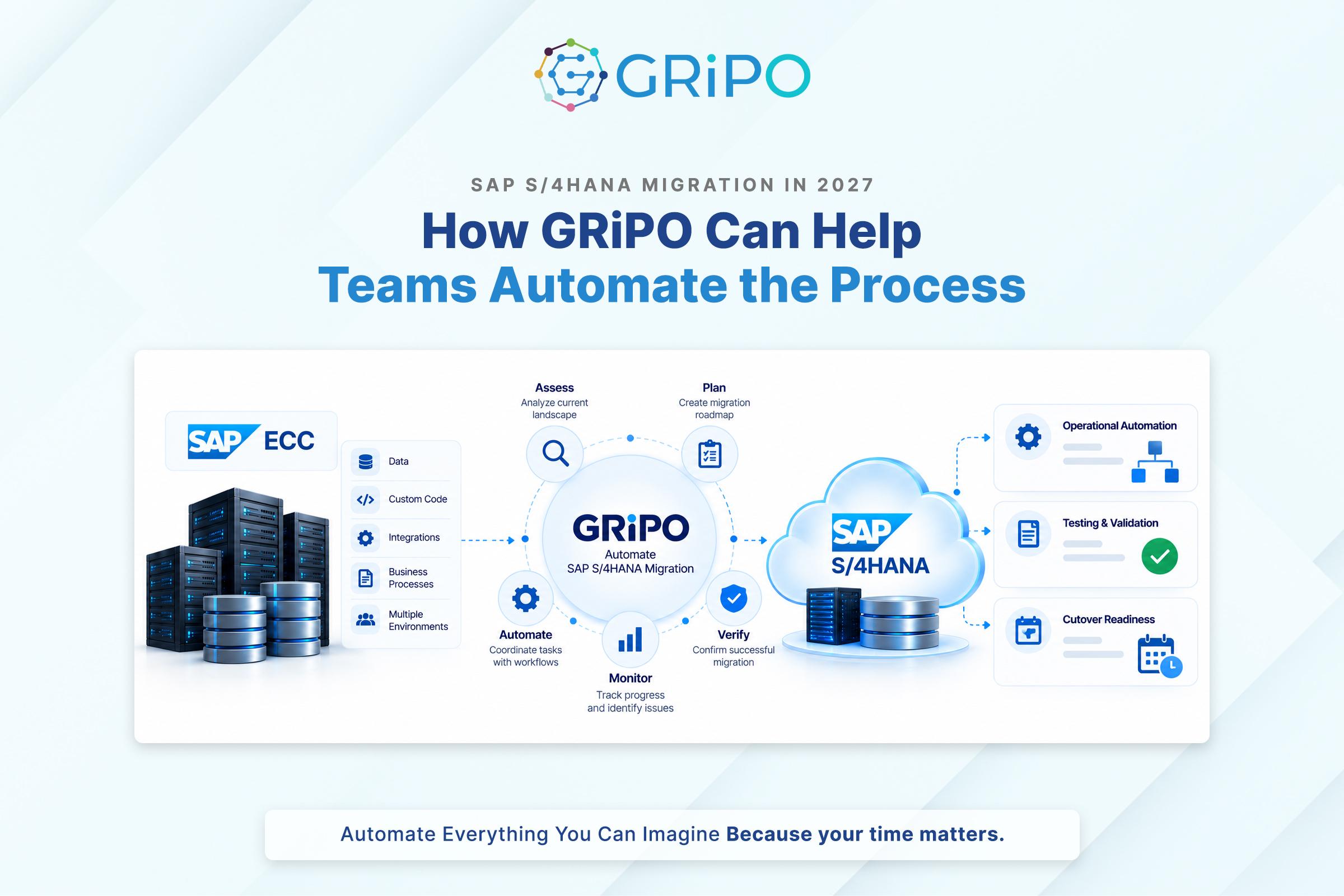
Migrating from SAP ECC to SAP S/4HANA is a major enterprise transformation. It involves more than moving an ERP application to a new environment. Organizations must assess their existing systems, review custom code and integrations, prepare data, test business processes, coordinate cutover activities, and verify that the new environment operates correctly. For organizations planning their migration in 2027, the timeline adds further pressure. SAP provides mainstream maintenance through December 31, 2027, for specified SAP Business Suite 7 core applications, subject to the applicable product and release. Organizations should confirm their own maintenance deadlines using SAP’s official maintenance strategy.
The challenge is coordinating dozens of technical and operational activities across SAP specialists, infrastructure teams, security engineers, application owners, and business stakeholders. GRiPO helps teams coordinate repeatable migration tasks through visual workflows, AI agents, plugins, and sandboxed code execution. Rather than relying entirely on disconnected manual checks, organizations can build workflows that collect information, identify exceptions, notify responsible teams, track approvals, and verify completed actions.
Why SAP S/4HANA Migration Is Challenging
Every SAP landscape has different requirements. Some organizations operate relatively standardized systems, while others depend on extensive custom code, third-party integrations, regional deployments, and years of historical data.
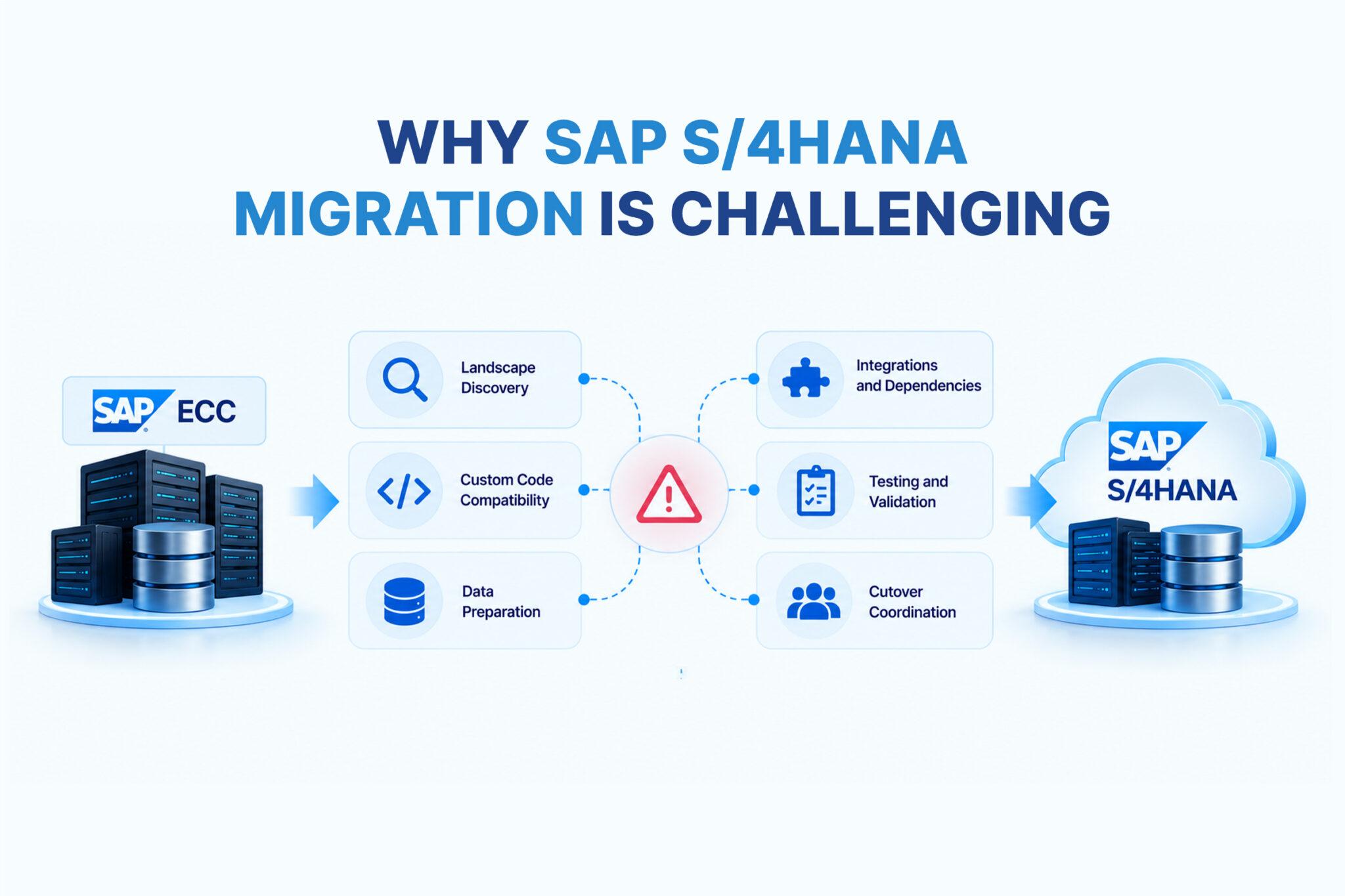
Common migration challenges include:
- Landscape discovery: Identifying SAP systems, dependencies, interfaces, and application owners.
- Compatibility: Reviewing custom code, add-ons, and integrations for potential issues.
- Data preparation: Identifying data-quality problems and defining what must be transferred.
- Testing: Validating business processes, APIs, integrations, and performance.
- Cutover coordination: Aligning technical changes, approvals, communications, and business readiness.
- Post-migration verification: Confirming that the new environment works as expected and that outstanding issues are addressed.
A migration plan can document all these activities, but execution becomes difficult when teams track them across separate spreadsheets, tickets, scripts, and communication channels. Workflow automation helps connect these activities into a repeatable process.
Prepare for Migration With Better Readiness Checks
Before choosing a migration approach, organizations need a clear understanding of their existing SAP landscape. SAP’s Readiness Check documentation provides guidance on assessing conversion considerations, simplification items, custom-code concerns, add-on compatibility, and other migration factors.
Teams should establish an inventory covering systems, versions, environments, integrations, owners, and known technical dependencies. GRiPO can help coordinate this preparation through configured integrations and workflows. For example, a workflow could collect available inventory information, check whether required assessment records have been submitted, notify system owners about missing information, and create follow-up tasks.
An AI agent can summarize collected findings and organize exceptions for review. Technical compatibility decisions should still be based on authoritative SAP assessments, validated rules, and specialist review rather than an AI-generated assumption. The result is a more consistent readiness process, with clearer ownership and fewer forgotten tasks.
Coordinate Migration Tasks Across Teams
SAP migration typically involves multiple teams working on interdependent activities. Infrastructure may need to be ready before testing begins, while data validation and application checks must finish before cutover approval. GRiPO workflows can help coordinate these dependencies.
For example, a migration coordination workflow could:
- Collect task status from configured project-management and engineering systems.
- Check whether required prerequisites have been completed.
- Identify overdue tasks or missing approvals.
- Notify the responsible team or create a follow-up ticket.
- Summarize outstanding blockers for the migration lead.
- Record status updates and verify that required evidence is available.
Consider a situation where an integration test cannot begin because the target environment is not ready. A workflow could identify the missing prerequisite, notify the infrastructure owner, and keep the dependent task flagged until readiness is confirmed. This does not replace project management or technical ownership. It helps teams execute established processes more consistently and gives migration leads better visibility into blockers.
Automate Repeatable Validation and Testing Tasks
Testing is one of the most important stages of an SAP S/4HANA migration. A successful technical deployment does not automatically prove that business processes, integrations, and scheduled jobs are working correctly.
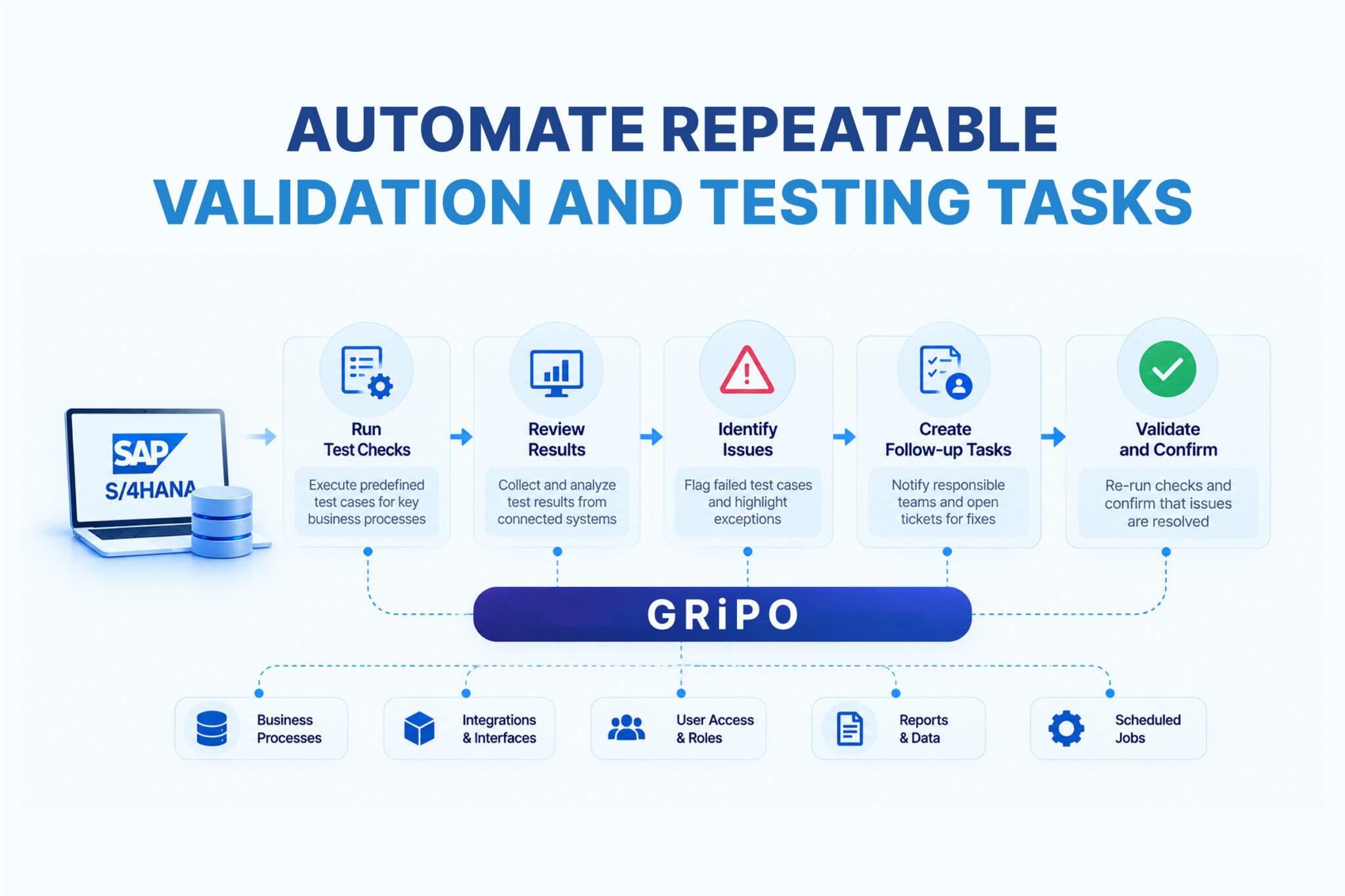
Organizations need to validate critical operations such as financial processing, inventory management, data exchange, user access, and reporting according to their own requirements. With configured integrations and controlled execution, GRiPO can help coordinate repeatable validation tasks.
A workflow might:
- Retrieve test results from connected systems.
- Check whether required test cases have completed.
- Run approved scripts or checks in an appropriate execution environment.
- Flag failed or missing results.
- Create tickets for responsible application or engineering teams.
- Notify stakeholders when required checks are ready for review.
GRiPO’s sandboxed code execution can support controlled execution of suitable scripts without requiring every task to run directly on an administrator’s local machine. The execution environment, permissions, network access, and credentials must be configured to match the organization’s security requirements. Automation should support not bypass testing standards. Business-critical results still need appropriate validation and sign-off.
Improve Cutover Coordination
Cutover is the point where migration activities converge. Teams may need to complete final data preparation, confirm system readiness, coordinate deployment steps, validate integrations, and communicate status to stakeholders. Missing one prerequisite can delay the transition or create operational risk.
A GRiPO cutover workflow could organize a checklist of required activities and verify that each step has supporting evidence. It could notify owners about incomplete tasks, escalate overdue approvals, and prepare a consolidated status summary for the migration lead.
For example, before a planned cutover, the workflow could check whether:
- Required technical readiness checks are complete.
- Critical test results have been reviewed.
- Responsible teams have provided their approvals.
- Backup and recovery requirements have been addressed.
- Communication and rollback plans are available.
The workflow should not independently declare the system ready based only on task completion. Final cutover approval belongs to the authorized people following the organization’s change-management process.
Verify the Environment After Migration
Migration work continues after the new SAP S/4HANA environment becomes available. Teams must confirm that critical services operate correctly, integrations are functioning, and outstanding issues are being resolved.
GRiPO can help coordinate post-migration checks through configured workflows.
For example, a workflow could collect application health checks and approved test results, identify missing or failed checks, notify the responsible owners, and track remediation through to verification.
A useful post-migration process should include:
- Application and integration validation.
- Review of critical business-process test results.
- Monitoring and alert checks.
- Tracking of unresolved migration issues.
- Confirmation that responsible owners have accepted operational handover.
- Documentation of verification results and outstanding risks.
These checks help create a clear record of what was verified and what still requires attention.
Why Use GRiPO for SAP Migration Workflows?
GRiPO brings several capabilities together to help teams coordinate operational work.
Visual workflow builder: Design repeatable processes for readiness checks, task coordination, testing, and verification.
AI agents: Summarize available information, organize exceptions, and help teams understand which issues need attention.
Plugin integrations: Connect supported systems and services so workflows can exchange information and trigger approved actions.
Sandboxed code execution: Run suitable scripts in a controlled environment with configured access and execution boundaries.
Workflow tracking: Coordinate notifications, follow-ups, approvals, and verification steps across migration activities.
These capabilities are useful when migration work spans multiple teams and tools. The exact workflow depends on the organization’s SAP landscape, available integrations, access permissions, and security controls.
GRiPO does not replace SAP migration tools, SAP expertise, or formal change management. It helps connect the operational tasks surrounding them.
Explore GRiPO at https://gripo.io/.
SAP S/4HANA Migration Checklist
Use this checklist to structure the migration process.
Before migration
- Confirm the maintenance timeline for the relevant SAP products and releases.
- Assess the existing landscape, custom code, integrations, and data.
- Select a migration approach that fits business and technical requirements.
- Assign owners to critical systems and migration activities.
- Define readiness criteria, testing requirements, and approval processes.
During migration
- Track dependencies, blockers, and outstanding approvals.
- Coordinate testing and record results.
- Validate technical changes through approved procedures.
- Maintain clear communication between engineering and business teams.
- Confirm cutover prerequisites before final authorization.
After migration
- Verify critical applications and integrations.
- Track unresolved issues through to completion.
- Confirm monitoring, operational ownership, and support readiness.
- Document test evidence and post-migration sign-off.
- Automate repeatable checks where appropriate.
Conclusion: Make SAP Migration More Coordinated
SAP S/4HANA migration requires careful planning, technical validation, and coordination across the organization. Readiness assessments, testing, cutover, and post-migration verification all depend on completing the right tasks in the right order.
GRiPO can help automate the workflows around these activities by connecting configured integrations, AI-assisted analysis, controlled code execution, notifications, and verification steps. This allows teams to reduce repetitive coordination work while retaining the approvals and technical controls required for an enterprise migration.
Planning your SAP S/4HANA migration? Explore GRiPO to see how workflow automation can help your teams coordinate migration activities more consistently.
Frequently Asked Questions
Why are organizations planning SAP S/4HANA migration around 2027?
SAP provides mainstream maintenance through the end of 2027 for specified SAP Business Suite 7 core applications. Organizations should verify the applicable maintenance terms for their products and releases.
What are the main challenges of SAP S/4HANA migration?
Common challenges include system compatibility, custom code, data preparation, integrations, testing, cutover coordination, and post-migration validation.
How can GRiPO help with SAP migration?
GRiPO can coordinate configured readiness checks, task tracking, notifications, approved scripts, testing workflows, and post-migration verification.
Can GRiPO automate SAP migration testing?
It can help coordinate suitable automated checks and test-result workflows through configured integrations and controlled execution. Testing scope and system access must be validated for each environment.
Does GRiPO replace SAP migration tools?
No. GRiPO complements existing SAP tools and migration processes by helping teams coordinate repeatable operational tasks and follow-ups.
How does workflow automation improve cutover readiness?
A workflow can track prerequisites, missing evidence, task status, and approvals, then notify responsible teams. Final cutover authorization should remain with designated decision-makers.
Is SAP migration automation secure?
Security depends on implementation. Teams should apply least-privilege permissions, protect credentials, restrict execution access, retain audit records, and require approval for consequential changes.
What should organizations verify after migration?
Organizations should validate critical business processes, integrations, application health, monitoring, unresolved issues, and operational handover.
Key Takeaways
- SAP S/4HANA migration requires coordination across technical and business teams.
- Readiness assessments help identify compatibility and dependency issues early.
- Workflow automation can connect task tracking, testing, approvals, and verification.
- GRiPO supports migration coordination through visual workflows, AI agents, plugins, and sandboxed execution.
- Technical decisions and production changes must remain subject to validated evidence and appropriate approval.
- Post-migration verification is essential to confirm operational readiness.