
An AI workflow can look inexpensive in a prototype and become surprisingly costly in production. A developer sends a few prompts to a large language model, receives useful answers, and builds an automation around the result. At low volume, the approach appears reasonable. But once that workflow handles thousands of events, processes long inputs, retries failed calls, and operates around the clock, the economics change.
The issue is not necessarily that the model is too expensive. It may be doing work that the workflow does not actually require. Consider a DevOps automation that receives an alert, evaluates its severity, identifies the responsible team, and decides whether an incident needs escalation. The system needs reliable answers to a limited set of questions. It may not need a long explanation, a generated report, or an open-ended reasoning session for every alert.
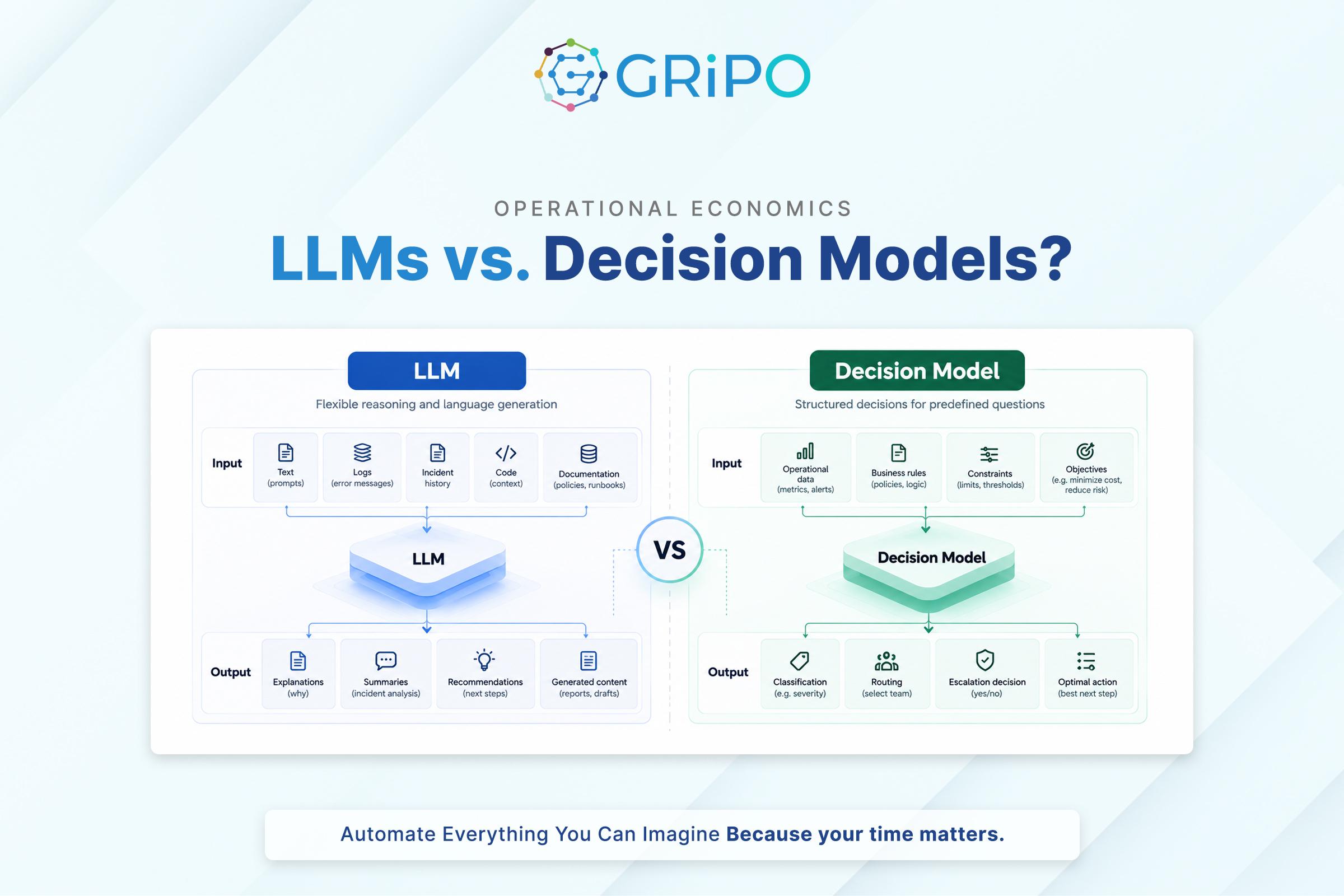
This is where the operational economics of large language models (LLMs) and decision models begin to diverge. LLMs are designed for flexible language understanding and generation. Decision models focus on answering bounded questions with structured outputs. They serve different purposes, and neither is automatically cheaper in every environment. The right choice depends on workload volume, input size, latency requirements, error costs, infrastructure, and the amount of work required around each model call.
For engineering leaders, the useful question is not simply which model has the lowest price per request. It is which architecture delivers a correct, usable decision at the lowest total operating cost.
The Real Cost of an AI Decision
Most AI cost discussions begin with inference pricing. That is a useful starting point, but it does not represent the complete operating cost of an automated workflow.
A production system has several cost layers:
- Inference: Charges for input tokens, output tokens, or model execution.
- Latency: Time spent waiting for the model, including network and service overhead.
- Orchestration: The services that collect context, call models, validate outputs, and route results.
- Retries and recovery: Additional calls caused by timeouts, malformed outputs, or uncertain decisions.
- Engineering maintenance: Work required to maintain prompts, schemas, integrations, evaluations, and model versions.
- Operational risk: The cost of false escalations, missed incidents, incorrect routing, or unsafe automated actions.
- Infrastructure: Compute, memory, storage, monitoring, and availability requirements for self-hosted deployments.
These costs interact. A model that is inexpensive per request may require extra validation calls. A faster model may reduce the time an incident remains unresolved. A more capable LLM may be worth its higher price when it prevents an expensive operational mistake.
A practical cost model is:
Total cost per usable decision =
inference + orchestration + validation + retries + infrastructure allocation + operational overhead
For a more meaningful comparison, divide the total by the number of decisions that meet the required quality standard.
That distinction matters. A system that produces 100,000 outputs is not necessarily more economical than one that produces 90,000 if the first system generates more invalid or incorrect results.
Why LLM Economics Change at Scale
LLMs are useful because they can handle a wide range of inputs without requiring a separate, narrowly defined model for every task. They can interpret unfamiliar error messages, summarize long incident histories, compare configuration changes, explain code, and produce recommendations.
That flexibility also has a computational cost.
Input size affects the bill
An LLM may need to process a large prompt containing system instructions, logs, deployment history, repository context, and tool results. If the same context is included repeatedly, the workflow can pay to process much of the same information on every call.
For example, an incident assistant might include thousands of lines of logs when it only needs the service name, error rate, deployment timestamp, and current health status to classify an alert.
Reducing unnecessary context can improve both cost and latency. It is a worthwhile optimization regardless of which model architecture the team chooses.
Generated output has a cost
A workflow that requests a detailed explanation for every alert may generate far more text than its downstream systems can use. If the next step only needs urgent: true and team: platform, a long natural-language response introduces additional generation time and output-processing work.
Structured output modes and constrained generation can help, but the model may still be doing more work than a bounded decision requires.
Retries multiply the expense
Production workflows encounter rate limits, network failures, malformed responses, and ambiguous results. Some systems retry automatically; others call a second model to validate the first response.
Those safeguards may be appropriate, but they should be included in the cost calculation. The relevant metric is not the price of one successful call. It is the average cost of obtaining an acceptable result under real operating conditions.
Where Decision Models Change the Economics
A decision model is designed for tasks where the input state is available and the required answers can be defined in advance.
Instead of generating an unrestricted response, the model evaluates specified questions and returns structured decisions, often with probabilities for the permitted answers. Examples include classifying an incident, routing a support request, evaluating a policy condition, or assigning a risk category.
Cloudflare’s October 2026 introduction of Clef describes this approach as an alternative for bounded decisions within agentic workflows. Its models return probabilities for defined answer options rather than generating free-form text for every decision. Cloudflare’s announcement explains the model design and intended use cases. The economic advantage comes from matching the computation to the task.
Imagine an alert-routing workflow with three questions:
- Is the alert urgent?
- Which team owns it?
- Should the workflow escalate it to a human?
A decision model can answer those questions within a defined schema. The workflow can then apply deterministic rules to route the alert, notify the correct channel, or request approval. The model does not need to write a report about the alert unless the workflow specifically requires one.
This can reduce output generation, simplify response handling, and improve latency. The size of the benefit depends on the chosen models, input length, serving infrastructure, and task accuracy. It should be measured rather than assumed.
Bounded does not mean risk-free
Decision models still make mistakes. A probability is not a guarantee of correctness, and a highly confident output can still be wrong. Model evaluation, confidence thresholds, fallback paths, and human review remain important.
There is also a design constraint: the team must define meaningful questions and answer options. If the task requires inventing a remediation strategy for a novel incident, a bounded classifier may not be enough.
The economic case is strongest when the decision repeats frequently, the answer space is manageable, and the downstream action is well defined.
A Practical Cost Comparison
Consider a hypothetical engineering team processing 500,000 operational events per month. These might include alerts, deployment checks, support tickets, or policy evaluations.
The following table compares architectural characteristics rather than claiming that one model class always wins.
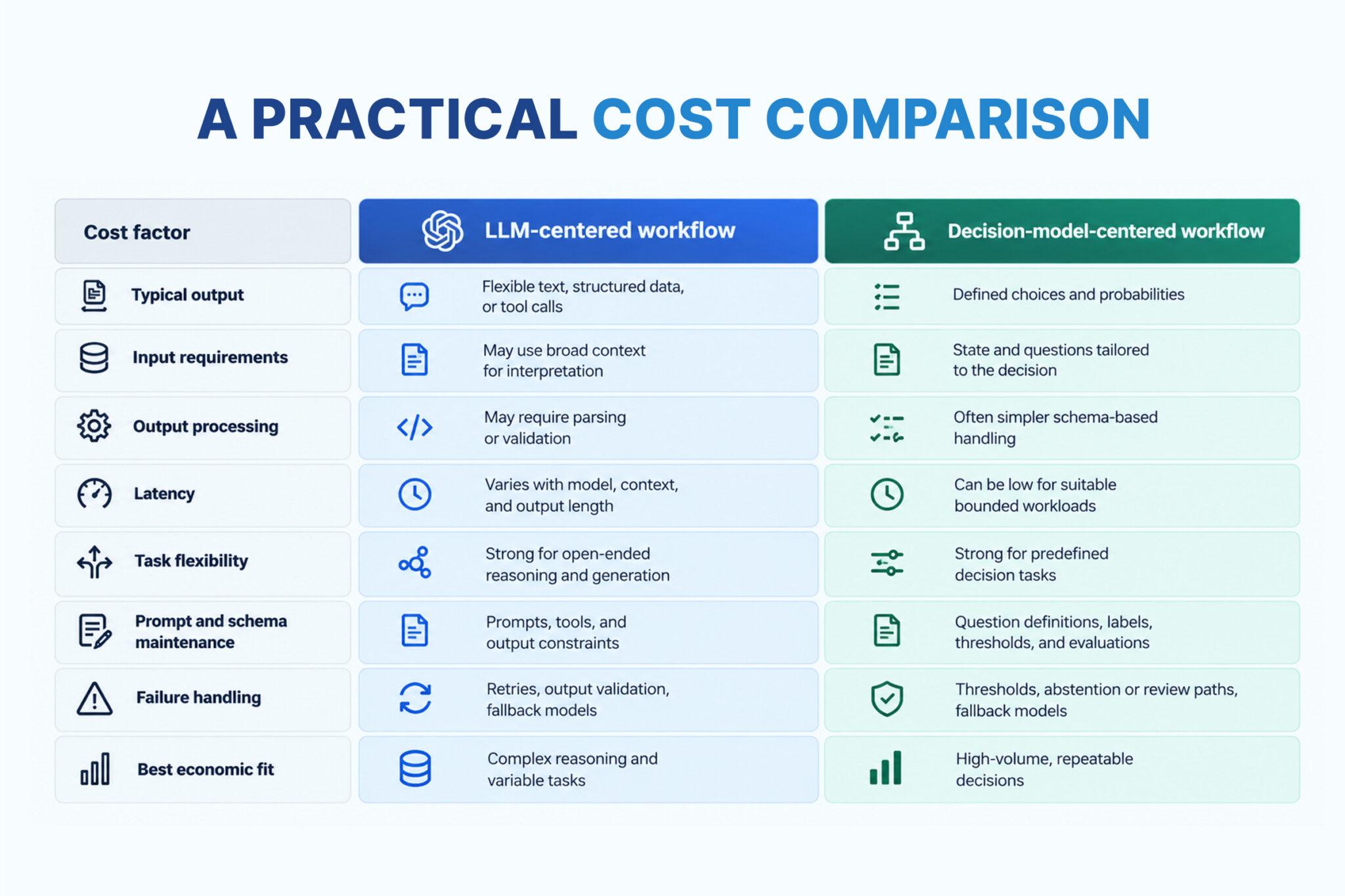
The comparison does not mean every decision model has lower total cost. A small LLM can be less expensive than a large decision model for a particular workload, and self-hosting a decision model can cost more than using an efficient managed API at low volume.
The architecture should be selected using measured cost per acceptable decision, not a broad category label.
A Simple Break-Even Calculation
Suppose a team evaluates two architectures for a high-volume classification task. The numbers below are illustrative, not published prices or benchmark results.
- Architecture A costs $0.80 per 1,000 model calls.
- Architecture B costs $0.20 per 1,000 model calls.
- Both process 500,000 calls per month.
- Architecture B requires an additional $150 per month in allocated infrastructure and maintenance.
The monthly model-call costs would be:
| Item | Architecture A | Architecture B |
| Calls per month | 500,000 | 500,000 |
| Cost per 1,000 calls | $0.80 | $0.20 |
| Inference cost | $400 | $100 |
| Additional monthly overhead | $0 | $150 |
| Total monthly cost | $400 | $250 |
Under these assumptions, Architecture B saves $150 per month before accounting for differences in accuracy, latency, and operational risk.
But now suppose Architecture B requires additional review because its classification quality is below the team’s production threshold. If that review adds $250 in monthly labor and operational cost, its total becomes $500. The apparent inference savings disappear.
The lesson is straightforward: compare the cost of a decision that meets the business requirement, not just the cost of a model call.
A useful evaluation should include representative production inputs, realistic concurrency, p50 and p95 latency, error rates, retry frequency, and the cost of downstream mistakes. Teams should also test whether the same input and question schema work consistently across the cases they expect to handle.
The Hidden Cost of Latency
Latency is not just a user-experience metric. In automated operations, it can affect business outcomes.
Suppose an incident workflow must classify an alert before routing it to the on-call team. If a model call takes several seconds and the workflow runs at high volume, those delays can accumulate across queues and dependent steps. For an interactive system, latency affects the time a user waits. For a security workflow, it may affect how quickly a suspicious event reaches an analyst. For infrastructure automation, it may delay a deployment gate or remediation decision.
The economic value of a faster model depends on the workflow. A reduction from one second to 100 milliseconds may matter significantly in a high-throughput request path. It may have little financial value in a nightly report that already finishes before business hours. Measure the end-to-end workflow, not only model inference. Network calls, data retrieval, policy checks, and downstream APIs can dominate total execution time.
For guidance on inference measurements, Google Cloud’s machine-learning inference documentation describes metrics such as request latency, time to first token, throughput, and token generation rates.
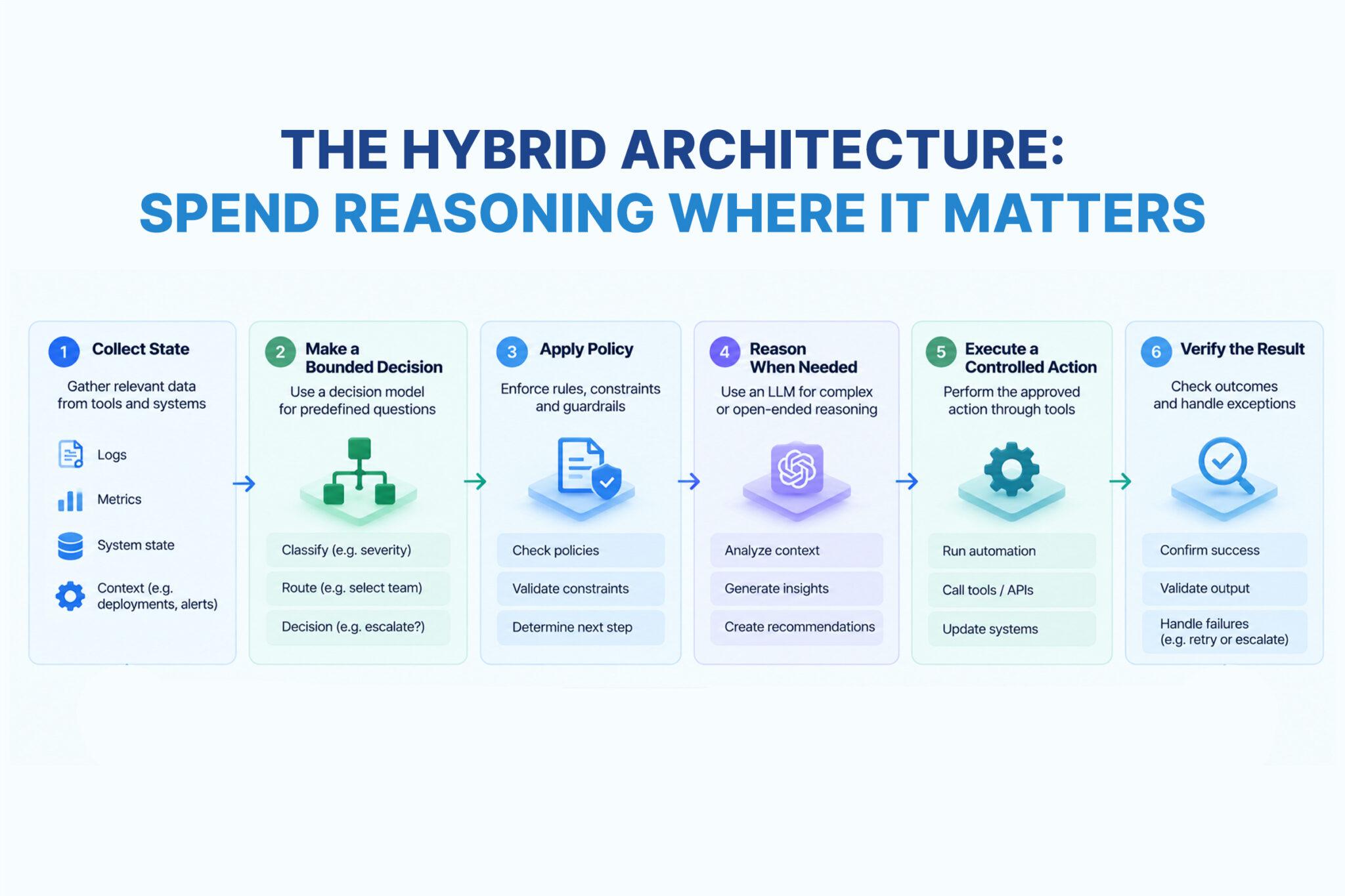
The Hybrid Architecture: Spend Reasoning Where It Matters
For many enterprise systems, the best answer is not to replace every LLM call with a decision model. It is to reserve expensive or open-ended reasoning for tasks that need it.
A hybrid architecture separates the workflow into distinct responsibilities:
Consider an automated Kubernetes incident workflow.
The system collects pod health, recent deployment changes, restart counts, error rates, and relevant alerts. A decision model evaluates whether the incident is urgent, which team should own it, and whether the case falls into a known category.
A policy layer checks whether the proposed next step is permitted. If the incident matches an approved runbook, the workflow can notify the team or initiate a predefined action within its authorization limits. If the evidence is incomplete or the incident does not match a known pattern, an LLM can examine the logs, correlate recent changes, summarize likely causes, and recommend next steps. Actions with meaningful production impact can require human approval.
This design can reduce unnecessary LLM calls without removing the ability to reason about complex situations. It also creates a useful separation of concerns. The decision model handles bounded classification. The policy engine enforces explicit rules. The LLM interprets complex context. The workflow system controls execution and records what happened. No model should independently authorize a high-impact action merely because its output looks confident. Access controls, policy enforcement, approvals, and verification belong in the surrounding system.
Managed Inference vs. Self-Hosting
The operational economics also depend on where the model runs.
Managed inference
A hosted service reduces the need to operate GPUs, manage model-serving infrastructure, and maintain deployment capacity. It can be a good fit for teams with variable demand, limited ML infrastructure expertise, or a preference for usage-based billing.
The trade-offs include provider pricing, network dependency, data-handling requirements, service limits, and possible vendor lock-in. Teams should evaluate current pricing and service terms for the exact model and workload.
Self-hosted inference
Running an open-weight model in a team’s own environment can provide greater control over data location, runtime configuration, and serving policies. It may become economical at sustained utilization when the team can operate the infrastructure efficiently.
However, self-hosting is not free inference. GPU or CPU capacity, memory, power, idle time, upgrades, monitoring, availability, and engineering support all contribute to total cost.
Low utilization can make dedicated infrastructure expensive. High utilization can create capacity constraints and increase latency. Quantization may lower resource requirements, but teams must test whether the resulting quality meets their needs.
A fair comparison uses the same workload and quality threshold, then includes both direct inference charges and the cost of operating the system.
How to Evaluate the Economics in Production
Before committing to a model architecture, build a small evaluation around actual workflow data.
1. Define the decision. Write down the exact questions the system must answer, the permitted outcomes, and the cases that should be escalated rather than decided automatically.
2. Create a representative test set. Include common cases, unusual inputs, incomplete records, conflicting evidence, and examples where the correct result is a human review.
3. Measure quality first. Record accuracy by class, false-positive and false-negative rates, calibration where relevant, and the impact of errors. A cheaper architecture that fails the quality requirement should not advance just because it has a lower inference bill.
4. Measure the complete path. Include data collection, model inference, validation, retries, policy evaluation, downstream API calls, and verification. Record median and tail latency, not only averages.
5. Calculate cost per acceptable decision. Include compute, hosted API usage, engineering overhead, and the expected cost of mistakes or additional human review.
6. Test at expected volume. Evaluate realistic traffic patterns and concurrency. A system that performs well in a single-request test may behave differently under sustained load.
7. Set fallback conditions. Define what happens when confidence is low, the input is incomplete, the model returns an unexpected result, or the requested action is outside policy.
8. Re-evaluate periodically. Model prices, serving performance, traffic, and accuracy can change. The most economical design today may not remain optimal as workloads evolve.
This process turns model selection into an engineering decision backed by evidence rather than a debate about which model family is universally better.
Where GRiPO Fits into the Economics
Model choice is only one part of the cost equation. The workflow surrounding the model determines how often it is called, what context it receives, which systems it can access, and whether its output leads to a verified result.
GRiPO is designed around AI-powered workflow automation, isolated code execution, AI agents, and integrations through a plugin system. For an enterprise team evaluating decision models and LLMs, a workflow platform can help connect the pieces of the operational process: collect information from existing systems, run the required evaluation, apply routing and approval logic, call an agent when deeper reasoning is necessary, and send the result to the appropriate destination.
For example, an incident workflow could retrieve monitoring data, classify an alert, route the event through a defined approval path, and invoke an AI agent to prepare a more detailed investigation only when the initial decision indicates that further analysis is needed.
The objective is not to add a model to every step. It is to make each step explicit, measurable, and governed.
Teams should validate their chosen model endpoint, connectivity, credential handling, and execution requirements before deployment. Sensitive actions should remain subject to least-privilege permissions, appropriate isolation, and auditable controls.
GRiPO’s website provides more information about its workflow automation approach. The value for an engineering organization comes from coordinating models and tools into a controlled process—not from assuming that any single model will solve every operational problem.
The Decision Is Economic, Not Ideological
LLMs and decision models solve different classes of problems. LLMs provide flexible interpretation and generation. Decision models provide structured outputs for bounded questions. The economics depend on how closely the model’s capabilities match the work it is asked to perform.
For a high-volume routing or classification task, a decision model may reduce latency and simplify output handling. For an unfamiliar incident that requires investigating logs, connecting evidence, and explaining a likely cause, an LLM may justify its additional cost. For many enterprise workflows, combining the two is a more practical choice than insisting on either one alone.
Start with the decisions your system makes repeatedly. Measure their volume, quality requirements, latency budget, and cost of failure. Then select the least complex architecture that satisfies those requirements—and retain a path to deeper reasoning when the situation demands it.
That is the core of operational AI economics: spend computation where it changes the outcome, and make every automated decision accountable to a measurable result.
External reference suggestions
- Cloudflare: Introducing Clef decision models — background on bounded, structured decisions in AI workflows.
- Cloudflare: Clef performance and pricing updates — useful context for how model performance and prices evolve.
- Google Cloud: ML inference on GKE — technical reference for latency, throughput, and inference evaluation.
Any model pricing or benchmark figure added to the article should be checked against the current provider documentation before publication.
Suggested FAQ schema content
What is the main difference between LLMs and decision models?
LLMs generate and interpret language across a wide range of tasks. Decision models focus on answering predefined questions with structured outputs, making them suitable for bounded classification and routing decisions.
Are decision models always cheaper than LLMs?
No. Cost depends on model size, serving method, input length, utilization, infrastructure, and task accuracy. A decision model can be more economical for a suitable high-volume task, but teams should benchmark the complete workflow.
How do you calculate the cost of an AI decision?
Include inference, orchestration, validation, retries, infrastructure allocation, engineering overhead, and the expected cost of errors. Divide the total by the number of decisions that meet the required quality threshold.
Can decision models replace LLMs in enterprise automation?
Not completely. Decision models are useful for bounded tasks, while LLMs remain valuable for complex interpretation, explanation, and open-ended reasoning. Many systems benefit from using both.
Why does latency matter in AI workflows?
Latency affects responsiveness and can delay dependent operations. In incident response, security triage, and high-throughput systems, reducing decision time can improve operational performance.
Is self-hosted AI inference cheaper than a hosted API?
It depends on utilization and operational overhead. Self-hosting adds infrastructure, maintenance, monitoring, and capacity-planning costs, while hosted inference generally charges according to the provider’s pricing model.
What is cost per acceptable decision?
It is the total cost of operating a model-based workflow divided by the number of outputs that meet the required quality standard. It helps teams avoid choosing a model based only on cheap but unreliable calls.
How can teams reduce unnecessary LLM calls?
Use concise context, cache reusable information where appropriate, route bounded decisions to suitable models, avoid generating unused text, and invoke deeper reasoning only when needed.
Are model confidence scores enough to automate production actions?
No. Confidence scores must be evaluated against real outcomes and calibrated for the task. High-impact actions also need policy checks, permissions, approval paths, and fallback handling.
How does a hybrid AI architecture work?
A hybrid architecture uses a decision model for predefined questions and an LLM for cases requiring deeper reasoning. Workflow logic coordinates the models, enforces policy, and controls execution.
Which metrics should teams track when comparing AI models?
Track task accuracy, false-positive and false-negative rates, cost per acceptable decision, median and p95 latency, throughput, retry rates, and human-review workload.
How can GRiPO support AI workflow economics?
GRiPO provides workflow automation, AI agents, isolated code execution, and plugin-based integrations. These capabilities can help teams coordinate model calls and operational actions within a measurable workflow, subject to their specific integration and security configuration.
Key takeaways
- Inference price alone does not determine the real cost of AI automation.
- Decision models can be economical for repetitive, bounded tasks with defined outputs.
- LLMs remain valuable when a workflow needs flexible interpretation, explanation, or open-ended reasoning.
- Hybrid architectures can reserve deeper reasoning for cases that need it.
- Self-hosted inference requires a full infrastructure and maintenance cost calculation.
- Model accuracy, fallback handling, and human review belong in the economics calculation.
- Benchmark the complete workflow and compare cost per acceptable decision at realistic volume.