
Artificial intelligence can summarize an incident, explain a code change, generate a remediation plan, and answer questions about application behavior. But production software often needs something more specific: a decision that can be consumed directly by another component.
Consider a security system evaluating a suspicious request. The application doesn’t necessarily need a paragraph explaining the request. It needs to determine whether the request should be challenged, blocked, or sent for further review. A support platform might need to select a department, while a DevOps workflow might need to determine whether a proposed infrastructure change requires approval.
Traditional applications handle these situations with rules and classifiers. Generative large language models (LLMs) offer more flexibility, but their natural-language responses can introduce additional parsing and validation work when the application only needs a specific answer.
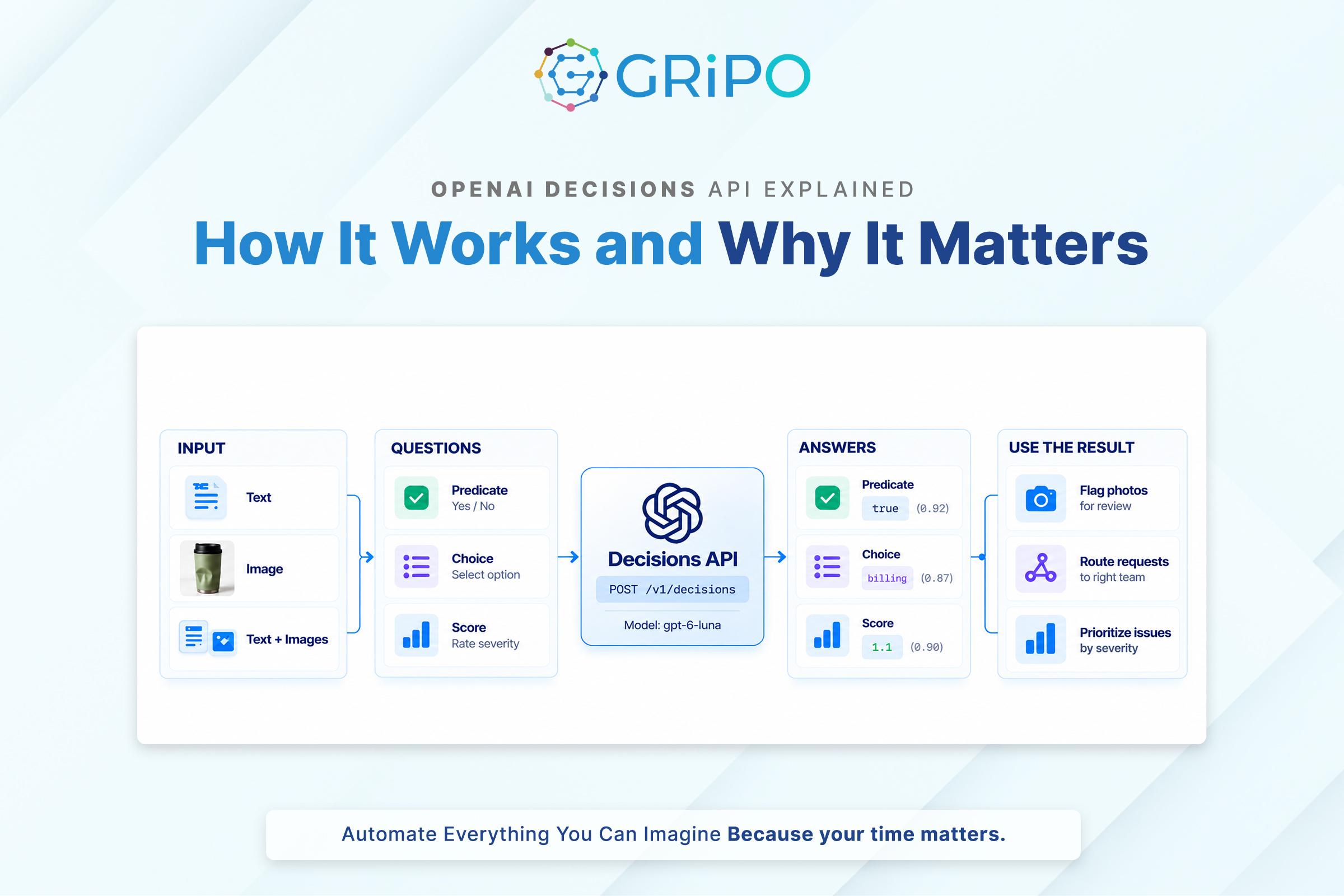
The OpenAI Decisions API addresses this problem by allowing developers to provide context and define questions with specific answer types. Instead of generating a conventional text response, the API returns structured answers that applications can use for classification, routing, scoring, and other decision-oriented tasks.
OpenAI released the Decisions API in beta on October 6, 2026, powered by GPT-6 Luna. OpenAI describes it as a way to turn text and images into typed answers, reporting decision responses up to 10 times faster than the Responses API. That performance figure is OpenAI’s own claim, not a guarantee for every application or workload. Official announcement and API changelog.
The broader significance is architectural. Rather than treating every AI task as text generation, developers can separate open-ended reasoning from bounded decisions and connect those decisions to application logic.
What Is the OpenAI Decisions API?
The OpenAI Decisions API is an API for evaluating text or image inputs against explicitly defined questions and returning typed answers. Developers specify the context, the questions they want answered, and the valid choices or scoring levels where applicable. The model evaluates that information and returns results in a structured response.
The API currently uses GPT-6 Luna and supports three question types: predicate, choice, and score. Each type serves a different purpose, from estimating whether a statement is true to selecting a category or evaluating an input against an ordered rubric. OpenAI Decisions API documentation.
For example, a customer-support platform could submit a ticket and ask whether the issue is urgent, which department should handle it, and how severe the problem is. The API can return typed answers for those questions instead of requiring the application to extract them from a generated paragraph.
This makes the Decisions API particularly relevant when the input needs contextual interpretation but the output must fit a defined structure.
Why Did OpenAI Introduce a Decisions API?
Generative models are flexible, but that flexibility isn’t always necessary. If an application needs to select one of four categories, generating several sentences before extracting the category can add avoidable complexity.
Consider a conventional workflow in which an application submits a support ticket to an LLM. The model responds with an explanation, and the application then parses that response to determine the department, urgency, and issue type. Even when the response is well written, the application still needs to validate the extracted values and handle unexpected output.
A decision-oriented workflow takes a more direct path. The application supplies the ticket, defines the questions, and receives typed answers that correspond to those questions. Application code can then validate the results and pass them to the appropriate routing logic.
The architectural difference looks like this:
Conventional text-generation workflow
Input → LLM → Generated text → Parsing and validation → Application logic
Decision-oriented workflow
Input → Defined questions → Decisions API → Typed answers → Application logic
The second pattern is useful when the application already knows the possible outcomes. It reduces dependence on free-form text parsing, although developers must still handle API failures, refusals, unexpected results, and uncertain predictions.
The Decisions API does not make traditional LLMs obsolete. Generative models remain useful for writing explanations, analyzing logs, creating code, and handling open-ended reasoning. The Decisions API addresses a narrower requirement: producing answers that software can use directly.
How Does the OpenAI Decisions API Work?
The workflow begins with the evidence the application wants evaluated. This might be a customer message, a security event, a support ticket, a screenshot, or a collection of operational details. The application then defines one or more questions, each with a type and instructions that describe the intended judgment.
For a classification task, the application might provide a ticket and ask which team should handle it. For a predicate task, it might ask whether the ticket describes a production outage. For a scoring task, it might ask how severe the issue is according to an ordered set of criteria.
The API evaluates the input and returns an answer for each question. The surrounding application can then apply business rules, authorization checks, and workflow logic before taking any action.
A typical architecture looks like this:
Application Input
       ↓
Question Definitions
       ↓
OpenAI Decisions API
       ↓
 Typed Answers
       ↓
Validation and Business Policy
       ↓
Application or Workflow Action
The important distinction is that the API provides an assessment; it doesn’t automatically own the application’s operational policy. Developers remain responsible for deciding what an answer permits and what should happen when the result is uncertain.
The Three Question Types
The Decisions API supports three distinct question types. Choosing the right one matters because each represents a different kind of decision.
1. Predicate: Estimate Whether a Condition Is True
A predicate question asks the model to estimate how likely a statement about the input is to be true. The result includes a probability between zero and one.
For example, a security application could ask whether an API request appears suspicious based on its request details and authentication history. A support platform might ask whether a customer message describes a service outage rather than an ordinary usage question.
A predicate question is useful when the application needs to evaluate a condition without selecting a category from a longer list.
{

  "type": "predicate",
  "name": "production_outage",
  "instructions": "Is the input describing a production outage?"

}
This example illustrates the question definition, not a complete API request. The actual input and question must be sent using the documented Decisions API request format.
2. Choice: Select From Predefined Options
A choice question asks the model to select one option from a list supplied by the application. It is suitable for categories that don’t have a natural order, such as billing, technical support, and sales.
For example, an application could define the following options for routing customer tickets:
{
  "type": "choice",
  "name": "department",
  "instructions": "Which team should handle this request?",
  "choices": [
    {"value": "billing"},
    {"value": "technical"},
    {"value": "sales"},
    {"value": "other"}
  ]
}
The API returns the selected value along with confidence information and probabilities for the available choices. Developers should include a fallback such as other when real inputs might not fit neatly into the main categories. The fallback can route ambiguous cases to a human review queue rather than forcing an inappropriate classification.
3. Score: Evaluate Against an Ordered Rubric
A score question evaluates an input against ordered levels. It is useful when categories have a meaningful progression, such as low, medium, and high severity.
Suppose an incident-management application needs to assess the impact of a reported problem. It could define levels that distinguish cosmetic issues from problems with workarounds and failures that completely block a critical operation.
The API returns a score and probabilities associated with the defined levels. The score is a probability-weighted average of the level indices, so it can fall between the discrete levels. For example, a score of 1.2 does not necessarily mean the input was assigned directly to the second category; it can represent a distribution across several levels.
Use choice for categories without a meaningful order and score when the ordered progression itself matters. See OpenAI’s question-type documentation.
A Practical Example: Routing Customer Support Tickets
Imagine a SaaS company receives hundreds of support tickets every hour. Some concern billing, others report technical failures, and a smaller number describe incidents affecting multiple customers. Sending every ticket to the same queue creates unnecessary work and slows down responses to urgent issues.
The application can use the Decisions API to classify each ticket according to its content. It might ask whether the issue is urgent, which department should handle it, and how severe the reported problem is.
A ticket stating, “Our checkout has been failing for every customer for the past 20 minutes,” could be evaluated as an urgent technical issue with high severity. The application could then route it to the on-call engineering queue, notify the incident channel, and start the established incident-response process.
The workflow might look like this:
Incoming Support Ticket

          ↓

    Decisions API

          ↓

Urgency + Department + Severity

          ↓

   Validate Results

          ↓

    Routing Policy

          ↓

Assign Ticket / Notify On-Call
The API handles the classification. The support platform still controls assignment permissions, escalation rules, notification delivery, and incident-management procedures.
That separation makes the workflow easier to maintain. If the organization changes its escalation policy, developers can update the application logic without necessarily changing the classification questions.
Using the Decisions API in DevOps and Infrastructure Automation
The same pattern can be applied to DevOps workflows, where operational systems constantly generate events that require interpretation. A monitoring platform might detect elevated error rates after a deployment. Before launching a remediation workflow, the application could evaluate whether the event appears related to the deployment, whether the issue affects production, and whether it should be escalated.
A decision result could help route the event toward investigation, rollback review, or capacity analysis. However, a model’s classification should not directly authorize a destructive infrastructure operation.
A safer workflow separates the assessment from execution:
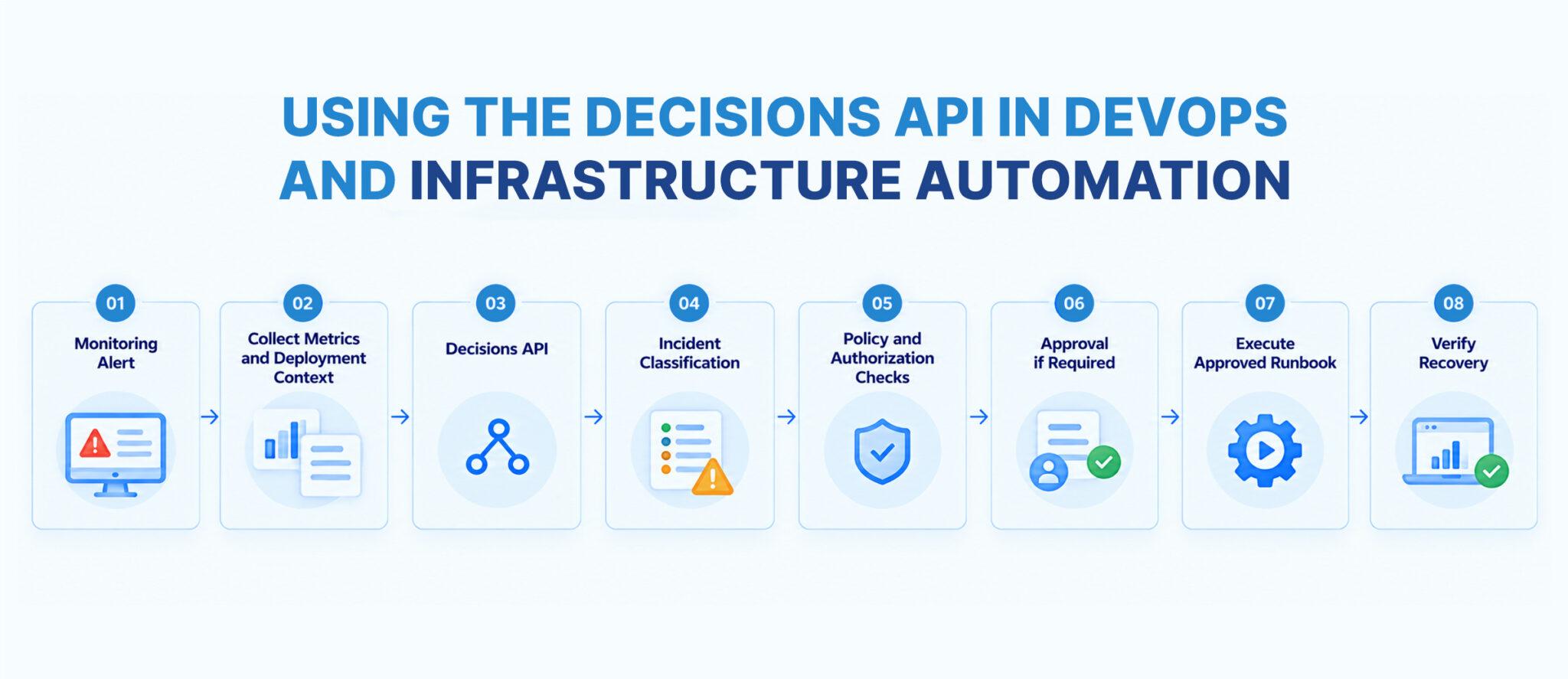
For example, if a deployment coincides with a sudden increase in checkout errors, the system could classify the incident as a possible deployment regression. The workflow could then collect deployment metadata, check rollback eligibility, verify that the relevant service and environment are correct, and request approval where policy requires it.
The model helps interpret the context, but deterministic controls determine which actions are permitted. That matters because a wrong classification can have real operational consequences if it is allowed to trigger an unreviewed production change.
Decisions API for AI Agent Guardrails
AI agents can plan tasks, call tools, and interact with external systems. Those capabilities become more useful when agents can act, but they also create a governance problem: an agent’s ability to request an action should not automatically grant permission to execute it.
The Decisions API can serve as one component of a guardrail architecture. Before an agent performs a sensitive operation, an application can evaluate the requested action and its context. Questions might include whether the action affects production, whether it falls within the agent’s assigned scope, or whether a human approval step is required.
Consider an agent that proposes running terraform apply. The system can collect the proposed plan, target environment, resource changes, and relevant policy context. A decision assessment can help classify the request, while authorization and policy checks determine whether the operation can proceed.
AI Agent Proposes Action
          ↓
    Decisions API
          ↓
Structured Assessment
          ↓
Policy + Authorization
          ↓
Allow / Deny / Request Approval
          ↓
  Isolated Execution
          ↓
Verification and Audit
A decision model should not replace access controls, infrastructure policy engines, or human approval requirements. Its output is an additional signal for the application to evaluate. Sensitive actions should remain constrained by explicit permissions and execution boundaries, even when the model’s assessment appears confident.
How Fast Is the OpenAI Decisions API?
OpenAI’s October 6, 2026 API changelog describes the Decisions API as returning typed answers up to 10 times faster than the Responses API. This is an official vendor claim, not a universal benchmark for every request. OpenAI API changelog.
Actual performance depends on the input size, whether images are included, the number and complexity of questions, network conditions, service load, and the surrounding application. A workflow that collects information from five APIs before making a decision may still take several seconds even if the model call itself is fast.
For a useful evaluation, measure end-to-end latency rather than focusing only on inference time. Track median and tail latency, the rate of incorrect decisions, fallback frequency, and the time saved compared with the existing implementation. Run tests against representative inputs before deciding whether the API meets a production service-level objective.
Speed also shouldn’t be evaluated in isolation. A fast decision that frequently misclassifies high-risk events can be more expensive than a slower but safer workflow. The right target is a balance of latency, accuracy, cost, and operational risk.
Decisions API vs. Responses API
The Decisions API and Responses API address different output requirements. The Decisions API is designed for typed decisions; the Responses API is a more general interface for generating content, reasoning, and building broader model interactions.
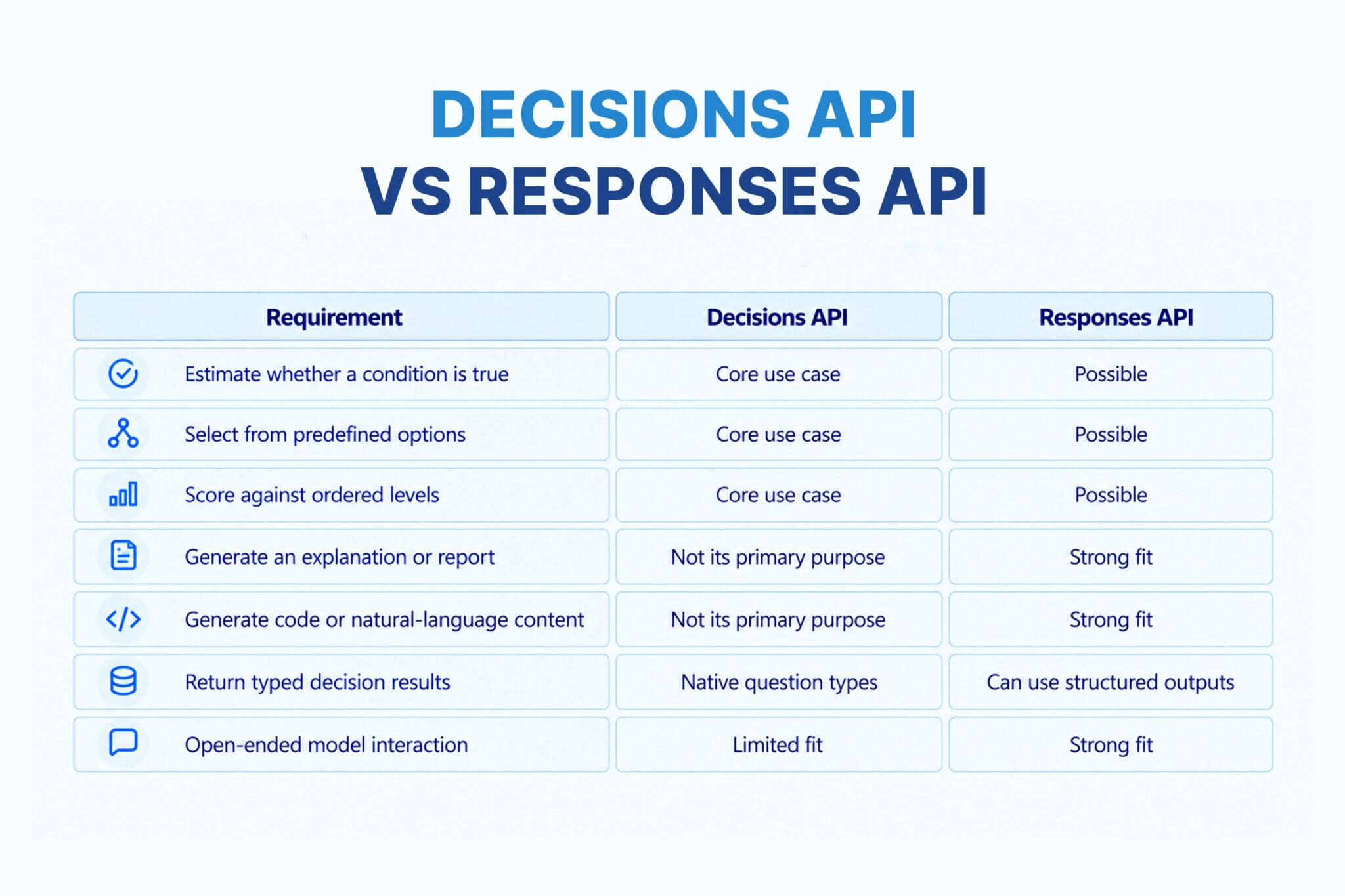
The choice should be based on what the application needs from the model. If the next component expects a decision such as billing, technical, or sales, the Decisions API is a natural candidate. If it needs a detailed incident explanation, a generated remediation plan, or an object following a custom schema, the Responses API may be more appropriate. OpenAI’s documentation explicitly recommends using the Responses API with Structured Outputs when the requirement is a custom JSON object rather than one of the Decisions API’s supported answer types.
These APIs can also complement each other. A generative model can investigate a complicated issue and explain the likely causes, while a decision request classifies a specific condition that feeds into application logic. The application can then enforce its policies and execute an approved workflow.
Security and Production Considerations
A typed response is easier to consume than free-form text, but it does not make a decision automatically safe or correct. Production implementations should validate every response, define fallback behavior, and keep policy enforcement outside the model.
Start by testing the model against representative examples, including ambiguous inputs, incomplete context, unusual edge cases, and cases where none of the normal categories is appropriate. Measure false positives and false negatives separately, especially when decisions affect security or infrastructure.
Next, define what happens when the API times out, returns an error, refuses a request, or produces a low-confidence assessment. Depending on the workload, the safe fallback might be to queue the event for manual review, preserve the current system state, or retry under a controlled policy. For sensitive operations, failing closed may be appropriate, but the exact behavior should follow the system’s risk requirements rather than a universal rule.
Also consider data handling. Send only the information necessary for the decision, protect API credentials, restrict access to logs, and review the provider’s current data-retention and processing terms against your organization’s requirements. Security teams should account for sensitive customer data, infrastructure metadata, and any image inputs included in requests.
Finally, monitor decisions in production. Store the question definition, model version, decision result, applicable policy, and action taken where appropriate and permitted. This creates a traceable record for investigating errors and improving the workflow over time.
Where GRiPO Fits Into a Decision-Based Architecture
A decision API provides the model’s assessment, but production automation still needs orchestration, integrations, policy checks, execution, and verification. Those components are what turn a classification result into a complete operational workflow.
GRiPO is an AI-powered DevOps automation platform built around visual workflows, isolated code execution, AI agents, and integrations. A team could use a decision result as one step in a broader workflow that collects context from monitoring tools, applies internal rules, requests approval, executes an approved script, and verifies the outcome.
For example, a cloud-operations workflow could collect AWS metrics and Kubernetes utilization, classify an anomaly, identify the appropriate response path, and notify the resource owner. If remediation is approved, the workflow can execute the relevant CLI commands in an isolated environment and then check whether the resource state changed as expected.
The important design principle is to keep each responsibility explicit. The decision API evaluates the evidence, workflow logic applies the organization’s policy, and a controlled execution environment runs the approved operation. Integrations connect those steps to the systems engineers already use.
This is useful whether the decision comes from OpenAI’s Decisions API, another decision model, or a conventional rules engine. GRiPO’s role is to help teams connect decisions to controlled, observable automation rather than leaving the result as an isolated model response.
Should You Use the OpenAI Decisions API?
The OpenAI Decisions API is worth evaluating when your application repeatedly asks questions with a defined answer type. It is particularly relevant for classification, routing, rubric-based scoring, image assessment, and decision steps inside agent workflows.
It is less suitable when the primary requirement is open-ended generation, detailed explanations, code creation, or unrestricted reasoning. Those tasks generally benefit from a generative interface.
Before adopting the API, create a representative test set, define acceptable error rates, compare latency and cost with your current approach, and decide how the application will handle uncertainty and failures. If a decision can trigger a sensitive action, add explicit authorization, policy enforcement, and appropriate human oversight.
The key idea is simple: use a decision-oriented API when the application needs a decision, not a paragraph. Then surround that decision with the controls and workflow logic required to make it useful and safe in production.
FAQ
What is the OpenAI Decisions API?
The OpenAI Decisions API is an API that evaluates text and image inputs against defined questions and returns typed answers. It supports predicate evaluation, selection from predefined choices, and scoring against ordered levels.
How does the OpenAI Decisions API work?
Developers submit input and define questions with instructions and the appropriate answer type. The API evaluates the input and returns structured answers, which the application can validate and use in its own logic.
Which model powers the OpenAI Decisions API?
The API launched in beta with GPT-6 Luna, according to OpenAI’s API changelog. Check the current documentation for any changes to supported models.
What are the three question types in the Decisions API?
The API supports predicate, choice, and score. Predicate estimates whether a statement is true, choice selects from predefined options, and score evaluates an input against ordered levels.
Is the OpenAI Decisions API faster than the Responses API?
OpenAI reports that the Decisions API can return typed answers up to 10 times faster than the Responses API. Actual performance varies by workload, input size, network conditions, and application architecture.
Can the OpenAI Decisions API process images?
Yes. The API accepts text and image inputs, allowing developers to evaluate visual evidence alongside textual context. The exact input format and supported limits should be checked in the current documentation.
What is the difference between the Decisions API and the Responses API?
The Decisions API is designed for specific typed answers, such as classifications and scores. The Responses API is a general-purpose interface for broader generation and reasoning tasks, including explanations, code, and custom structured outputs.
Can the Decisions API be used for AI agent guardrails?
Yes. Developers can use its decisions as one input to a guardrail workflow that evaluates proposed actions before execution. Authorization, business policies, and tool permissions must still be enforced by the application.
Can the Decisions API automate DevOps tasks?
It can help classify incidents, evaluate operational conditions, and select a predefined response path. Actual infrastructure changes should remain subject to explicit policies, authorization, execution controls, and verification.
Does a confidence score guarantee that a decision is correct?
No. Confidence and probability information should not be treated as a guarantee of correctness. Teams should test model behavior on representative data, measure error rates, and define appropriate thresholds and fallback behavior.
Is the OpenAI Decisions API suitable for enterprise applications?
It can be suitable for enterprise classification and decision workflows, provided the organization validates accuracy, latency, cost, privacy, data handling, and reliability. High-impact decisions need additional controls and human oversight where appropriate.
How can GRiPO complement the OpenAI Decisions API?
GRiPO can orchestrate the surrounding workflow by connecting data sources, AI agents, plugins, isolated code execution, approvals, and verification steps. The decision API supplies an assessment; the workflow controls what happens next.
Key Takeaways
- The OpenAI Decisions API is designed for typed answers rather than conventional free-form text generation.
- It launched in beta on October 6, 2026, powered by GPT-6 Luna.
- Its three question types are predicate, choice, and score.
- It supports text and image inputs.
- OpenAI reports up to 10 times faster typed-answer responses than the Responses API; actual results depend on the workload.
- The API is suited to classification, routing, scoring, and decision steps in AI agent workflows.
- It does not replace generative models, deterministic business rules, authorization systems, or security controls.
- Enterprise teams should test accuracy, latency, cost, and fallback behavior before production adoption.
- GRiPO can help connect model decisions to integrations, controlled execution, and end-to-end workflow automation.