
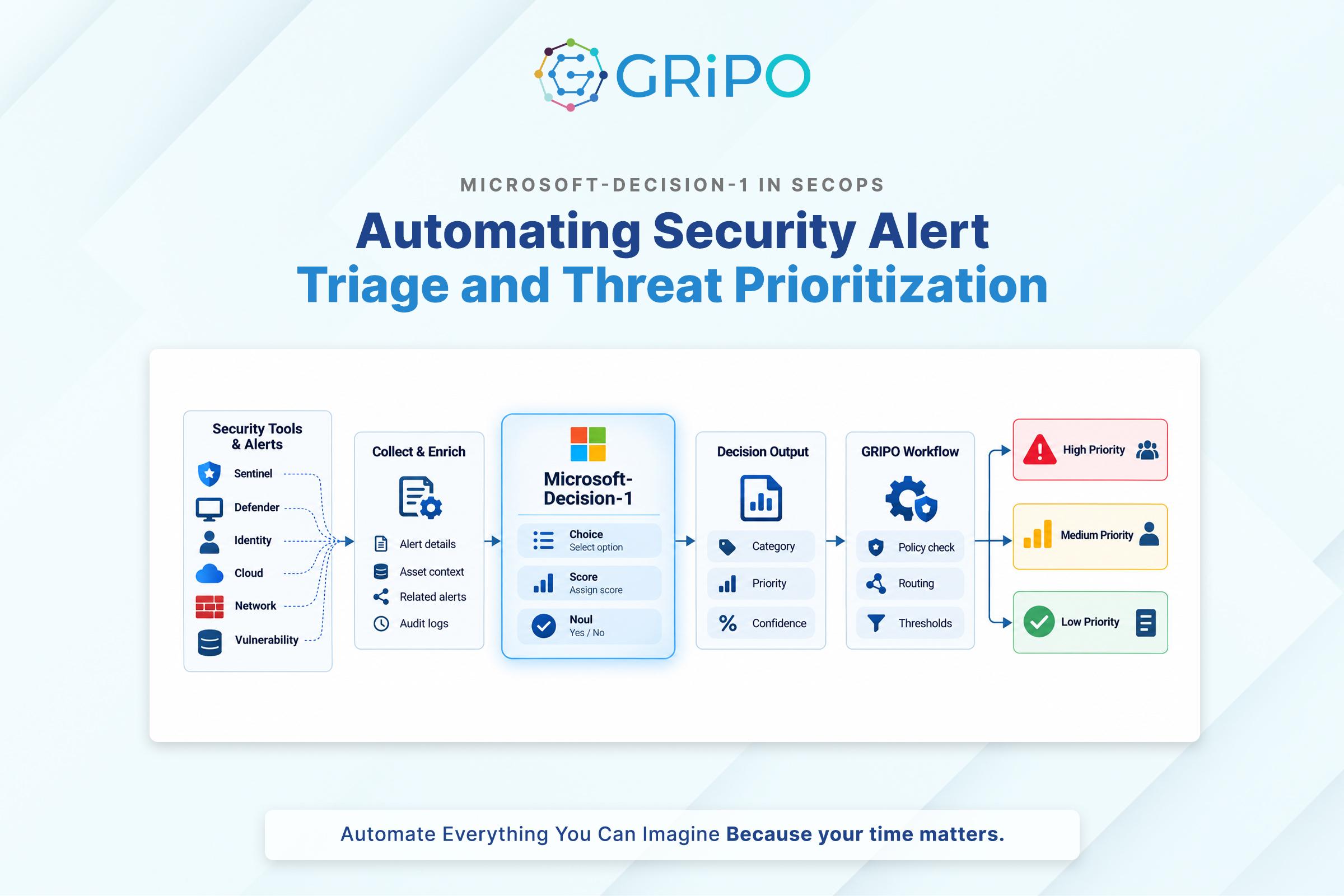
A security operations center rarely suffers from a shortage of alerts. The harder problem is deciding which alerts deserve immediate investigation, which can be grouped with an existing incident, and which require more evidence before an analyst can make a call. An endpoint detection platform may report suspicious PowerShell activity. A cloud security tool may flag an unusual permission change. An identity system may detect an unfamiliar sign-in, while a vulnerability scanner reports a newly exposed service. Each event has a different context, and treating every alert as equally urgent quickly overwhelms the team.
This is where Microsoft-Decision-1 becomes relevant to security operations. Released in October 2026, the model is designed for structured decisions such as classification, ranking, routing, and verification. Instead of generating a free-form response, it evaluates defined questions and returns structured decisions. Depending on the question type, the result may be a binary probability, a selected option with associated probabilities, or a score on an ordered scale. For SecOps teams, that creates an opportunity to evaluate decision-model-based automation for security alert classification, threat prioritization, and investigation routing.
There is an important boundary, however. A decision model is not a threat detection engine, a substitute for forensic investigation, or an authorization system. It can help evaluate information already collected by security tools, but its outputs must be tested against real security data and governed by the organization’s response policies.
The practical question is how to introduce model-based decisions into a security workflow without weakening the controls that protect production systems.
Why Security Alert Triage Needs More Than Severity Labels
Most security teams already have severity labels, detection rules, asset criticality ratings, and escalation procedures. These controls are essential, but a severity label alone does not always establish the order in which analysts should investigate incidents.
Consider three alerts arriving within a short period:
- An endpoint reports a suspicious script on a developer’s workstation.
- A cloud identity account receives an unexpected privilege assignment.
- A vulnerability scanner identifies a critical vulnerability on an internet-facing server.
All three may be marked high priority by their respective tools. Yet the right response depends on context: whether the account is privileged, whether the script actually executed, whether the vulnerable service is exposed, and whether other telemetry indicates active exploitation. The security team needs to combine several signals rather than rely on a single label.
Microsoft Sentinel’s automation and SOAR documentation describes how security operations teams use automation rules and playbooks to handle recurring enrichment, response, and remediation tasks. The underlying principle remains useful when introducing decision models: automate predictable work, but preserve investigation capacity for situations that need expert attention.
A decision model can add another evaluation step. Given a structured security event and a defined set of choices, it can classify the event, assign a relative priority, or determine whether the case should move to a review queue. That is different from discovering a threat independently. The model needs relevant evidence from the systems that observe endpoints, identities, networks, cloud resources, and applications.
What Microsoft-Decision-1 Does in a Security Workflow
Microsoft-Decision-1 is available through Microsoft Foundry for classification, routing, ranking, and other bounded decision tasks. Its API accepts a state text or JSON and one or more typed questions. The response provides structured decisions and probabilities rather than a written rationale. Microsoft’s official documentation describes three useful question types:
- Choice: Select one option from a defined set, such as a security queue or incident category.
- Score: Assign a value on an ordered scale, such as a relative priority level.
- Noul: Evaluate a binary question, such as whether an event contains evidence of a particular condition.
These question types map naturally to some SecOps tasks. An application might ask which team should investigate an event, whether an incident warrants urgent review, or how a case should be ordered in a queue. But the model’s output is still a model judgment. A probability score does not establish that an attack occurred, and the API does not provide a free-form explanation that can substitute for supporting evidence.
For security use, the surrounding application should retain the original event, relevant telemetry references, policy checks, and the decision outcome. If an analyst needs an explanation, the system should present the underlying evidence or use a separate, appropriately controlled analysis step. The most useful role for Microsoft-Decision-1 is therefore narrow and explicit: evaluate a defined question using supplied evidence, then let the security workflow determine what happens next.
Use Case 1: Prioritizing Alerts by Risk and Context
A common SecOps problem is sorting alerts that appear equally severe but have different potential consequences. Imagine a cloud environment with an alert for an unusual sign-in, another for a new role assignment, and a third for a failed compliance check. A static severity score may not reflect the full context of the affected account, resource exposure, or related activity.
A decision workflow can combine information from the SIEM, identity provider, asset inventory, and cloud security tools before asking the model to classify the event.
Useful context may include:
- The affected asset and its business criticality
- Whether the identity has privileged access
- Whether the event is part of an existing incident
- Recent authentication or configuration changes
- Relevant detection-rule results
- Whether the evidence indicates potential customer or production impact
The model can select a category from predefined options, such as routine, elevated, high, or urgent. If the workflow needs a numerical value on an ordered scale, it can instead use a score question with clearly defined levels. The labels must be carefully defined. “Urgent” should mean something operationally specific in the organization’s incident process, rather than simply sounding more severe than “high.”
Example: Unexpected privilege assignment
Suppose a cloud audit log records an identity receiving a privileged role outside the normal change process. The security platform supplies the actor, target identity, role, timestamp, resource scope, and change-management context. A decision model could evaluate whether the event belongs in a routine change-review queue, a high-priority identity investigation, or a human-review category because important evidence is missing.
The workflow should still verify the event against authoritative audit logs and change records. If a privileged change is prohibited by policy, the relevant control should not wait for a model score before enforcing that policy. The model helps prioritize investigation; it does not replace the access-control system.
Use Case 2: Classifying Alerts Before They Reach an Analyst
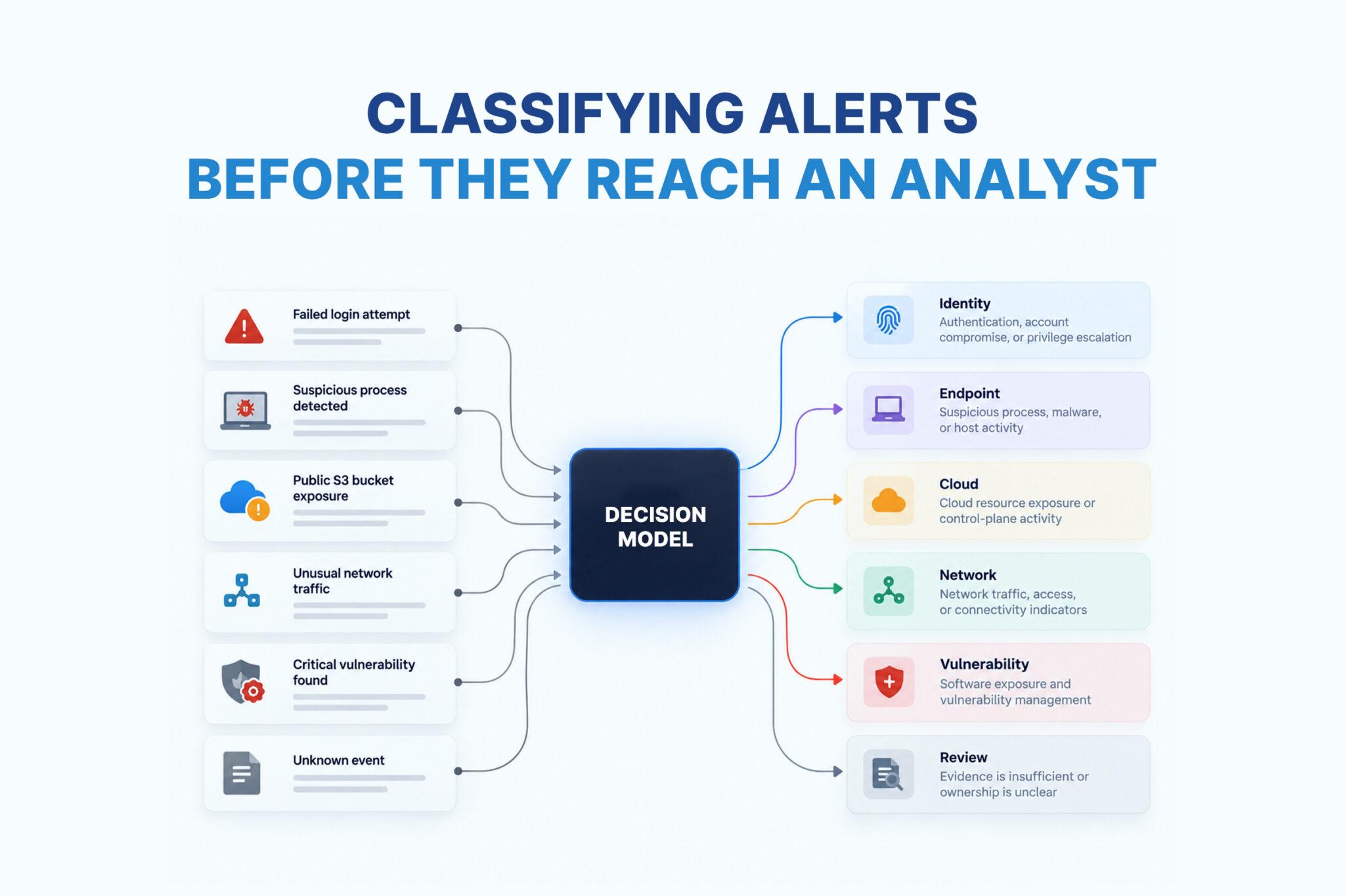
Security teams frequently receive events that need different investigation paths. An endpoint detection may require host-level analysis, an identity alert may need authentication records, and a cloud configuration finding may belong to the cloud security team. Routing every event through the same queue adds handoffs and delays.
A decision model can evaluate a structured alert and choose among predefined categories such as:
- identity: Authentication, account compromise, or privilege escalation
- endpoint: Suspicious process, malware, or host activity
- cloud: Cloud resource exposure or control-plane activity
- network: Network traffic, access, or connectivity indicators
- vulnerability: Software exposure and vulnerability management
- review: Evidence is insufficient or ownership is unclear
These labels are illustrative. An organization should adapt them to its team structure, incident taxonomy, and existing security tooling.
A practical workflow might look like this:
- Receive the event from the SIEM or detection platform.
- Enrich it with asset, identity, and incident metadata.
- Check whether it matches an existing case or duplicate event.
- Ask the decision model to select a category.
- Validate the result against routing rules and known ownership.
- Create or update the case in the appropriate queue.
- Send uncertain or conflicting results to an analyst.
The review category matters. Without an option for uncertainty, a classifier may be forced to choose a team even when the available evidence is inadequate. Routing should also respect established ownership rules. If a detection is already tied to a specific control or response playbook, a model should not override that authoritative mapping without a defined reason.
Use Case 3: Classifying Suspicious Activity for Further Investigation
One of the most consequential mistakes in security automation is treating an indicator as proof of compromise. A suspicious login is not necessarily an account takeover. A process launching PowerShell is not automatically malicious. An unusual outbound connection may have a legitimate operational explanation.
At the same time, a benign-looking event can become significant when correlated with other activity. A decision model can help categorize the evidence available at a particular point in an investigation. For example, it might classify a case as:
- Evidence consistent with routine activity
- Suspicious activity requiring further investigation
- Strong indicators warranting urgent analyst review
- Insufficient evidence to classify
The output should guide the next investigative step, not conclusively determine whether a threat exists.
Consider an endpoint alert that reports a script interpreter launching with encoded arguments. The workflow retrieves the process tree, parent process, user context, file reputation, and related network events. A model evaluates the supplied state and selects a triage category. If the result indicates suspicious activity, the workflow can collect additional telemetry and assign the case to an analyst. If the result is uncertain, it can preserve the alert and request further evidence.
It should not automatically close the alert solely because the model selected a benign category. Nor should it isolate a critical server solely because the model selected a suspicious one. For a production security program, the cost of false negatives and false positives is asymmetric and context-dependent. A missed compromise can be severe, but unnecessary containment can also interrupt business operations. The response policy must account for both.
Use Case 4: Prioritizing Vulnerability Remediation
Vulnerability management offers another potential application because security teams often have more findings than they can remediate immediately. A critical CVSS score is useful, but remediation priority also depends on exposure, exploitability, asset importance, compensating controls, and the availability of a fix.
A workflow could combine scanner results with an asset inventory, exposure data, and existing risk policies. Microsoft-Decision-1 could then evaluate a bounded question about the relative remediation queue or select a defined priority category. For example, an internet-facing service with a known exploited vulnerability may deserve earlier attention than a similarly scored issue on an isolated development host. The model should receive the relevant evidence rather than infer exposure or exploit status from the vulnerability identifier alone.
The workflow can then create remediation tickets, route them to the responsible team, and track the deadline specified by the organization’s policy. This is a prioritization aid, not a replacement for established vulnerability scoring or remediation requirements. If policy mandates a remediation deadline, a model-generated low priority must not extend it.
A Practical API Pattern for Security Alert Triage
Microsoft-Decision-1 supports structured requests that combine a state with one or more questions. The following example illustrates how a SecOps application could ask for a triage category and an urgency assessment.
It is an illustrative request body, not a complete production integration. The endpoint, deployment name, authentication, and response handling must be configured according to the current Microsoft Foundry documentation.
{

  "model": "YOUR_DEPLOYMENT_NAME",

  "state": {

    "source": "cloud_audit",

    "event": "Unexpected privileged role assignment",

    "environment": "production",

    "change_ticket": "not_found",

    "actor_type": "service_account",

    "target_scope": "multiple_resources",

    "related_alerts": 2

  },

  "questions": {

    "category": {

      "type": "choice",

      "instructions": "Select the most appropriate initial investigation category.",

      "criteria": {

        "identity": "Investigate identity, authentication, or privilege activity",

        "cloud": "Investigate cloud resource or control-plane activity",

        "review": "The available evidence is insufficient to route confidently"

      }

    },

    "urgent_review": {

      "type": "noul",

      "instructions": "Does the supplied evidence warrant urgent human security review?",

      "criteria": {

        "true": "The event contains contextual indicators that warrant urgent analyst review",

        "false": "The supplied evidence does not establish a need for urgent review"

      }
    }
  }
}
In a real deployment, the application would send this request to the configured Microsoft Foundry decision endpoint. Microsoft’s documentation specifies the endpoint pattern as:
<your-foundry-resource-endpoint>/providers/microsoft/v1/systemone
The model value in the request is the deployment name configured in Foundry. Authentication can use an appropriate supported method, such as Microsoft Entra ID or an API key, according to the deployment’s requirements. Consult the Microsoft Foundry API guide for the current request and response contract.
The application must not interpret the sample’s field values as confirmed threat indicators. In a production implementation, those values would come from verified security telemetry, and the output would be checked against the organization’s policies.
Building a Safe Decision Pipeline
A model call is only one step in a SecOps automation. The workflow around it determines whether the decision is useful and safe.
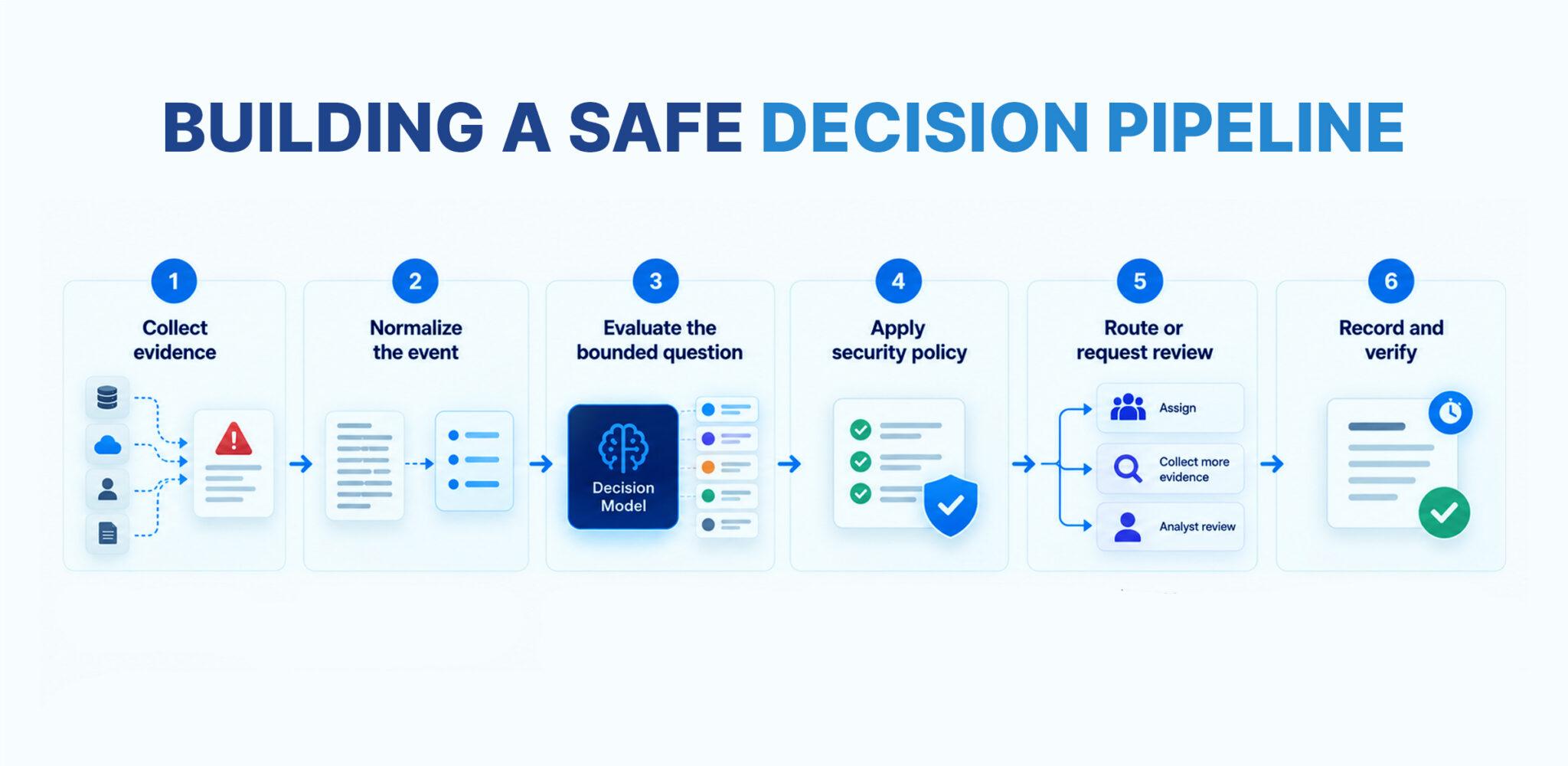
A defensible architecture separates the process into six stages:
1. Collect evidence. Retrieve the original alert, relevant identity or asset metadata, and related telemetry from authorized sources.
2. Normalize the event. Convert data into a consistent schema, remove irrelevant fields, and redact secrets or unnecessary personal information.
3. Evaluate the bounded question. Call the decision model with clear instructions and a defined set of outcomes.
4. Apply security policy. Validate the result against authoritative controls, known incident rules, ownership mappings, and response requirements.
5. Route or request review. Assign the case, collect further evidence, or ask an analyst to review the decision.
6. Record and verify. Log the decision and policy path, then confirm that any downstream action completed successfully.
This architecture also supports a sensible division between decision models and generative LLMs. A decision model can classify a case or rank a queue, while an LLM can be invoked when the analyst needs a natural-language summary of a large evidence set or a draft investigation report.
The LLM’s explanation should remain separate from the authorization decision. A persuasive narrative does not make an action safe, and a model-generated recommendation should not override a deterministic control.
Security Controls That Must Stay Outside the Model
SecOps automation operates in a high-consequence environment. A routing error may delay an investigation; an unsafe response action could disable an account, interrupt a service, or destroy valuable evidence.
Several safeguards should be treated as architectural requirements.
Least-privilege access: Give the workflow only the permissions required for its job. A classifier that assigns cases should not automatically have permission to disable identities or modify cloud infrastructure.
Deterministic policy enforcement: Enforce mandatory controls in policy engines, access-control systems, and response playbooks. A model score should never bypass a hard security requirement.
Human review for consequential actions: Require authorized approval before actions such as isolating critical systems, disabling privileged accounts, or making broad changes to production access unless a separately approved incident-response policy explicitly authorizes automated containment.
Protection against untrusted input: Security alerts can include attacker-controlled strings, filenames, process arguments, URLs, and log messages. Treat these as data, not instructions. Validate inputs and prevent model outputs from being executed as commands.
Auditable decisions: Preserve the original alert reference, relevant evidence, model and deployment version, selected category, probability values, policy result, and action outcome. Store only what is necessary and protect those records against unauthorized access.
Data protection: Redact credentials, tokens, and unrelated sensitive information. Verify data handling, retention, access, and residency requirements before sending security telemetry to an external inference service.
Fallback handling: Define what happens when the API is unavailable, the response is malformed, or the result is uncertain. The fallback should preserve the alert and route it through an approved process not silently discard it.
These controls are consistent with the risk-based incident-response approach described in NIST SP 800-61 Rev. 3, which emphasizes integrating incident response with broader cybersecurity risk management.
How to Evaluate Microsoft-Decision-1 for SecOps
Before putting a decision model into a live security workflow, test it on representative historical data. Start with a narrow task such as routing cloud identity alerts or prioritizing a specific class of endpoint events. Define the available categories and document what each one means operationally.
Build a labeled test set containing common alerts, known false positives, genuine incidents, ambiguous events, and cases with missing context. Where possible, use analyst-reviewed outcomes rather than treating existing severity labels as unquestionable ground truth.
Measure more than overall accuracy:
- Recall for high-risk cases: How often does the model correctly flag events that require urgent attention?
- False-positive rate: How much unnecessary investigation or escalation does it create?
- Routing accuracy: Does the event reach the correct queue or team?
- Review rate: How often does the workflow need an analyst because the result is uncertain?
- Latency and throughput: Can it handle the expected alert volume within the workflow’s time budget?
- Operational cost: What does each successfully handled event cost, including enrichment, retries, review, and infrastructure?
- Robustness: Do results change materially when the wording or order of options changes?
Microsoft’s documentation specifically warns that results can be sensitive to question wording and option definitions, and recommends validating thresholds on labeled examples. The model’s outputs should not be treated as universally calibrated measures of threat likelihood. Validate binary and choice probabilities, as well as ordered scale scores, against labeled security cases before using them to set production thresholds.
Run the model in shadow mode first. Let it produce classifications while the existing security process remains authoritative. Compare the output with analyst decisions and actual incident outcomes before allowing it to influence routing or response. Only after the results meet the team’s requirements should selected low-risk actions be automated. Keep monitoring, audit logging, and a clear way to disable model-driven decisions.
Where GRiPO Fits in SecOps Automation
A decision model becomes operationally valuable when it is connected to the systems that collect evidence and carry out security workflows. GRiPO is an AI-powered workflow automation platform with visual workflow building, isolated code execution, AI agents, and plugin-based integrations. These capabilities can be used to design the surrounding process: retrieve security data, call configured services, branch on results, request analyst approval, and deliver actions to the appropriate tools.
For example, a SecOps workflow could receive a security alert, enrich it with approved asset and identity context, call Microsoft-Decision-1 through a configured API connection, and apply predefined routing rules. The workflow could then create a case in Jira, notify a security channel, or send the event to a human review queue.
If the case requires deeper investigation, an AI agent or other analysis tool could help summarize supporting telemetry. Any remediation action would still need to follow the organization’s access controls, response policy, and approval requirements.
This is an implementation pattern, not a claim that Microsoft-Decision-1 is available as a prebuilt GRiPO integration. Teams need to configure and validate the endpoint, credentials, response mapping, and network access for their environment.
The objective is to make each decision observable and controlled. Security teams should be able to determine what evidence entered the workflow, which decision was returned, what policy was applied, and whether the final action succeeded.
When Microsoft-Decision-1 Is a Good Fit and When It Is Not
Microsoft-Decision-1 is worth evaluating when the task is bounded and repeatable: assigning a security category, ranking a review queue, selecting an investigation path, or checking whether a case meets a defined condition. It is less suitable as the sole mechanism for discovering unknown attacks, reconstructing a complex intrusion, or deciding whether to execute a high-impact containment action without independent controls.
Some tasks do not need a model at all. If a policy explicitly requires every exposed asset with a particular vulnerability to be escalated, a deterministic rule may be clearer, cheaper, and easier to audit. Other tasks may need a generative LLM or specialist security tooling because they require complex interpretation or detailed explanation.
The strongest architecture uses the simplest reliable component for each step. Rules enforce hard requirements. Decision models handle appropriate bounded judgments. LLMs assist with open-ended analysis and summaries. Analysts remain responsible for consequential decisions according to the organization’s incident-response policy.
Final Recommendation
Microsoft-Decision-1 offers SecOps teams a model to evaluate for structured security alert triage, threat prioritization, and investigation routing. Its value depends on whether it improves a specific workflow compared with existing rules, classifiers, or analyst-led processes. Start with one alert category, define the expected decisions, and test against historical cases that include both real threats and false positives. Measure high-risk recall, false-positive rates, routing accuracy, review volume, and operational cost.
Then introduce the model in shadow mode before enabling limited automation. Keep threat evidence, authorization, policy enforcement, and high-impact response actions under appropriate controls. The aim is not to let a model decide which alerts matter without oversight. It is to help security teams direct their attention more consistently, preserve evidence, and move cases through a controlled process so analysts can spend more time investigating genuine risk and less time sorting repetitive alerts.
FAQ
What is Microsoft-Decision-1 for SecOps?
Microsoft-Decision-1 is a structured decision model that can be evaluated for security tasks such as alert classification, queue prioritization, and investigation routing. It does not replace security detection tools or incident-response expertise.
Can Microsoft-Decision-1 detect cyberattacks?
It can evaluate supplied evidence against defined questions, but it should not be treated as a standalone threat detection engine. Detection platforms, telemetry, threat intelligence, and validated security controls remain essential.
How can Microsoft-Decision-1 help prioritize security alerts?
A workflow can provide alert context and ask the model to select a defined priority category. The result can help order an investigation queue, provided the classification has been tested against representative security data.
Can Microsoft-Decision-1 reduce false positives?
It may help classify alerts more consistently, but false-positive reduction is not guaranteed. Teams should compare its results with existing rules and analyst decisions, measuring both false positives and missed high-risk events.
Can Microsoft-Decision-1 automatically close security alerts?
Automatic closure should not be based solely on a model output. Any closure policy should require validated evidence, appropriate checks, auditability, and a safe path for uncertain cases.
Can Microsoft-Decision-1 classify phishing and identity alerts?
These are possible evaluation scenarios if the workflow supplies appropriate evidence and defines clear categories. The model’s performance on each alert type must be tested before production use.
Does Microsoft-Decision-1 provide an explanation for its security decisions?
Its decision API returns structured answers and probability information rather than a free-form rationale. Applications should preserve supporting evidence and can use a separate analysis step when a human-readable summary is needed.
What happens when Microsoft-Decision-1 is uncertain?
The workflow can route the event to an analyst, request more evidence, or use a validated fallback. A review option and thresholds should be established using real examples and the consequences of mistakes.
Is Microsoft-Decision-1 safe for automated incident response?
Safety depends on the complete implementation. Least-privilege access, deterministic policy enforcement, human approval for consequential actions, audit logs, and independent verification should remain in place.
How can Microsoft-Decision-1 fit into a SIEM or SOAR workflow?
A SIEM or SOAR workflow can enrich an event, call the model through a configured API, and use the structured result to select a queue or next step. The integration should preserve existing policy controls and record the decision path.
How can GRiPO support SecOps automation?
GRiPO can coordinate configured API calls, workflow branches, AI agents, integrations, and approval steps. Teams must validate the specific model connection, credentials, and security controls in their environment.
How should SecOps teams evaluate Microsoft-Decision-1?
Use labeled historical alerts and measure high-risk recall, false-positive rate, routing accuracy, review rate, latency, robustness, and cost. Start in shadow mode before allowing the model to influence live actions.
Key takeaways
- Microsoft-Decision-1 can be evaluated for bounded security decisions, including alert classification, prioritization, and routing.
- A decision model does not replace threat detection, forensic analysis, or established response controls.
- High-risk recall and false negatives deserve particular attention during evaluation.
- Model outputs should be checked against evidence and deterministic security policies.
- Shadow testing and a human-review path should precede production automation.
- GRiPO can coordinate the workflow around configured model calls, integrations, and controlled actions.