
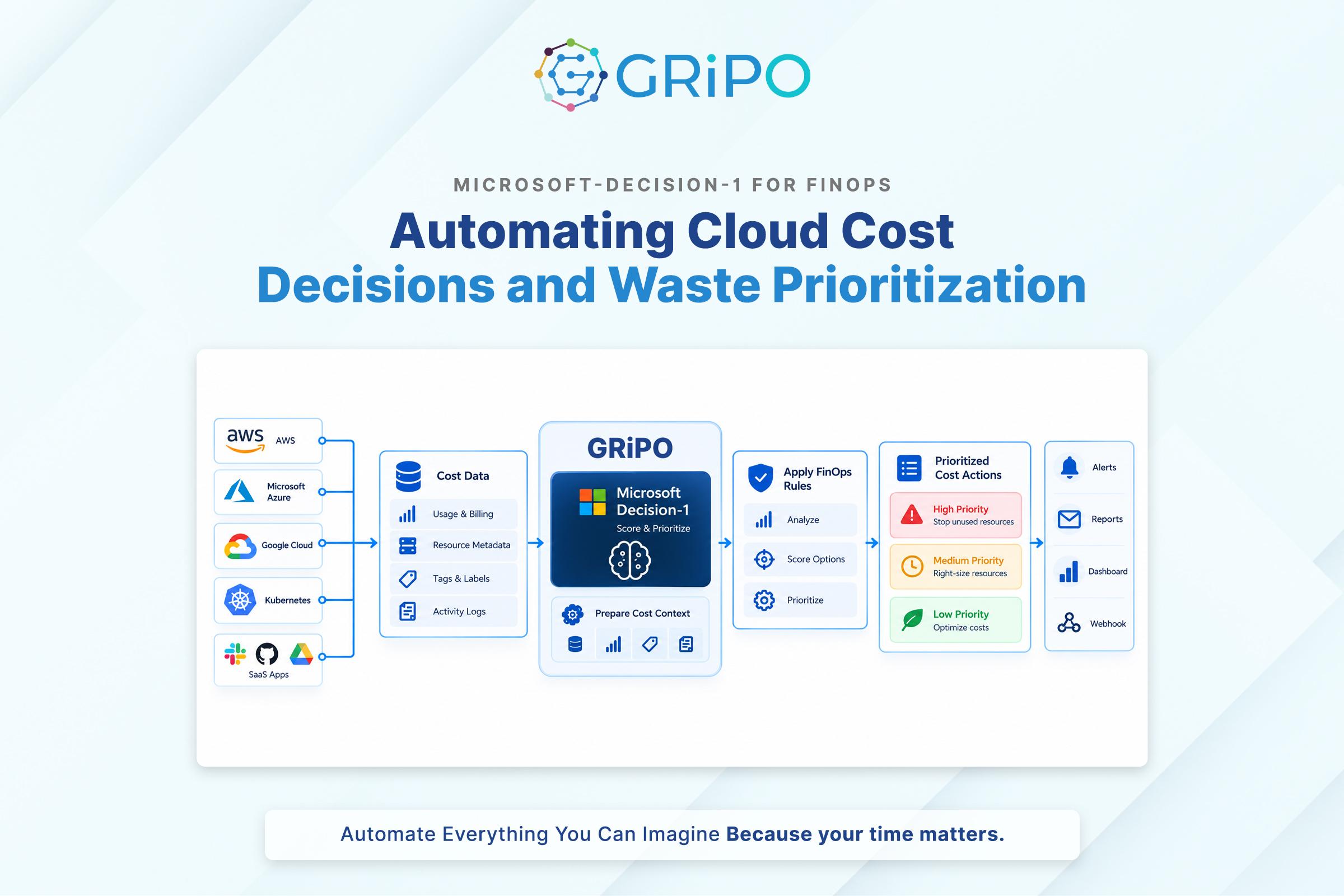
A cloud bill rarely tells an engineering team exactly what to do next.
It might show that compute spending increased by 22%, Kubernetes costs are rising, or a database is consuming more resources than forecast. But the bill does not explain whether the increase reflects healthy business growth, an inefficient workload, a forgotten development environment, or a temporary event that requires no intervention. That gap between cost visibility and a defensible decision is one of the harder problems in FinOps.Microsoft-Decision-1 offers a model-based approach worth evaluating for this part of the process. Designed for structured decisions such as classification, ranking, and scoring, it can assess a defined set of questions and return structured outcomes rather than a free-form explanation. For FinOps teams, this creates potential applications in cost-anomaly prioritization, optimization opportunity classification, and routing savings recommendations for review.
The important distinction is that finding expensive resources and deciding which resources should be optimized are two different tasks. A decision model may help evaluate the second, provided it receives reliable cost and workload context. It should not independently decide to terminate production infrastructure or treat every spending increase as waste. This article explores how Microsoft-Decision-1 could fit into a cost-management workflow, how to prioritize savings opportunities, and how to connect model-based decisions to governed execution.
Why Cloud Cost Optimization Gets Stuck After Reporting
Most mature cloud environments already collect billing data, usage metrics, budgets, tags, and resource inventory. Cloud providers and FinOps tools can identify cost increases and expose underutilized resources. The challenge often starts after a finding appears.
Imagine a monthly report identifies these opportunities:
- An oversized production database with potentially significant savings.
- A development cluster that runs overnight despite limited use.
- A collection of unattached storage volumes.
- A sudden increase in data-transfer charges.
- A compute workload whose spending rose because customer demand increased.
Each finding needs a different response. Some can be corrected through a scheduled change. Others require workload-owner confirmation, performance analysis, or a deeper investigation into the cause of the cost increase. A simple ranking by dollar amount can be misleading. The largest potential saving may involve the highest reliability risk, while a smaller opportunity may be easy to validate and safe to implement.
FinOps is concerned with maximizing the business value of technology spending, not reducing the bill at any cost. The FinOps Foundation framework emphasizes collaboration, timely and accurate data, shared accountability, and business value as the basis for technology decisions. That makes cost optimization a prioritization problem as much as a reporting problem. Teams need to decide which opportunities are worth pursuing, what evidence is missing, who owns the next step, and how to confirm that the change actually delivered value.
What Microsoft-Decision-1 Brings to FinOps
Microsoft-Decision-1 is available through Microsoft Foundry for structured decision tasks, including classification, ranking, and scoring. Applications provide a state such as a JSON object containing cost and workload information and ask one or more defined questions. The model returns structured decisions and probability information rather than generated prose. Microsoft’s official documentation describes the supported question types and known limitations.
For FinOps, possible questions include:
- Which cost anomaly should be investigated first?
- Does this resource appear to be a candidate for optimization review?
- Which team should own this savings opportunity?
- Does the proposed action require workload-owner approval?
- Is the available evidence sufficient to recommend a next step?
These are bounded decisions. The model can select among predefined categories, but it does not replace billing calculations, utilization analysis, resource ownership records, or policy enforcement.
For example, an application could supply a cost anomaly with its baseline, current spend, resource type, environment, utilization metrics, business owner, and workload criticality. The model could classify the finding as a routine investigation, a high-priority optimization opportunity, or a case requiring additional evidence.
The workflow would then apply explicit rules to determine the next step. This separation is important. Cost data and deterministic calculations establish the facts. The decision model evaluates a defined question. The workflow and governance layer control what happens afterward.
Use Case 1: Prioritizing Cloud Waste by Business Impact
A cloud environment can contain hundreds of potential optimization opportunities. Reviewing them one by one is time-consuming, while ranking them only by estimated savings ignores effort and risk.
A more useful prioritization process considers several dimensions:
- Potential savings: How much money could the proposed change save over a defined period?
- Confidence in the estimate: Is the estimate based on actual utilization and pricing data or a rough assumption?
- Implementation effort: How much engineering time and coordination will the change require?
- Operational risk: Could the change affect availability, latency, resilience, or recovery?
- Business context: Does the resource support a critical service, a seasonal workload, or a temporary project?
- Ownership: Is there a clear team responsible for validating and implementing the change?
A decision model can evaluate the supplied context and classify an opportunity into a predefined queue. For example, a small, well-understood storage cleanup might be classified as a low-risk action for routine review, while a database rightsizing proposal could be marked for workload-owner assessment. The model should not invent the savings estimate or calculate financial impact from incomplete information. Those values should come from billing records, pricing data, utilization measurements, and explicit assumptions.
Example: Three optimization opportunities
Suppose a FinOps team identifies three potential actions:
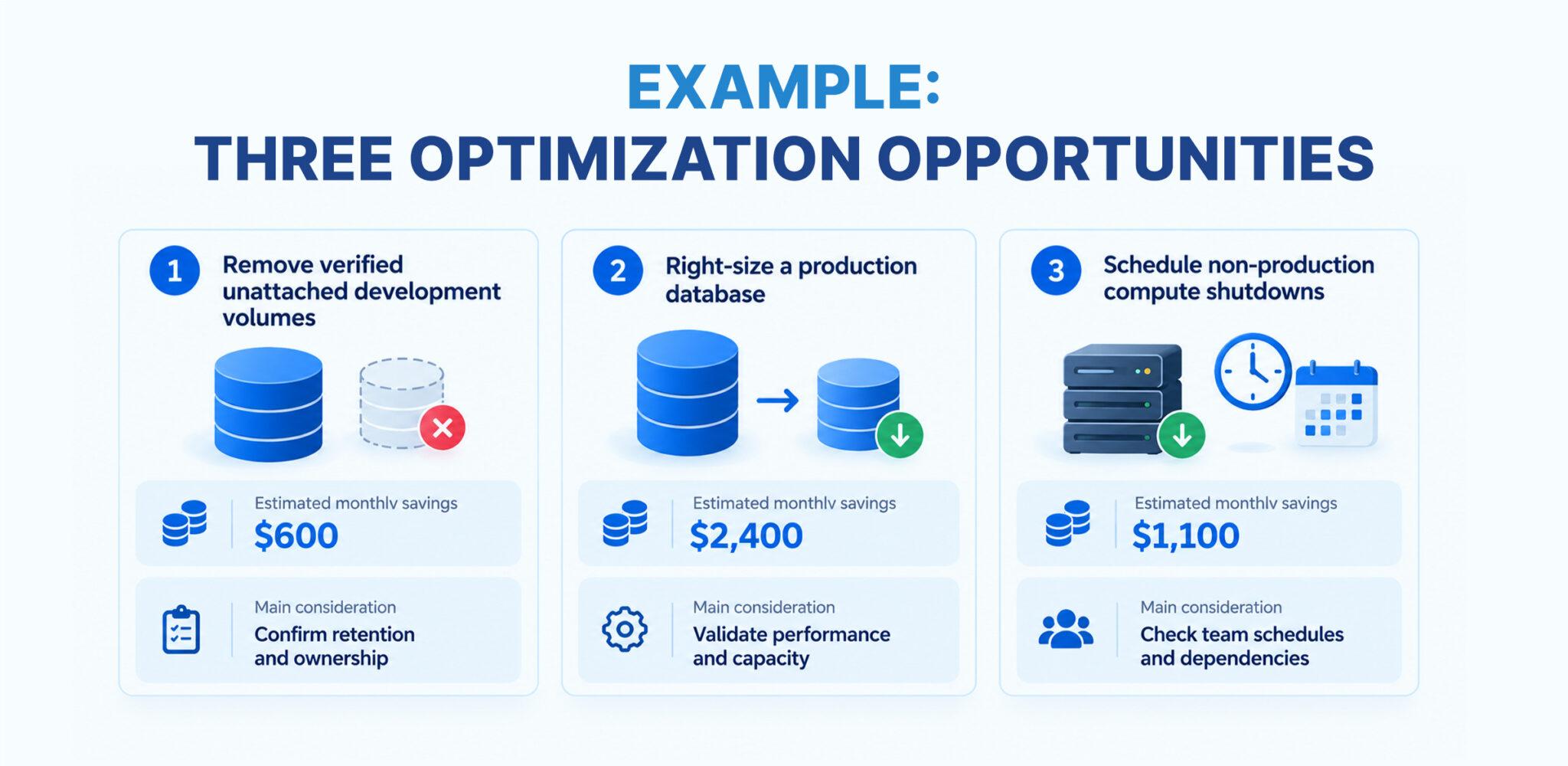
These numbers are illustrative. They do not represent measured GRiPO customer results or guaranteed savings.
A naive process might tackle the database first because it offers the largest saving. A more thoughtful workflow could prioritize the unattached volumes if ownership and retention checks are complete, then schedule the compute shutdowns after validating dependencies. The database change may deliver greater savings, but it also requires more analysis and a controlled rollout. Microsoft-Decision-1 could be evaluated to classify these opportunities using the organization’s predefined criteria. The final order should still reflect explicit business priorities and verified operational constraints.
Use Case 2: Separating Genuine Cost Anomalies from Expected Growth
Not every spending increase is waste. A SaaS company may see higher compute costs after a successful product launch. Data-transfer charges may increase because more customers are using a feature. A database may require additional capacity during a seasonal peak.
If an automation treats every increase as a problem, it creates noise and can encourage harmful cost-cutting decisions. A better workflow combines billing data with context such as request volume, customer growth, deployment history, workload utilization, and budget forecasts.
A decision model can then classify an anomaly into categories such as:
- Expected growth requiring forecast adjustment
- Potential inefficiency requiring investigation
- Unexpected spending requiring urgent review
- Insufficient evidence for classification
The model is not performing financial reconciliation. It is evaluating a structured state assembled by the application.
For example, if compute spending rises by 30% while request volume rises by 45% and cost per transaction falls, the increase may reflect efficient growth rather than waste. Conversely, if spending rises while usage remains flat, the team may need to investigate idle resources, configuration drift, or a pricing change. The important metric is not always total spend. Cost per unit of business value can reveal whether the organization is becoming more or less efficient.
The FinOps Foundation’s guidance on cloud unit economics explains how metrics such as cost per transaction or cost per customer can connect technology spending to business outcomes. A model can help categorize findings using those metrics, but the underlying calculations and definitions must remain consistent and auditable.
Use Case 3: Prioritizing Kubernetes Cost Optimization
Kubernetes costs are difficult to interpret because the relationship between infrastructure spend and application demand is not always obvious.
A cluster may be expensive because workloads are overprovisioned, node utilization is low, requests and limits are poorly configured, or workloads require additional capacity for resilience. Shared nodes and incomplete allocation data can also make it difficult to attribute costs accurately.
A useful workflow begins with measurements rather than assumptions.
Collect information such as:
- CPU and memory requests compared with actual utilization
- Node utilization and autoscaler activity
- Namespace, workload, and team allocation
- Replica counts and scaling behavior
- Service-level objectives and recent performance
- Workload schedules and known peak periods
The workflow can identify candidate actions, such as reviewing overprovisioned requests or checking whether non-production workloads can be scheduled more efficiently. Microsoft-Decision-1 could then classify the opportunities by review priority or choose the appropriate next step from a predefined set. A workload with persistent low utilization and clear ownership may be a good candidate for rightsizing analysis. A workload with low average utilization but strict latency requirements may need specialist review instead.
The model should not directly change CPU requests, reduce replicas, or scale down production workloads without independent safeguards. Those actions require capacity analysis, workload testing, rollout controls, and verification. The same principle applies to other optimization work: the model helps organize the decision, while engineering evidence determines whether the proposed change is safe.
Use Case 4: Turning Savings Recommendations into Governed Actions
A recommendation has little financial value if nobody implements it or checks the result. This is where a decision model can fit into a larger FinOps process. Once a candidate action has been identified, the workflow can classify the required approval path, identify the responsible team, and prepare the next task.
For example, a workflow could:
- Detect a cost anomaly or optimization opportunity.
- Retrieve billing, utilization, ownership, and workload metadata.
- Calculate a savings estimate using explicit pricing and usage assumptions.
- Ask Microsoft-Decision-1 to classify the opportunity.
- Apply governance rules based on resource criticality and action type.
- Create a Jira task or send a review request through a configured integration.
- Execute only approved actions through a permitted automation path.
- Compare actual cost and workload health after the change.
The final step matters. A rightsizing recommendation should not be counted as realized savings merely because a ticket was closed. The team needs to confirm that spend changed as expected and that service performance remained within acceptable limits. Savings measurement should also distinguish estimated, approved, implemented, and verified savings. Otherwise, FinOps reports can overstate the financial impact of automation.
A Practical Request Pattern for Cost Opportunity Classification
Microsoft-Decision-1 accepts structured state and typed questions. The following JSON illustrates how an application might ask the model to classify a cloud optimization opportunity.
This is an illustrative request body, not a complete production integration. The deployment name, endpoint, authentication, and response mapping must follow the current Microsoft Foundry documentation.
{

  "model": "YOUR_DEPLOYMENT_NAME",
  "state": {
    "resource_type": "non_production_compute",
    "environment": "development",
    "monthly_cost": 850,
    "utilization_summary": "Low utilization outside working hours",
    "estimated_monthly_savings": 320,
    "owner_identified": true,
    "shutdown_schedule_confirmed": false,
    "production_dependency": false

  },

  "questions": {
    "priority": {
      "type": "choice",
      "instructions": "Classify the next review priority using the supplied evidence.",

      "criteria": {
        "high": "A material opportunity has sufficient evidence and should be reviewed promptly",
        "normal": "The opportunity is suitable for the regular optimization queue",
        "review": "Important evidence is missing or the proposed change needs additional assessment"

      }
    },

    "approval_needed": {
      "type": "noul",
      "instructions": "Does the proposed change require owner confirmation before execution?",
      "criteria": {
        "true": "The schedule or operational requirements have not been fully confirmed",
        "false": "The required owner and policy checks have already been satisfied"

      }
    }
  }
}
The amounts and conditions are fictional examples. In a real system, cost values should include their currency, measurement period, and source, and the workflow should validate them before constructing the request.
The output should not itself authorize a shutdown. A deterministic policy should verify ownership, approved schedules, resource dependencies, and any relevant exceptions. If the resource has a production dependency or the schedule is unconfirmed, the workflow should require further review. The model’s probabilities can inform routing thresholds, but those thresholds should be calibrated against historical decisions and the cost of mistakes.
Building the FinOps Decision Pipeline
A reliable implementation should separate financial measurement, model-based classification, policy enforcement, and execution.
1. Collect and normalize cost data. Retrieve billing records, usage information, resource inventory, tags, and ownership data from authorized sources. Normalize resource identifiers and time periods before comparing values.
2. Calculate the financial facts. Determine the baseline, anomaly amount, estimated savings, and relevant unit-cost metrics using documented formulas. Keep raw provider data and calculation assumptions available for audit.
3. Add business context. Include workload criticality, environment, service objectives, change windows, and the team’s ownership information. Avoid sending unrelated data to the model.
4. Ask a bounded question. Define the categories and the criteria that distinguish them. Include an option for missing evidence or review where appropriate.
5. Apply governance rules. Use deterministic controls to decide whether the opportunity can proceed, needs an owner approval, or must be escalated. Model output should never override budget policies, access permissions, or mandatory operational controls.
6. Execute through an approved path. Use existing infrastructure tooling and narrowly scoped credentials. Separate the ability to recommend an action from the permission to perform it.
7. Verify the result. Compare actual spending with the baseline and check workload health. Record realized savings only after the defined verification period and accounting rules are satisfied.
This pipeline makes it easier to understand where a recommendation came from, who approved it, what changed, and whether the change created business value.
Measuring the Economic Value of Decision Automation
The business case should account for more than the cost of the model call.
Relevant metrics include:
- Savings opportunity precision: What proportion of prioritized opportunities were worth pursuing?
- Time to decision: How long does it take to move from a cost finding to an approved next step?
- Implementation rate: What share of approved opportunities are actually completed?
- Verified savings: How much reduction is confirmed after implementation?
- Regression rate: How often does an optimization cause a reliability or performance problem?
- Cost per reviewed opportunity: What does it cost to enrich, classify, review, and process each finding?
- Unit-cost improvement: Did cost per transaction, customer, job, or other business unit improve?
Run a comparison against the existing process. A model that speeds up classification but produces poor recommendations may increase review workload rather than reduce it.
A simple rules-based baseline is also essential. If a deterministic rule can safely handle a case such as identifying a resource with a verified owner, no dependencies, and an approved shutdown schedule there may be no reason to add a model call. Use Microsoft-Decision-1 where contextual judgment adds measurable value, not merely because a decision can be expressed as a question.
Security, Governance, and Financial Accountability
FinOps automation can affect production capacity, customer experience, resilience, and financial reporting. A cost-saving action is not successful if it creates an outage or hides an expense instead of eliminating waste. Use least-privilege access for billing data and infrastructure operations. Keep model credentials in an approved secret-management system, and do not expose cloud keys or sensitive customer data in prompts or logs.
Treat resource names, tags, tickets, and metadata as potentially untrusted input. Validate fields and prevent model outputs from being interpreted as executable commands. Keep the approval policy outside the model. A model may classify a change as low risk, but the workflow must still check whether the resource is protected, whether the owner approved the change, and whether the action is permitted.
Maintain an audit trail linking the original cost finding, calculation inputs, model and deployment version, decision result, approval, execution, and post-change verification. Finally, make cost reduction subordinate to business requirements. FinOps aims to maximize the value delivered by technology spending, balancing cost with performance, reliability, security, and business needs.
Where GRiPO Fits into FinOps Automation
The model is only one component of the system. To create measurable value, it must be connected to the data sources, approval processes, and infrastructure tools that turn a finding into a verified result.
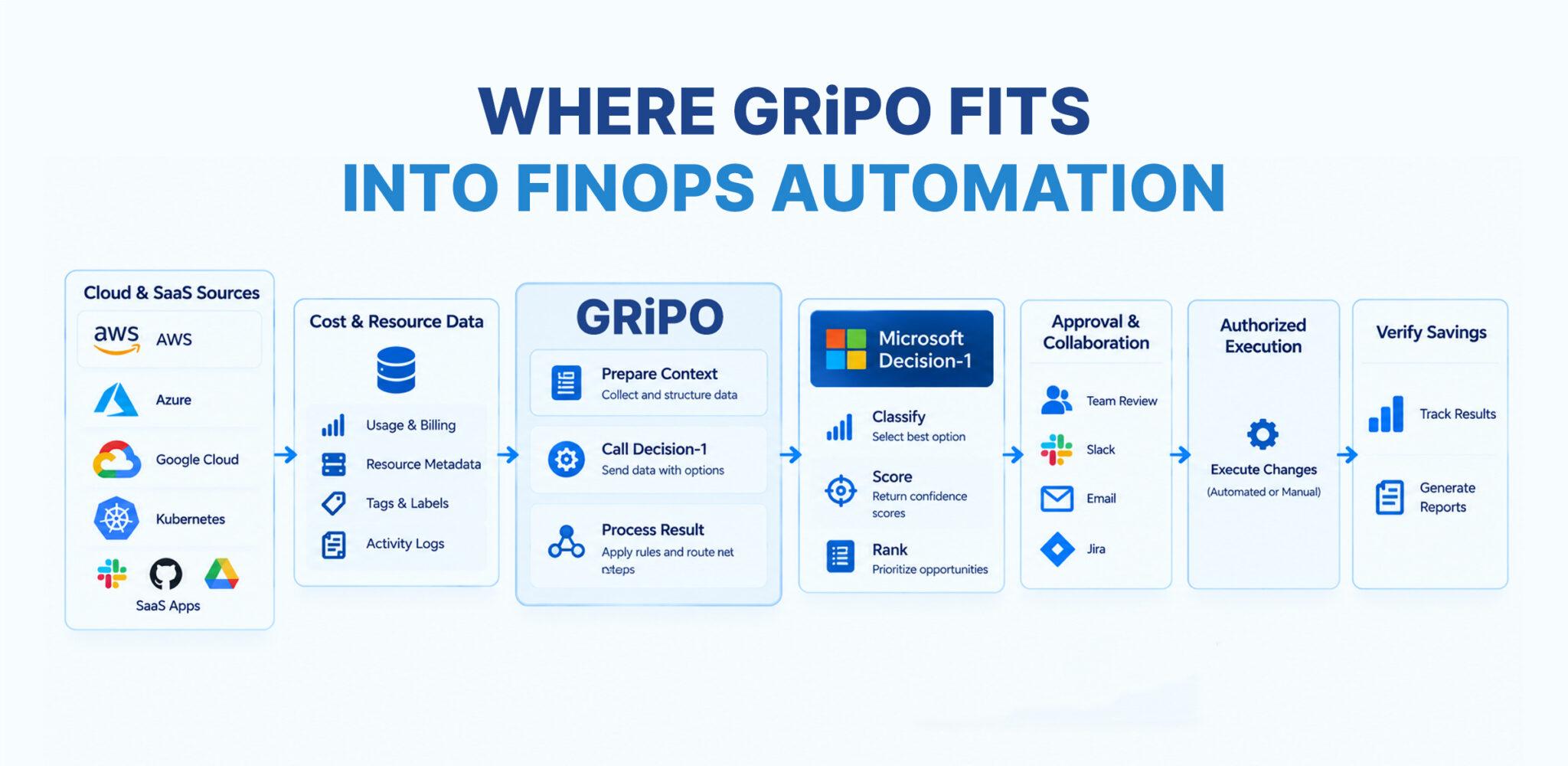
GRiPO is an AI-powered workflow automation platform with visual workflows, isolated code execution, AI agents, and a plugin system for connecting external services. These capabilities can be used to coordinate the broader FinOps process: retrieve cost data, run calculations, call a configured decision endpoint, branch on the result, request approval, and route an approved action through the relevant infrastructure tooling.
For example, a GRiPO workflow could collect cloud billing data, calculate estimated savings, classify the opportunity through a configured Microsoft-Decision-1 API connection, and create a Jira task for the resource owner. After approval, the workflow could invoke the appropriate operational integration and check whether the change produced the expected result.
This is an implementation pattern, not a claim that Microsoft-Decision-1 is available as a prebuilt GRiPO integration. Teams must configure and validate the endpoint, credentials, response handling, and permissions in their environment. The objective is to close the loop between cost visibility and operational follow-through. A report identifies a possible opportunity; a governed workflow determines who should act, what approval is required, and whether the result delivered measurable value.
Final Recommendation
Microsoft-Decision-1 is worth evaluating for FinOps workflows where a large number of cost findings need consistent classification and prioritization. Potential applications include ranking optimization opportunities, distinguishing expected spending growth from anomalies, and routing resource changes for the right level of review. Start with one narrow workload, such as non-production compute optimization or cloud cost anomaly classification. Use historical data to test whether the model improves prioritization compared with existing rules. Measure review effort, verified savings, implementation rate, and regression risk not just model accuracy.
Then connect the decision to a controlled workflow with explicit ownership, approval rules, least-privilege execution, and post-change verification. The goal is not to automate every cost decision. It is to help FinOps and engineering teams spend their time on the opportunities that create the most business value, while ensuring that every optimization remains explainable, governed, and measurable.
FAQ
What is Microsoft-Decision-1 for FinOps?
Microsoft-Decision-1 is a structured decision model that can be evaluated for FinOps tasks such as classifying cost anomalies, prioritizing optimization opportunities, and routing savings recommendations for review.
Can Microsoft-Decision-1 automatically identify cloud waste?
It can evaluate supplied cost and utilization information to classify potential waste. Reliable identification still depends on accurate billing data, resource inventory, workload context, and appropriate validation.
How can decision models prioritize cloud cost savings?
A workflow can supply estimated savings, implementation effort, workload criticality, and operational risk, then ask the model to classify opportunities using defined criteria. Financial calculations and final approval should remain separate.
Can Microsoft-Decision-1 optimize AWS, Azure, and Google Cloud costs?
It can be evaluated in workflows that process normalized cost and resource data from these providers. Provider-specific data collection, pricing calculations, integrations, and execution permissions must be configured separately.
Can Microsoft-Decision-1 help reduce Kubernetes costs?
It can help classify opportunities such as rightsizing reviews or non-production scheduling. Actual changes should be based on utilization measurements, capacity requirements, service-level objectives, and engineering approval.
How is Microsoft-Decision-1 different from a cloud cost anomaly detector?
An anomaly detector identifies unusual spending patterns. A decision model can evaluate the supplied anomaly and context to classify its priority or recommend a workflow path. The two can complement each other.
Should AI automatically shut down expensive cloud resources?
Not solely because a model classifies them as waste. The workflow should verify ownership, dependencies, schedules, and business requirements, then follow an approved execution policy.
How should FinOps teams measure automation ROI?
Track verified savings, time to decision, implementation rate, cost per reviewed opportunity, regression rate, and improvements in relevant unit-cost metrics. Include model, infrastructure, engineering, and human-review costs.
Can Microsoft-Decision-1 distinguish business growth from cloud waste?
It can evaluate context such as usage growth, cost per transaction, and forecast deviations. The result depends on the quality of the supplied data and should be validated against financial and engineering evidence.
What happens when the model is uncertain?
The workflow can route the opportunity to a human reviewer, request additional information, or use a validated fallback. It should not force an automated cost-cutting action when evidence is incomplete.
How can GRiPO support FinOps automation?
GRiPO can coordinate configured API calls, workflow logic, AI agents, integrations, approvals, and operational actions. The specific Microsoft-Decision-1 connection must be configured and validated for the environment.
Does reducing cloud spend always improve FinOps performance?
No. FinOps aims to maximize business value, not minimize spending regardless of consequences. Cost optimization must preserve the performance, reliability, security, and capacity required by the business.
Key takeaways
- Microsoft-Decision-1 can be evaluated for prioritizing cost anomalies and optimization opportunities.
- The highest-cost resource is not automatically the best savings target.
- Cost calculations should come from reliable billing and usage data, not model-generated estimates.
- Kubernetes rightsizing and resource scheduling require operational context.
- Model outputs should guide workflow decisions, not independently authorize infrastructure changes.
- Measure verified savings and business value rather than counting recommendations.
- GRiPO can coordinate the process from cost finding through approval, execution, and verification.