
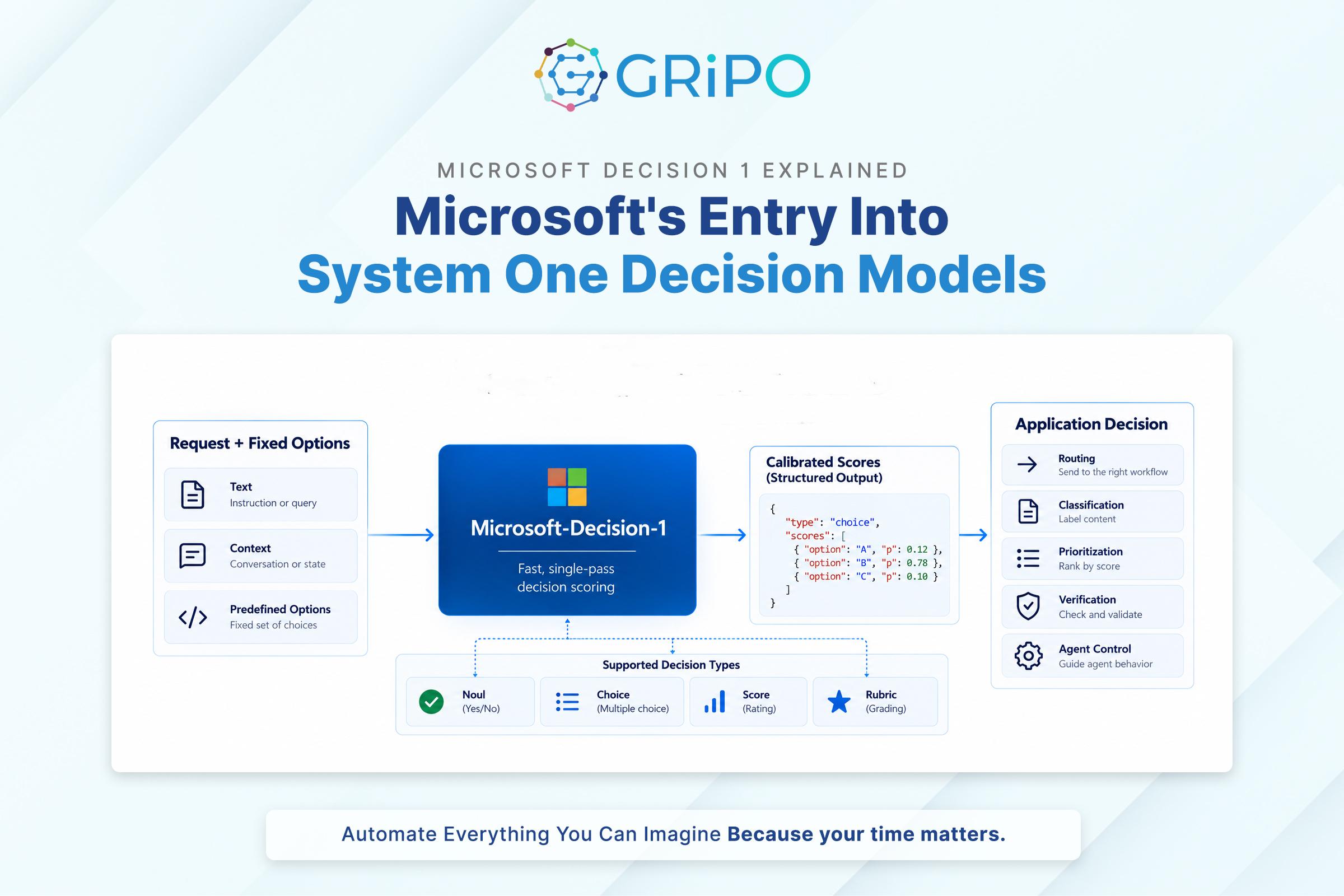
Microsoft’s announcement of Microsoft-Decision-1 on October 9, 2026, introduces a specialized model for a problem that developers encounter throughout AI applications: making decisions that software can act on directly.
Generative AI models are useful for writing code, explaining errors, summarizing documents, and investigating complex problems. But many applications also need smaller, more specific judgments. They need to classify an incident, select a destination for a request, evaluate an AI-generated response, or determine whether an agent should continue with its current task.
Those decisions don’t always require another generated paragraph.
Microsoft-Decision-1 is designed for this category of work. Microsoft describes it as a decision-scoring model that returns structured choices and probability scores for tasks such as routing, classification, prioritization, verification, and workflow control. It is available through Microsoft Foundry and OpenRouter.
The announcement matters beyond Microsoft’s own AI ecosystem. It highlights an architectural approach in which generative models and specialized decision models handle different responsibilities.
This article examines Microsoft’s published technical details, its reported performance results, practical enterprise applications, and the role decision models could play in AI automation.
What Is Microsoft-Decision-1?
Microsoft-Decision-1 is a model designed to evaluate a question against supplied information and return a structured decision.
According to Microsoft’s announcement, the model was created by post-training Qwen3.5-9B for fast, single-pass decision scoring. Microsoft also says it plans to rebase the model on other model families, including Microsoft AI and OpenAI models.
The model supports several decision formats:
- Yes/no decisions: Determine whether a statement is likely to be true.
- Multiple-choice decisions: Select an answer from a predefined set of options.
- Rating decisions: Evaluate an item using an ordered scale.
- Rubric-based grading: Evaluate an AI response or proposed agent action against defined criteria.
The result includes probability information associated with the available answers.
Consider a deployment pipeline that needs to assess an infrastructure change. Rather than asking a generative model for a long explanation every time, the application could present the relevant evidence and ask the decision model to select a risk category.
An illustrative result might be:
{

  "risk_level": "high",

  "probabilities": {

    "low": 0.03,

    "medium": 0.12,

    "high": 0.78,

    "critical": 0.07

  }

}
This is an example for illustration, not a captured API response. Developers should follow Microsoft’s current API documentation for the actual request and response schema.
The application can use the selected category to route the deployment for additional validation or human review.
The distinction is straightforward: the model returns a decision; the application determines what to do with it.
What Are System One Decision Models?
System One Decision Models is a term associated with the emerging category of AI models focused on structured judgments rather than open-ended text generation. The terminology is associated with TypeSafe AI’s Jev decision model, while Microsoft’s announcement describes Microsoft-Decision-1 as a decision-scoring model.
These approaches share an important design principle: define the question and possible answers so that the result can be consumed directly by software.
This is different from asking a general-purpose model to generate a response and then parsing that response to discover what the application should do next.
For example, a conventional AI assistant might explain why an incident appears to be related to infrastructure. A decision model can instead classify the incident into a predefined category that an incident-management workflow understands.
The distinction doesn’t mean decision models are universally more reliable than generative AI. Their value depends on the task, the quality of the supplied information, and how well the model performs on representative examples.
Microsoft-Decision-1 is therefore best understood as part of the broader movement toward specialized AI components, not as evidence that generative models are becoming obsolete.
Microsoft-Decision-1 vs LLMs
The difference between a decision model and a generative LLM becomes clearer when each is assigned a specific task.
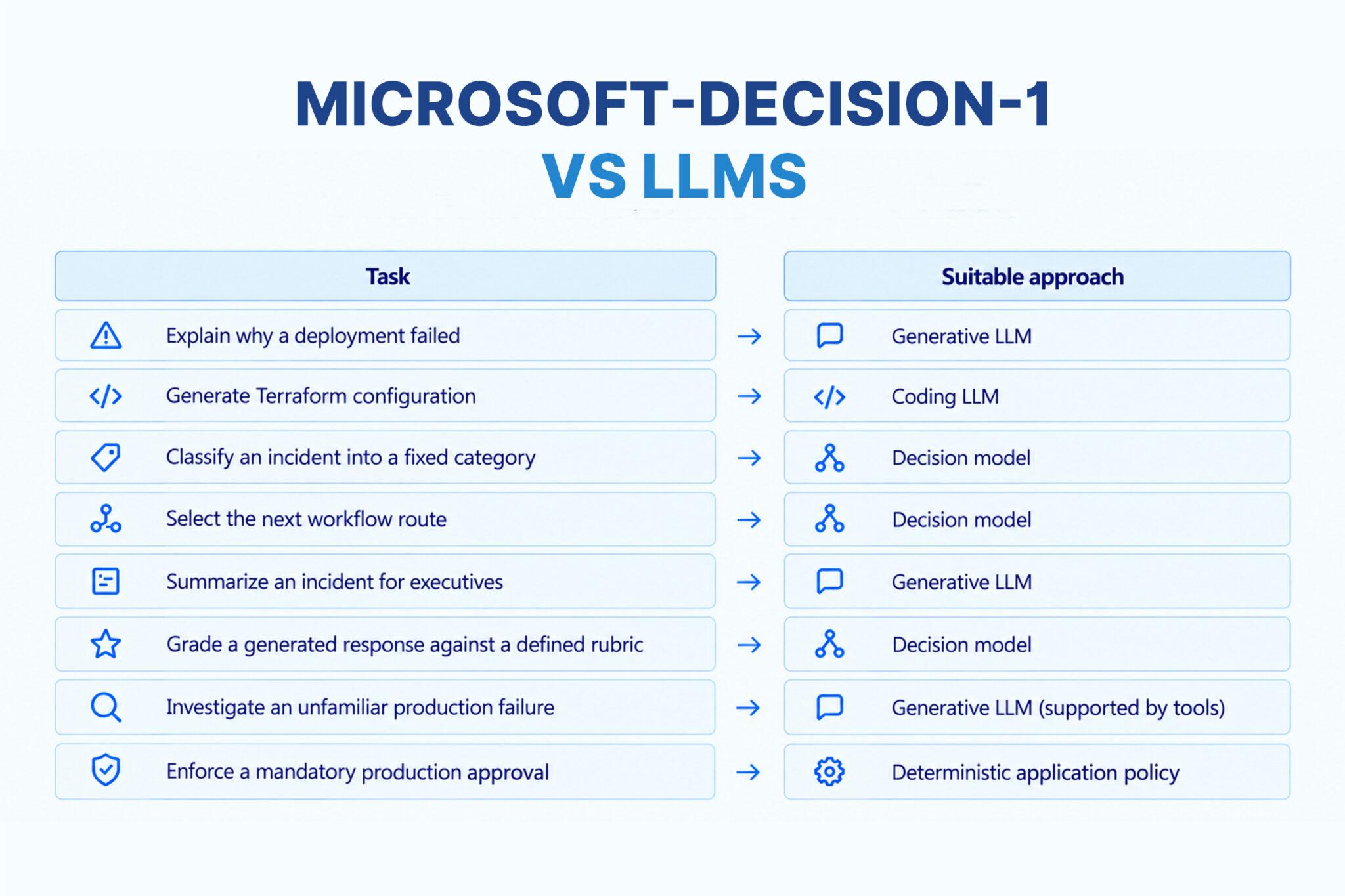
Microsoft positions its model for classification, routing, prioritization, verification, and agent control, while generative models remain appropriate for tasks requiring generated language or broader reasoning.
The practical question is not which model is better in general. It is which component is appropriate for each stage of an application.
A system that uses an LLM for every small classification may perform unnecessary generation. A system that relies exclusively on a decision model will struggle with tasks requiring extensive explanation, code generation, or open-ended investigation.
Combining the two can be more useful than forcing either to handle everything.
What Microsoft’s Benchmarks Actually Show
Microsoft reports that Microsoft-Decision-1 achieved the highest accuracy in its comparison across 36 benchmarks, covering nearly 150,000 questions kept blind from training. The company also reports that the model was 2.5 times faster than H2O-Lightning-4B v1.1, the runner-up in its latency comparison, and 35 times faster than GPT-6 Sol.
These are vendor-reported benchmark results. They should be attributed to Microsoft rather than presented as independently verified performance guarantees.
The announcement also describes several evaluation dimensions beyond raw accuracy.
Generalization: Microsoft tested the model across tasks including routing, ranking, long-context evaluation, multilingual inputs, reasoning, safety, and out-of-distribution cases.
Robustness: Microsoft reports that the model’s decision changed in an average of 1.3% of eight input perturbations, with no decision flips when option descriptions were paraphrased or options were reversed or shuffled.
Probability calibration: Microsoft emphasizes that probability estimates should help applications determine when to act, defer, or request review.
Safety: Microsoft says it tested 5,250 requests across 11 benchmarks covering harmful content, jailbreak attempts, and prompt injection.
These tests address meaningful engineering concerns. In a production workflow, a model should not change its decision merely because answer options were reordered or harmless formatting changed.
Still, benchmark performance isn’t enough to approve a model for every workload.
An enterprise team should measure accuracy, calibration, latency, failure handling, and the operational cost of incorrect decisions using its own data. A model suitable for customer-feedback classification may not be appropriate as the sole gate for a production infrastructure change.
Where Microsoft-Decision-1 Is Useful
Microsoft identifies several applications for its model, including AI response evaluation, incident response, data labeling, model routing, code scanning, and agent control. The company also describes internal uses in Xbox Research, Copilot quality control, incident response, and scientific discovery.
Three patterns are particularly relevant to engineering teams.
1. Routing requests to the right model or team
An AI application may receive thousands of requests that require different handling.
A decision model can classify an incoming request and route it to a suitable model, agent, team, or workflow. The routing policy can consider the request’s type and the application’s constraints.
For example, a simple account question might go to a lightweight workflow, while a complex infrastructure issue goes to a specialized engineering agent.
2. Evaluating AI-generated output
Applications that generate support responses, summaries, or code recommendations may need a separate evaluation stage.
Microsoft-Decision-1 can evaluate an output against predefined criteria and help determine whether it should be accepted, revised, or escalated.
This does not eliminate the need for conventional validation. Code should still be tested, security requirements should still be enforced, and sensitive customer communications may still require human review.
3. Controlling an AI agent’s next action
An agent can use a decision model to evaluate whether it should continue, retry, stop, or hand a task to another model, tool, or human.
This is especially useful when an agent operates inside a multi-stage workflow. Rather than making every decision through an open-ended generation call, the application can use a specialized decision stage where the options are well defined.
A Practical DevOps Example: Deployment Risk Assessment
Consider a CI/CD pipeline that uses GitHub Actions, Terraform, Kubernetes, and an AI coding agent.
The agent has inspected a proposed change and identified several relevant facts:
- The Terraform plan modifies production infrastructure.
- Automated tests have passed.
- A database migration is included.
- A security scanner has reported a finding that needs investigation.
The system needs to decide whether the change should proceed directly, undergo additional checks, or require human approval.
A practical workflow could look like this:
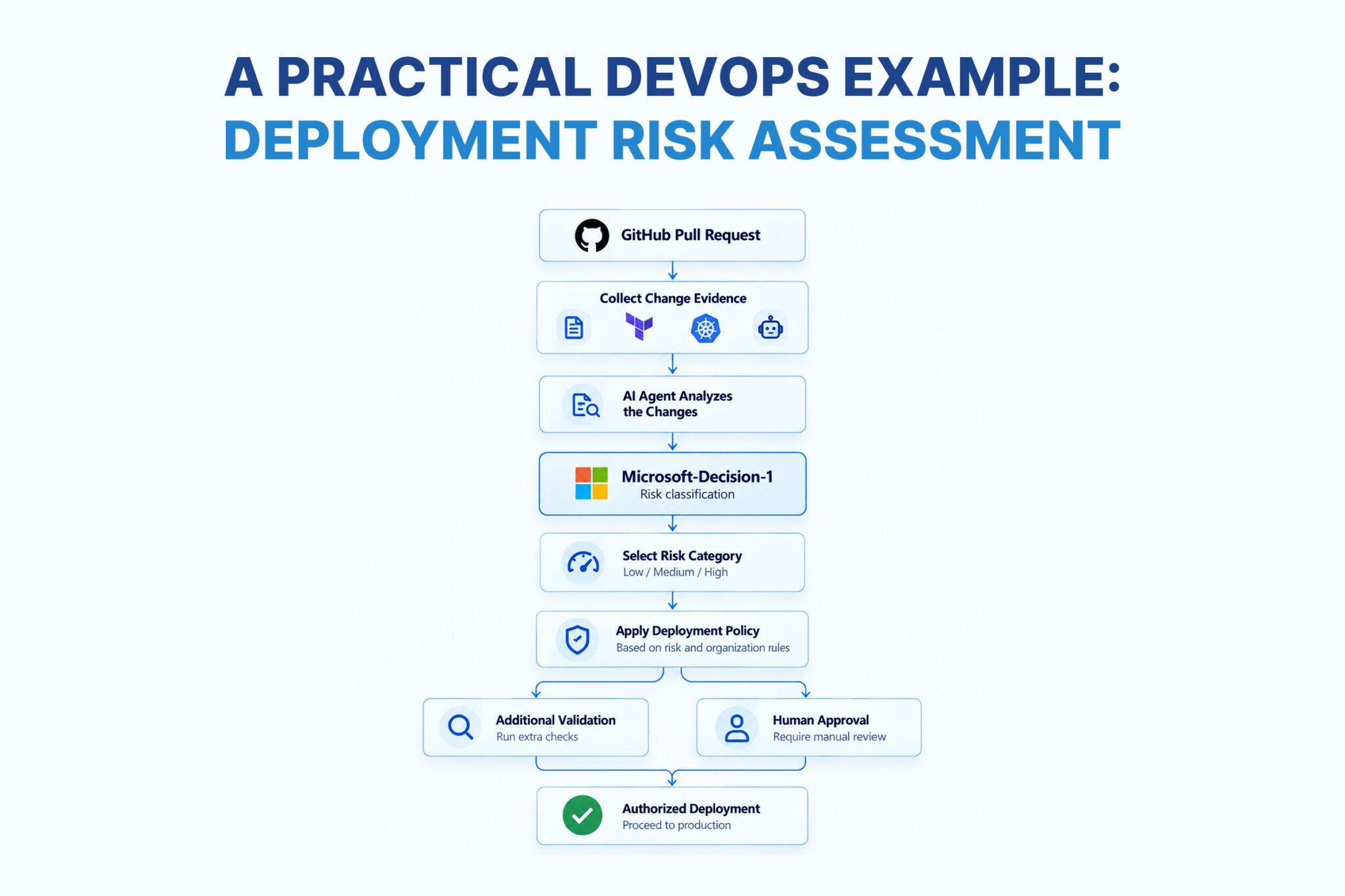
The decision model evaluates the supplied state and returns a risk classification. The workflow then applies the organization’s policy.
For example, a high-risk result might trigger a Jira approval request and a Slack notification. A lower-risk result might allow the pipeline to continue through additional automated checks.
The model should not be allowed to override mandatory requirements. If production deployment requires an approved change ticket, deterministic policy enforcement must verify that approval independently.
This separation keeps the system understandable: the agent analyzes the changes, the decision model evaluates a bounded question, and the workflow enforces the operational rules.
How to Get Started With Microsoft-Decision-1
Microsoft’s announcement directs developers to Microsoft Foundry and OpenRouter. Its documentation provides the implementation details for deploying and calling the model through Foundry.
Start with Microsoft’s primary resources:
- Microsoft-Decision-1 announcement — model design, reported benchmarks, use cases, and pricing.
- Microsoft-Decision-1 deployment documentation — deployment and API implementation.
- Microsoft Foundry model listing — model access through Foundry.
- Microsoft-Decision-1 on OpenRouter — the alternative access route listed by Microsoft.
Before integrating the model, verify current availability, authentication requirements, pricing, regional support, and data-handling terms.
Then choose a narrow task with a measurable outcome, such as incident classification or response-quality evaluation. Build a labeled test set, compare the model with your current approach, and measure how often its decisions lead to the correct operational result.
That is a better starting point than introducing a decision model into every workflow at once.
Limitations to Consider Before Production
Microsoft-Decision-1 offers a specialized capability, but several engineering considerations remain.
- Decision quality depends on the supplied state. Missing or misleading evidence can produce a poor result even when the question is well defined.
- Probability scores need evaluation. A predicted probability is not a guarantee. Teams should test calibration on representative data.
- The model does not replace explanation. When an engineer needs to understand why a decision was made, another component may need to investigate and explain the evidence.
- Hard policies should remain enforceable. Authorization checks, approval requirements, and compliance rules should not depend solely on an AI prediction.
- Hosted inference adds operational dependencies. Timeouts, service failures, authentication problems, and fallback behavior need to be handled explicitly.
- Some tasks don’t need an AI model. Simple rules and conventional classifiers may be faster, cheaper, or easier to validate for particular use cases.
The goal is not to use a decision model wherever possible. It is to use one where structured AI judgment offers a measurable advantage.
What Microsoft’s Announcement Means for AI Automation
Microsoft-Decision-1 adds another major vendor to the emerging market for specialized decision models. Its significance lies in making structured decision-scoring available through established AI development infrastructure.
The wider direction is clear: AI applications can use different components for different responsibilities.
A generative model can investigate a problem and explain possible solutions. A decision model can classify the resulting state or select among defined options. Deterministic application logic can enforce policy, while a workflow engine coordinates execution and approvals.
For DevOps teams, this can lead to more structured incident routing, automated triage, and controlled agent workflows. For enterprise architects, it provides another option for designing systems in which AI outputs translate into operational actions without granting a model unrestricted authority.
GRiPO fits into this broader architecture as an orchestration and execution platform. Teams can use its workflow automation, isolated sandbox execution, AI agents, and integrations to connect engineering tasks with external decision services. A Microsoft-Decision-1 integration would need to be configured through the appropriate API and workflow components; it should not be assumed to be a built-in integration.
The central principle is simple: use the right component for the job, and keep the authority to execute actions within explicit controls.
FAQs
What is Microsoft-Decision-1?
Microsoft-Decision-1 is a decision-scoring model designed to return structured choices and probability scores for tasks such as classification, routing, prioritization, and AI response evaluation.
How is Microsoft-Decision-1 different from an LLM?
A generative LLM produces text and supports broader reasoning tasks. Microsoft-Decision-1 focuses on structured decisions that applications can consume directly.
Is Microsoft-Decision-1 a System One Decision Model?
It fits the broader technical idea of a specialized decision model. However, Microsoft’s announcement describes it as a decision-scoring model rather than explicitly adopting the System One category name.
What model is Microsoft-Decision-1 based on?
Microsoft says it post-trained Qwen3.5-9B for fast, single-pass decision scoring, with plans to rebase it on other model families.
What tasks can Microsoft-Decision-1 perform?
Its documented applications include classification, routing, prioritization, verification, rubric-based evaluation, incident response routing, and agent control.
Can Microsoft-Decision-1 be used for DevOps automation?
Yes. Potential applications include incident classification, pull-request triage, deployment-risk assessment, and workflow routing, provided the decisions are tested and connected to appropriate controls.
Does Microsoft-Decision-1 replace generative AI?
No. It complements generative AI by handling bounded decisions. Generative models remain useful for code generation, investigation, explanations, and other open-ended tasks.
Where can developers access Microsoft-Decision-1?
Microsoft lists Microsoft Foundry and OpenRouter as access options. Check the official announcement and documentation for current availability and deployment requirements.
Are Microsoft-Decision-1’s probability scores guarantees?
No. They are model estimates. Developers should test calibration and define fallback behavior, especially for high-impact decisions.
Can Microsoft-Decision-1 control an autonomous AI agent?
It can evaluate proposed actions and return structured decisions that an application uses to choose the next step. Authorization, safety policies, and execution permissions must remain separately enforced.
How does Microsoft-Decision-1 fit into an enterprise workflow?
It can serve as a decision stage between evidence collection and workflow execution. The surrounding system interprets the result, applies policy, and determines whether to continue, request approval, or escalate.
How can GRiPO support decision-model workflows?
GRiPO can orchestrate AI agents, isolated execution environments, integrations, and conditional workflow steps. Connecting Microsoft-Decision-1 requires the appropriate API integration and workflow configuration.
12. Key Takeaways
- Microsoft-Decision-1 is designed for structured decision-scoring, not open-ended text generation.
- Microsoft reports strong benchmark performance, but production suitability should be validated against the team’s actual workload.
- Decision models complement generative LLMs rather than replacing them.
- DevOps teams can evaluate decision-scoring for incident routing, deployment triage, and AI-agent control.
- Probability scores require testing, and deterministic controls remain essential for security-sensitive operations.
- Workflow platforms such as GRiPO can connect decision services to agents, sandboxes, integrations, and approval processes.