
Most AI applications don’t actually need another paragraph of generated text. A support system may need to know which team should receive a ticket. A security system may need to determine whether a request should be blocked or challenged. A DevOps workflow may need to decide whether a deployment should continue, roll back, or wait for human approval. These are decisions, not writing tasks.
For years, developers have typically handled this problem in one of two ways. They either encode the logic themselves using rules and traditional classifiers, or they send the available context to a generative large language model and ask it to produce an answer that application code can interpret. Both approaches have their place, but neither is ideal for every decision-oriented workload.
A new category of models is taking a different approach. System One Decision Models are designed to evaluate application state against typed questions and return structured answers with probabilities rather than generating free-form text. TypeSafe introduced the System One category alongside Jev in September 2026, describing it as a class of models designed specifically for fast, structured decisions that software can consume directly. TypeSafe AI
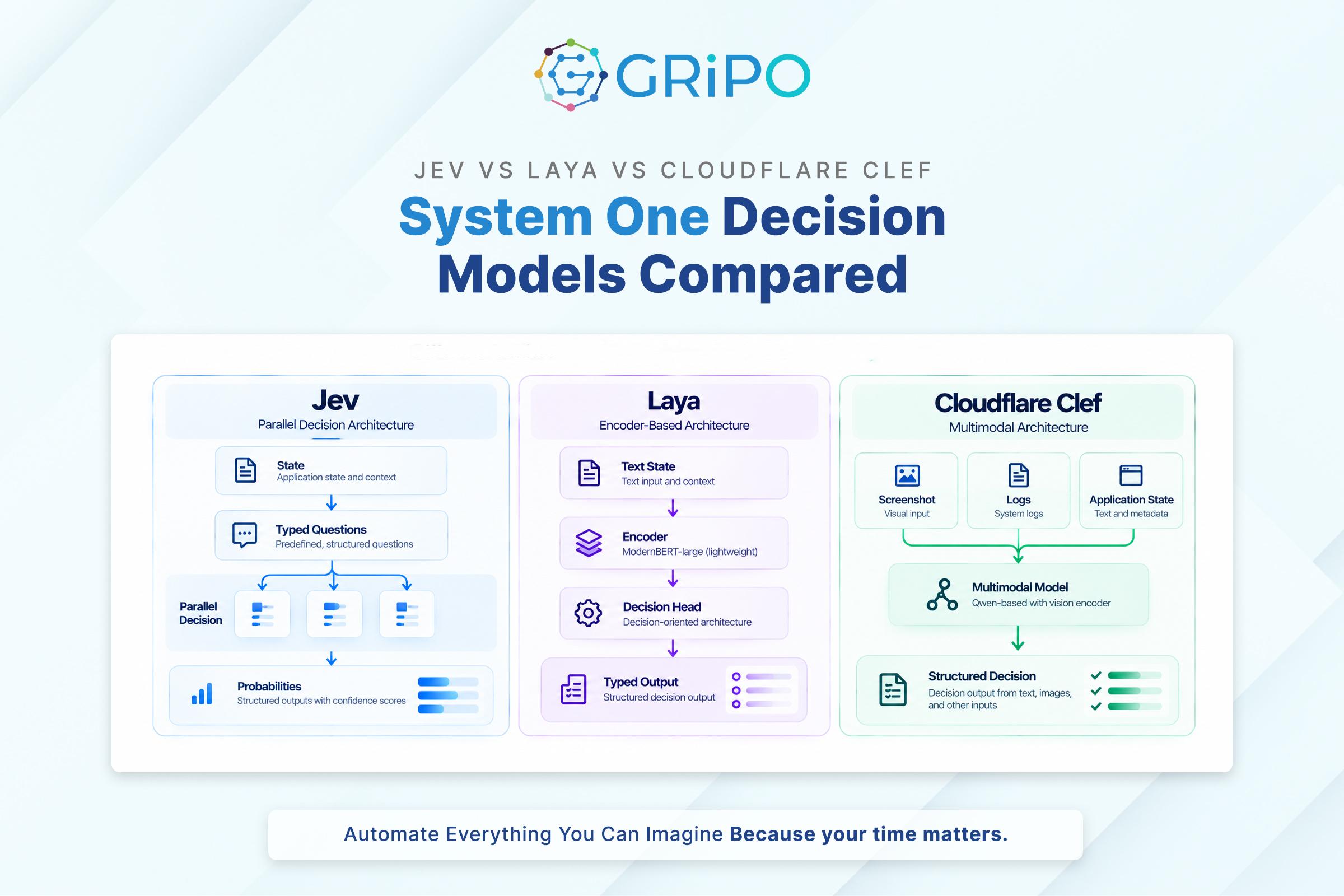
The category has since attracted other implementations, including Jev, Laya, and Cloudflare Clef. Although they share the same broad decision-oriented philosophy, they take different approaches to model architecture, deployment, scale, and capabilities. Jev established the System One category, Laya takes a much smaller open-weight approach aimed at efficient local inference, while Cloudflare’s Clef extends the concept into larger multimodal decision models with open weights and hosted inference through Workers AI.
The important question, however, isn’t simply which model has the highest benchmark score. Different applications have different requirements for latency, context size, accuracy, calibration, deployment control, cost, and multimodal input.
The better question is: Which System One Decision Model fits the way your application actually needs to make decisions?
What Are System One Decision Models?
A System One Decision Model takes application state, evaluates one or more typed questions about that state, and returns structured answers with probabilities. The key difference is that the model is not being asked to generate an open-ended response. Instead, the application defines the decisions it needs, along with the valid answer types, and the model evaluates the available context against those questions.
The important word here is typed.
Instead of sending a support ticket to a generative model with a broad instruction such as, “Analyze this support ticket and tell me what should happen,” an application can define a specific set of questions and acceptable answers. For example, consider a customer who reports:
“I was charged twice for the same subscription.”
The application could define three decisions:
- Department: billing | technical | sales
- Urgent: yes | no
- Category: duplicate-charge | refund | other
The System One model can then evaluate the ticket and return structured results such as:
department: billing
probability: 0.94

urgent: no
probability: 0.91

category: duplicate-charge
probability: 0.96
The application does not need to interpret a paragraph of generated text to determine what the model meant. It already knows the available question types and expected values, so the result can move directly into application logic, routing, policy checks, or an automation workflow.
This creates a meaningful architectural difference between a conventional generative AI workflow and a System One workflow.
Generative LLM
Application State

       ↓

      LLM

       ↓

Generated Text

       ↓

     Parse

       ↓

    Validate

       ↓

Application Logic
With this pattern, the application often has to extract the intended decision from generated language. Structured output formats and tool-calling can reduce that problem, but the underlying interaction is still centered around generating a response.
System One Decision Model
Application State

       ↓

Typed Questions

       ↓

System One Model

       ↓

Structured Decisions

       ↓

Application Logic
The second architecture is designed around the decision itself rather than the generation of text. The application defines what it needs to know, the model evaluates the available state against those questions, and the resulting structured decision can be consumed directly by software.
TypeSafe describes this as a machine-oriented alternative to conventional language-model interfaces. Rather than optimizing primarily for generated strings, Jev is designed to return type-safe decisions and calibrated probabilities that software can use directly. TypeSafe AI
That distinction makes System One Decision Models particularly interesting for automation. A workflow does not always need an AI system to explain what it thinks. Sometimes it simply needs a reliable answer to a bounded question: Should this deployment continue? Does this alert require escalation? Is this ticket security-related? Should this cloud resource be investigated?
When the required output is a structured decision rather than a piece of prose, a decision-oriented model can fit the architecture much more naturally.
Jev: Where the System One Category Started
TypeSafe introduced Jev on September 15, 2026, alongside the System One model category. The company’s central argument was that generative language models are optimized around human-facing interaction, while many software systems need something different: fast, structured, machine-consumable decisions. TypeSafe AI
Jev is designed around a simple interface:
State

  +

Typed Questions

  ↓

 Jev

  ↓

Typed Answers + Probabilities
For example, a DevOps application could provide an incident report and ask:
severity → low | medium | high | critical
rollback_required → yes | no
human_approval → yes | no
The application then receives decisions it can use in ordinary software logic. This is different from asking an LLM to generate a remediation recommendation and then trying to extract the answer from that recommendation.
TypeSafe also designed Jev around Reinforcement Learning for Calibrated Decisions (RLCD), with calibration treated as a first-class part of the model’s training objective. The company argues that confidence is important when AI decisions are going to be used by software rather than merely displayed to a person. TypeSafe AI
That distinction matters. If an AI says an incident is critical, the application may need to know not only the predicted class but also how much confidence the model has in that decision.
Laya: The Lightweight Open Model Approach
Laya takes a very different approach to System One Decision Models. The Laya project is an open-source decision model based on ModernBERT-large, with approximately 421 million parameters in its default English checkpoint. Its published model information lists an Apache 2.0 license and a default context length of 512 tokens for the base checkpoint. This makes Laya dramatically smaller than Cloudflare’s 27-billion-parameter Clef model, creating meaningful differences in deployment requirements, memory consumption, inference costs, and the hardware needed to run each model locally.
Laya’s architecture is closer to a specialized encoder with a decision head than to a conventional autoregressive language model. Rather than generating a textual response, it evaluates the available state against defined options and produces typed decisions. This approach gives Laya an interesting position in the System One ecosystem, particularly for workloads that are relatively narrow, text-based, and sensitive to latency or infrastructure costs.
Consider a support ticket classification workflow. A ticket enters the application, Laya evaluates it, and the model returns structured decisions about the appropriate department, urgency, and category. The workflow can then use those results to route the ticket, notify the responsible team, or trigger the next step without having to interpret a generated paragraph. Because the model is comparatively lightweight, teams may also have more flexibility to run decision logic close to the application rather than relying entirely on a large hosted model.
This makes Laya particularly worth evaluating for organizations that prioritize local inference, CPU-based deployment, cost control, or running decision models within their own infrastructure. However, a smaller specialized model does not automatically offer the same contextual capabilities or performance across every task as a much larger model. Teams should benchmark Laya against representative production data, measuring decision accuracy, confidence calibration, latency, and failure behavior before choosing it for critical workflows. Sharing the same structured output format does not mean that different System One models will deliver equivalent results.
Cloudflare Clef: A Larger Multimodal Approach
Cloudflare entered the System One Decision Model category on October 1, 2026, with the release of Clef and Clef-flash. Cloudflare describes Clef as a decision model in the same family as Jev. Rather than generating free-form text, the model evaluates application state against typed questions and returns probabilities for the permitted answers, allowing applications to consume its decisions directly. This approach makes Clef relevant to software systems that need structured, machine-readable decisions rather than open-ended responses. (Cloudflare Blog)
Cloudflare introduced two model variants to address different workload requirements. Clef, with 27 billion parameters, targets decision workloads where broader model capacity and decision quality are priorities, while Clef-flash, with 9 billion parameters, is positioned for latency-sensitive applications. Both are available through Workers AI, support a documented 64K context window, and have model weights released under the Apache 2.0 license on Hugging Face. (Cloudflare Workers AI documentation)
These choices give Clef a different position from Laya within the System One ecosystem. Laya emphasizes a lightweight, open-source architecture suited to teams evaluating local inference and more resource-efficient deployment. Clef, by contrast, combines larger models, multimodal capabilities, Cloudflare’s inference infrastructure, and compatibility with the System One interface. The practical choice depends on the application’s context requirements, latency targets, infrastructure constraints, and the level of operational control the team needs.
The Core Similarity: They Don’t Need to Generate Text
Despite their differences, Jev, Laya, and Clef share the same fundamental architectural idea: a model does not need to generate a paragraph to answer a bounded question. Instead of producing an open-ended explanation, a System One Decision Model evaluates application state and returns structured decisions that software can consume directly.
Consider a security event in an enterprise environment. Before deciding how to handle a request, the application may collect IP reputation, authentication history, endpoint information, request frequency, geographic information, previous incidents, and request metadata. A traditional generative LLM could analyze this context and produce a written explanation of the potential risk. A System One model can evaluate the same information against specific questions, such as whether the request appears malicious, whether the activity is suspicious, whether human review is required, or which action category applies.
The application can then use these structured results to determine the next step. For example, a decision may be passed through an established policy layer that determines whether the request should be allowed, denied, or escalated for further investigation. This separates the model’s assessment from the application’s enforcement logic, making the overall workflow easier to govern and audit.
The distinction is important in enterprise automation: the model provides intelligence, while the surrounding application provides control. The decision model evaluates the available evidence, but authorization rules, security policies, approval requirements, and execution controls determine what happens next. This separation is especially valuable in security operations, DevOps workflows, and other environments where an incorrect decision could trigger a consequential action.
Jev vs Laya vs Cloudflare Clef
The three models share the same basic decision-oriented philosophy, but their engineering trade-offs are different.
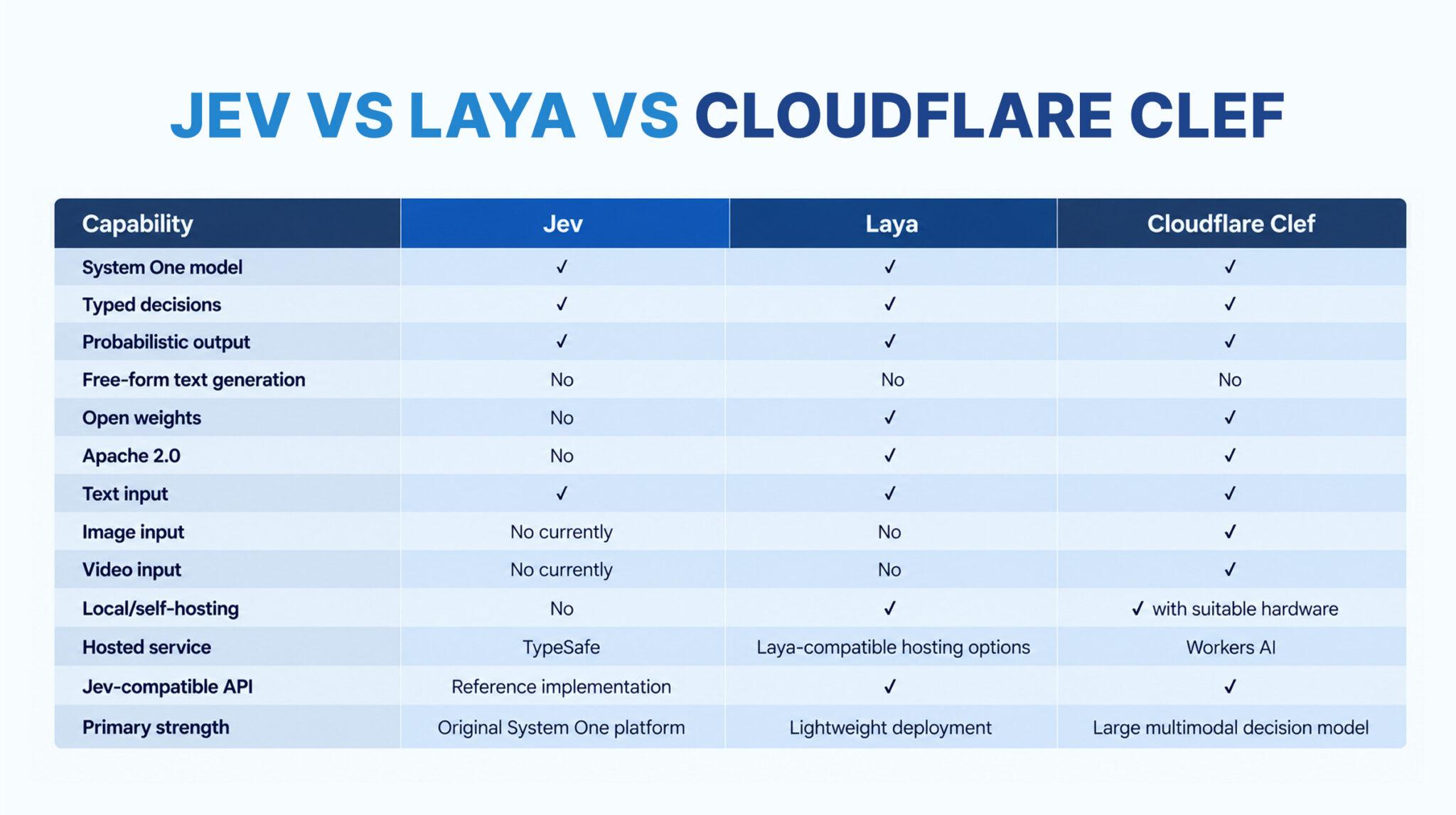
The table is useful, but it doesn’t tell the whole story. The real differences appear when you look at architecture, deployment, latency, and workload requirements.
Architecture: Jev vs Laya vs Clef
Jev
Jev is designed as a purpose-built System One Decision Model that uses a parallel decision process rather than conventional autoregressive text generation. Its basic workflow starts with the application state and a set of typed questions, evaluates the available answers in parallel, and returns structured decisions with associated probabilities. TypeSafe describes Jev as combining a new model architecture, a parallel sampler, and Reinforcement Learning for Calibrated Decisions (RLCD) training to support calibrated decision-making. The goal is to produce outputs that software can consume directly rather than responses designed primarily for human reading. (TypeSafe AI)
Laya
Laya takes a lighter, encoder-based approach to decision-making. Its published English checkpoint uses ModernBERT-large and has approximately 421 million parameters, with a decision-oriented architecture designed to evaluate input and return typed outputs. This makes Laya worth considering for workloads that do not require a very large model, particularly when deployment efficiency and infrastructure costs are important. Its practical architecture can be understood as a text-processing pipeline in which the input state passes through an encoder, a decision head evaluates the relevant options, and the model returns a structured result. For focused classification and routing tasks, this approach can offer an efficient alternative, provided that its accuracy meets the application’s requirements. (Laya AI)
Clef
Clef extends the System One approach into a larger model architecture. Cloudflare describes Clef as using a Qwen-based model that has been post-trained for decision-oriented workloads. The model family also incorporates a vision encoder, allowing Clef to evaluate visual information alongside other input when supported by the relevant model and interface. This expands the range of application states that can inform a decision beyond text alone. (Cloudflare Blog)
For example, a troubleshooting or security workflow could combine a screenshot with application logs and configuration state, then submit that context to Clef to assess a specific question. Potential applications include screenshot-based troubleshooting, visual security inspection, and document classification. The model’s output can then guide the next step in the workflow, such as routing an issue to the right team or requesting human review. As with other multimodal systems, results depend on the quality of the input, the supported interface, and how well the model performs on the target task.
Context Window and Input Types
One of the clearest differences between Jev, Laya, and Clef is the amount and type of information each model can process. Jev focuses on text-based decision-making through an interface that accepts application state and typed questions. Its documented interface does not currently indicate support for image or video inputs, making it a natural fit for applications where the relevant context can be represented as text. (TypeSafe API documentation)
Laya takes a more lightweight approach. Its published base English checkpoint documents a context length of 512 tokens, which may be sufficient for focused classification tasks but can constrain applications that need to evaluate larger amounts of context in a single request. Teams should distinguish the capabilities of this specific checkpoint from those of other model variants or implementations when evaluating deployment options. (Laya model documentation)
Clef offers a different set of capabilities. Cloudflare documents a 64K-token context window and support for text, JSON, images, and video. Its documentation also specifies support for up to four embedded images per request within the applicable limits. This broader context capacity and multimodal support make Clef worth evaluating for applications that need to combine several sources of information when making a decision. (Cloudflare Workers AI documentation)
These differences have practical implications for model selection. For a short support ticket or a narrow classification task, Laya may provide sufficient capability without requiring a larger model. If an application needs to evaluate extensive logs, configuration details, or other application state within a single request, Clef’s larger context window may be more suitable. For workflows that depend on visual information, such as analyzing screenshots alongside logs, Clef has an advantage over the currently documented text-focused approaches of Jev and Laya.
However, a larger context window does not automatically guarantee better decisions, and multimodal support is useful only when the application needs those inputs. The best choice depends on the actual workload, including the volume of context, required input formats, decision accuracy, latency, and deployment constraints.
Speed: Which System One Model Is Faster?
Latency is one of the strongest arguments for using System One Decision Models, particularly in applications where decisions sit directly in the critical path of an automated workflow. A support ticket may need to be routed immediately, a security event may require rapid classification, or a deployment pipeline may need a decision before proceeding to its next stage. In these scenarios, the time required to produce a result can be just as important as the quality of that result.
Cloudflare published benchmark results based on 43 runs, reporting median latencies of 209.3 milliseconds for Clef, 38.8 milliseconds for Clef-flash, and 524.1 milliseconds for Jev. The corresponding reported p95 latencies were 238.6 milliseconds, 122.4 milliseconds, and 536.0 milliseconds, respectively. These figures come from Cloudflare’s own benchmarking and should be treated as vendor-reported results rather than universal production performance. Actual latency can vary with hardware, network conditions, input length, concurrency, serving configuration, and the specific workload being evaluated. (Cloudflare Blog)
Within those reported measurements, Clef-flash has the lowest median latency, making it an interesting candidate for applications with tight response-time requirements. Clef offers a larger model for workloads that may benefit from additional capacity, while Jev provides TypeSafe’s managed decision-model approach. However, these figures alone do not establish which model will perform best for a particular application, because latency must be evaluated alongside decision quality and calibration.
Laya approaches the problem from a different direction. Its lightweight encoder-based architecture is designed to support efficient local inference, and the project’s published information reports millisecond-scale inference on suitable hardware. The actual result depends on the hardware, implementation, and workload, so teams should measure performance in their intended deployment environment rather than assume a particular latency.
This is why comparing models by parameter count alone can be misleading. A 421-million-parameter encoder running locally may be attractive for a narrow classification task, while a 9-billion-parameter model served at the edge may suit a different workload. A larger 27-billion-parameter model may also be justified when its decision quality and contextual capabilities provide enough value to offset the additional inference cost.
The practical choice comes down to the workload’s latency budget, infrastructure, and accuracy requirements. Before selecting a model, benchmark representative inputs under realistic concurrency and measure median and p95 latency, decision accuracy, calibration, resource consumption, and total cost. A fast response is useful only if the decision is reliable enough for the application that consumes it.
What About Accuracy?
Comparing the decision quality of Jev, Laya, and Clef is more complicated than comparing their architectures or latency figures. There is no single, universal measure of System One accuracy that determines which model is best for every application. A model may perform exceptionally well on one classification task and struggle with another, depending on the input data, question design, answer options, and decision boundaries. The most meaningful evaluation is therefore the one that reflects the decisions your application actually needs to make.
Cloudflare published benchmark comparisons in which Clef outperformed Jev on several evaluated tasks. For example, Cloudflare reported a score of 98.47 for Clef on BFCL case exact, compared with 95.75 for Jev. On BANKING77, Clef achieved a reported macro-F1 score of 94.20, compared with 79.74 for Jev. However, Cloudflare also reported evaluations, including When2Call and BRIGHT, where Jev performed better than Clef. These results illustrate that relative performance can change significantly across tasks, even when the models share the same decision-oriented interface. (Cloudflare Blog)
This is why benchmark tables need context. A model is not automatically the best choice because it leads on one benchmark, and published results should not be treated as a guarantee of production performance. The more useful question is: How well does the model perform on the decisions your system actually needs to make?
For an enterprise team, answering that question starts with building a representative evaluation dataset drawn from real or carefully validated application scenarios. For example, a team could assemble 500 support tickets, 500 security events, 500 infrastructure incidents, and 500 FinOps decisions, with each example labeled according to the expected outcome. The dataset should reflect normal cases as well as ambiguous inputs, rare events, incomplete information, and scenarios where the correct outcome is to request human review.
Each candidate model should then be evaluated against the same dataset using several metrics, including decision accuracy, probability calibration, false-positive and false-negative rates, median and p95 latency, inference cost, failure behavior, and confidence distribution. For security and infrastructure automation, the team should pay particular attention to the consequences of incorrect decisions. A false positive that sends an event for manual review may create additional work, while a false negative that allows a malicious request or unsafe deployment to proceed may carry a much higher operational cost.
This evaluation provides a more reliable basis for an architecture decision than a leaderboard comparison alone. It also helps teams determine whether a single model can handle their workload or whether different decision models are better suited to different tasks. Ultimately, the best System One Decision Model is the one that delivers the required accuracy, calibration, latency, and operational reliability under the conditions in which the application will actually use it.
The Importance of Calibration
System One models are interesting not only because they return structured answers, but also because they emphasize probability and uncertainty. Instead of returning only a classification, a model can provide a probability associated with its answer, giving the application additional information to consider when deciding what to do next.
Suppose three models classify the same security event as potentially malicious. Jev returns a probability of 0.96, Laya returns 0.81, and Clef returns 0.93. These values can help a security workflow distinguish between decisions that warrant immediate action and those that need further investigation. However, the numbers are useful only if they are reasonably calibrated. A model reporting a probability of 0.90 should be correct approximately 90% of the time across a sufficiently large set of comparable predictions for that confidence level to be interpreted reliably. A high probability alone does not guarantee that an individual prediction is correct.
An enterprise security workflow can translate these assessments into predefined operational responses. For example, a probability above 0.95 might trigger an automatic block, a result between 0.80 and 0.95 might send the event into quarantine for investigation, and a result below 0.80 might allow the request while continuing to monitor its activity. These thresholds are illustrative rather than universal; production thresholds should be established through validation against real security data, risk tolerance, and the consequences of false positives and false negatives. Depending on the application, a low-confidence result may also require human review rather than automatic approval.
TypeSafe positions calibrated confidence as a defining characteristic of System One models, while Cloudflare describes Clef as being trained for decision-oriented workloads with probability calibration as part of its approach. (TypeSafe AI, Cloudflare Blog)
This introduces an important architectural boundary for enterprise automation. The model assesses the available evidence and estimates the likelihood of a particular outcome. The policy layer interprets that assessment according to business rules, security requirements, and authorization constraints. The execution layer then carries out only the actions that have been permitted. Keeping these responsibilities separate makes automated decisions easier to test, govern, and audit.
AI should estimate. Policy should authorize. Software should execute.
Which Model Is More Open?
One of the clearest differences between Jev, Laya, and Clef is how they are licensed, deployed, and operated. Jev is a hosted model from TypeSafe, and its model weights are not publicly released. Applications access Jev through TypeSafe’s API, allowing teams to use its decision-model capabilities without managing the model infrastructure themselves. This approach can reduce operational overhead, although it means relying on the provider’s service, availability, and deployment options. (TypeSafe AI)
Laya takes an open-source, self-hosting approach. Its published model is released under the Apache 2.0 license and can be downloaded for local deployment. This gives engineering teams greater control over where inference runs and how the model is integrated into their infrastructure. It can be particularly attractive to organizations that prioritize local execution, infrastructure ownership, or control over model deployment, provided they have the resources to operate and maintain it. (Laya AI)
Clef combines open model weights with a managed inference option. Cloudflare has released Clef and Clef-flash under the Apache 2.0 license on Hugging Face while also making them available through Workers AI. This gives teams the flexibility to evaluate self-hosting or use Cloudflare’s hosted infrastructure, depending on their operational and deployment requirements. The availability of open weights does not eliminate the need to assess hosting costs, hardware requirements, security controls, and ongoing model maintenance. (Cloudflare Blog)
These approaches represent three distinct deployment philosophies. Jev provides managed decision intelligence through a hosted service, Laya emphasizes lightweight self-hosted decision intelligence, and Clef combines larger open-weight models with a managed inference option. None is universally better. The right choice depends on how much infrastructure your team wants to operate, the level of control it requires, its data residency and compliance obligations, and the performance it needs to achieve in production.
What Does “Jev-Compatible” Mean?
An important development in this ecosystem is API compatibility.
Cloudflare explicitly says Clef follows the System One API and is compatible with Jev integrations. Its documentation states that an existing Jev integration can be switched to Clef by changing the endpoint and model. Cloudflare Docs
Laya also provides a Jev-compatible API. Its documentation describes the same basic POST /v1/systemone request format, allowing applications built against the Jev interface to use Laya with changes primarily around the endpoint. Laya AI
That matters because an API-compatible ecosystem reduces switching costs.
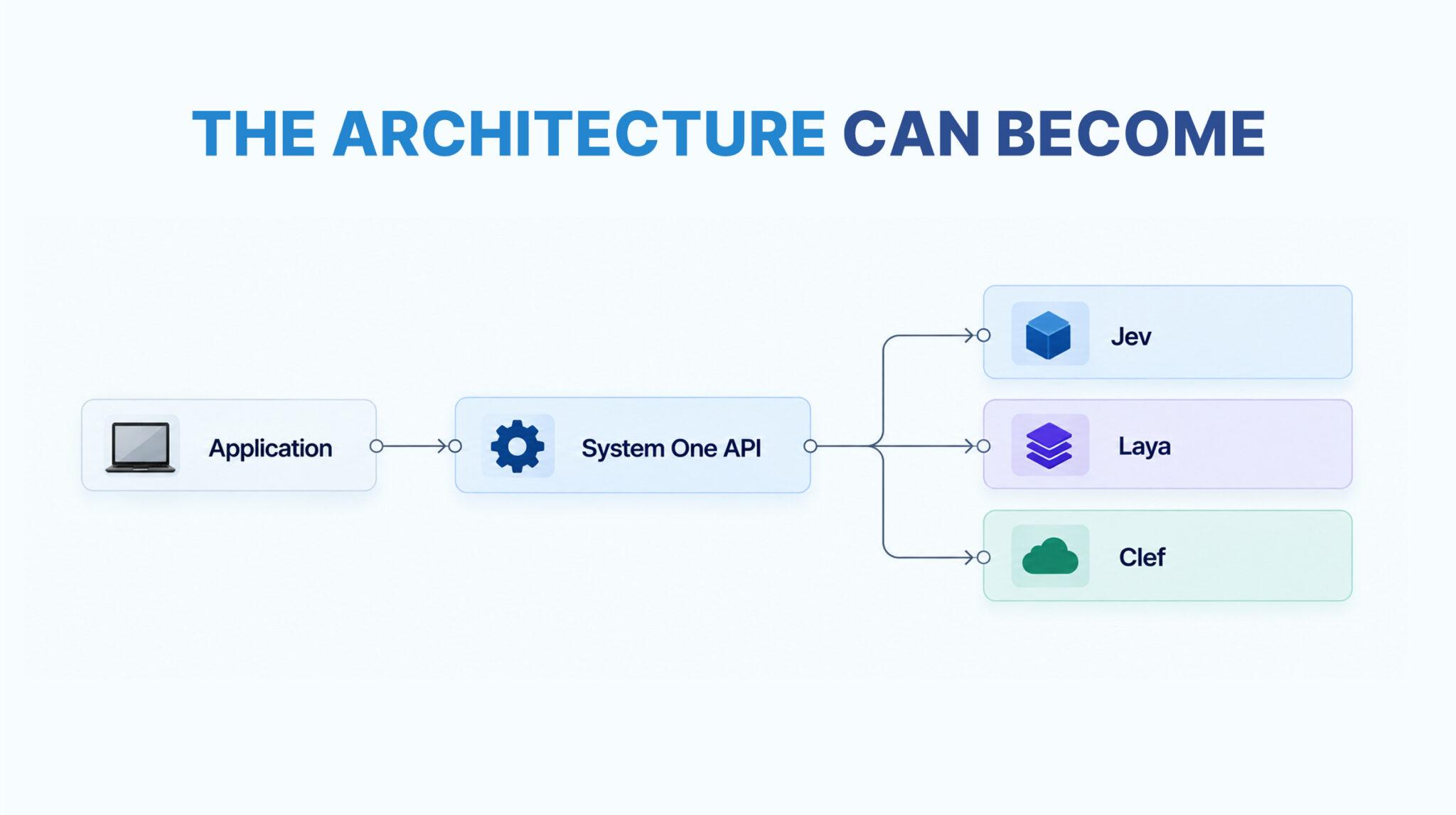
Instead of rebuilding the application whenever a new decision model becomes available, teams can evaluate different providers behind a similar interface. That could become one of the most important developments in the category.
When Should You Choose Jev?
Jev is particularly interesting when you want the original System One platform and a managed service focused specifically on machine-oriented decisions.
It may be a good fit when:
- You want TypeSafe’s hosted model.
- You don’t want to manage model infrastructure.
- Your workloads are primarily text-based.
- Calibrated decisions are central to the application.
- You want to build directly around the reference System One API.
- You value the original System One ecosystem.
TypeSafe also positions Jev for workflow automation, routing, scoring, verification, guardrails, and real-time applications. TypeSafe AI
The main trade-off is control.
You are depending on a hosted proprietary model rather than downloading and operating the model yourself.
When Should You Choose Laya?
Laya becomes particularly attractive when deployment efficiency matters as much as model capability. Its relatively small model architecture makes it worth evaluating for local inference, CPU-friendly deployments, edge applications, high-volume classification, privacy-sensitive workflows, narrow domain routing, and cost-conscious automation. It may also appeal to teams that want access to open model weights and greater control over how decision-making is deployed within their infrastructure.
For example, an internal engineering platform could receive a GitHub event, pass the relevant metadata to an internal service, and use Laya to determine whether the event requires a security review, should trigger a CI/CD workflow, or needs further investigation. The resulting decision could then be passed to the appropriate workflow without requiring a request to an external model provider for every classification. This architecture can be useful when an organization processes large volumes of routine events and wants to keep decision-making close to its existing services.
Running Laya locally can also simplify certain privacy and data-residency requirements because the organization can control where inference takes place and which data leaves its environment. However, local deployment does not automatically guarantee privacy or compliance. Teams still need to evaluate logging practices, access controls, network boundaries, model updates, infrastructure security, and the handling of sensitive information across the entire workflow. They should also benchmark the model against their actual workload to confirm that its decision quality and latency meet production requirements.
When Should You Choose Cloudflare Clef?
Clef becomes especially interesting when an application needs larger context, multimodal input, open model weights, or hosted inference through Cloudflare. Its combination of a larger decision model and flexible deployment options makes it a candidate for enterprise teams that need to evaluate substantial application state or incorporate visual information into automated decisions. It is particularly worth considering if your organization already uses Cloudflare Workers AI, wants to experiment with self-hosting, or needs compatibility with Jev-style decision interfaces.
Clef may be a good fit when an application needs to analyze images or video alongside text, process larger amounts of context, or use a larger decision model than a lightweight encoder-based approach. Teams with strict latency requirements can also evaluate Clef-flash, while organizations interested in deployment flexibility can explore the available open weights. As with any model choice, these capabilities should be assessed against the application’s accuracy, latency, cost, security, and operational requirements rather than treated as automatic advantages for every workload.
The multimodal capability is particularly significant for infrastructure and operations workflows. Imagine an incident-response system that receives a screenshot of a Grafana dashboard alongside application logs and deployment metadata. Instead of evaluating only the textual logs, a compatible Clef workflow could use the screenshot and accompanying context to classify the incident and return a structured decision. That decision could then determine whether to create an incident ticket, notify the on-call engineer, or request further investigation.
This creates a workflow in which visual evidence, operational data, and typed questions contribute to the same decision process. Cloudflare identifies its vision encoder as one of Clef’s distinguishing features, expanding the range of inputs that can inform a decision. By contrast, the currently documented Jev and Laya approaches discussed here focus on text-based decision-making and do not provide the same documented multimodal input capabilities. (Cloudflare Blog)
For teams building multimodal automation, Clef therefore offers an important capability to evaluate. Its suitability will still depend on whether the relevant input formats are supported by the chosen interface, whether the model interprets the evidence accurately, and whether its decisions meet the reliability requirements of the production workflow.
System One Models vs Generative LLMs
The most important comparison is not necessarily Jev versus Laya versus Clef. It is System One Decision Models versus generative AI, because that distinction determines how each technology fits into an application’s architecture.
Generative large language models remain the right choice for many tasks that require flexible reasoning or language generation. They can investigate an incident, explain a failure, generate code, summarize documentation, explore open-ended problems, develop remediation plans, and interact with users conversationally. These tasks benefit from a model’s ability to interpret complex instructions and produce detailed responses that are not restricted to a predefined set of answers.
System One Decision Models serve a different purpose. They are designed for bounded decisions that software needs to consume in a structured format. Typical applications include classifying events, routing tickets, scoring risk, verifying conditions, selecting among predefined options, detecting specific patterns, evaluating application state, branching workflows, and determining whether an action requires approval. Rather than asking the model to explain everything it has inferred, the application defines the decision it needs and receives a typed answer.
The strongest architecture often combines both approaches instead of expecting one model to handle every task. An application can first collect the relevant state and submit it to a System One Decision Model for an initial assessment. If the result indicates that deeper investigation is necessary, the workflow can invoke a generative LLM to analyze logs, explain a failure, or develop a remediation plan. The resulting recommendation can then pass through policy checks, authorization requirements, and any necessary human approval before controlled execution.
For example, a DevOps workflow could use a decision model to determine whether a deployment failure requires escalation. If further investigation is needed, a generative LLM could examine deployment logs, recent code changes, and infrastructure metrics to identify likely causes. The workflow would then evaluate the proposed remediation against established policies and execute only the actions that have been authorized.
This division of responsibilities makes the architecture more modular. Decision models handle bounded assessments, generative models handle deeper reasoning and explanation, and application logic governs execution. Each component can be evaluated against the requirements of its particular task rather than relying on a single model to make every decision, explain every outcome, and perform every action.
Where GRiPO Fits
This architecture maps naturally to enterprise workflow automation because each component has a distinct responsibility. A System One Decision Model answers “Should this happen?” by evaluating application state against defined questions and returning a structured decision. An AI agent addresses “Why is this happening, and what should we investigate?” by examining logs, metrics, configuration changes, and other relevant context to identify potential causes and recommend next steps. The workflow engine then determines “How do we execute the approved action?” by coordinating integrations, checking prerequisites, requesting human approval when required, and managing the sequence of operations. Finally, a sandbox answers “Where can we safely execute the code or infrastructure command?” by providing an isolated environment in which scripts, CLI tools, or other operations can run under defined security and resource constraints.
Together, these components create a more controlled approach to automation. The decision model assesses the situation, the AI agent investigates when deeper reasoning is needed, the workflow engine enforces the approved process, and the sandbox provides a controlled execution environment. For example, a cloud operations workflow could detect a sudden increase in infrastructure costs, use a decision model to determine whether the anomaly warrants investigation, ask an AI agent to identify potentially underutilized resources, and route a proposed cleanup through policy checks and human approval. Once authorized, the workflow could execute the cleanup in the appropriate environment and verify the result.
This is where GRiPO fits naturally into the architecture. Its visual workflow builder, AI agents, plugin integrations, and sandboxed code execution can connect investigation, decision-making, approval, execution, and verification into a single workflow. Rather than treating an AI-generated recommendation as permission to act, teams can design explicit controls around how decisions become operational changes. That separation is particularly valuable in enterprise environments where security, auditability, and reliable execution matter as much as automation speed.
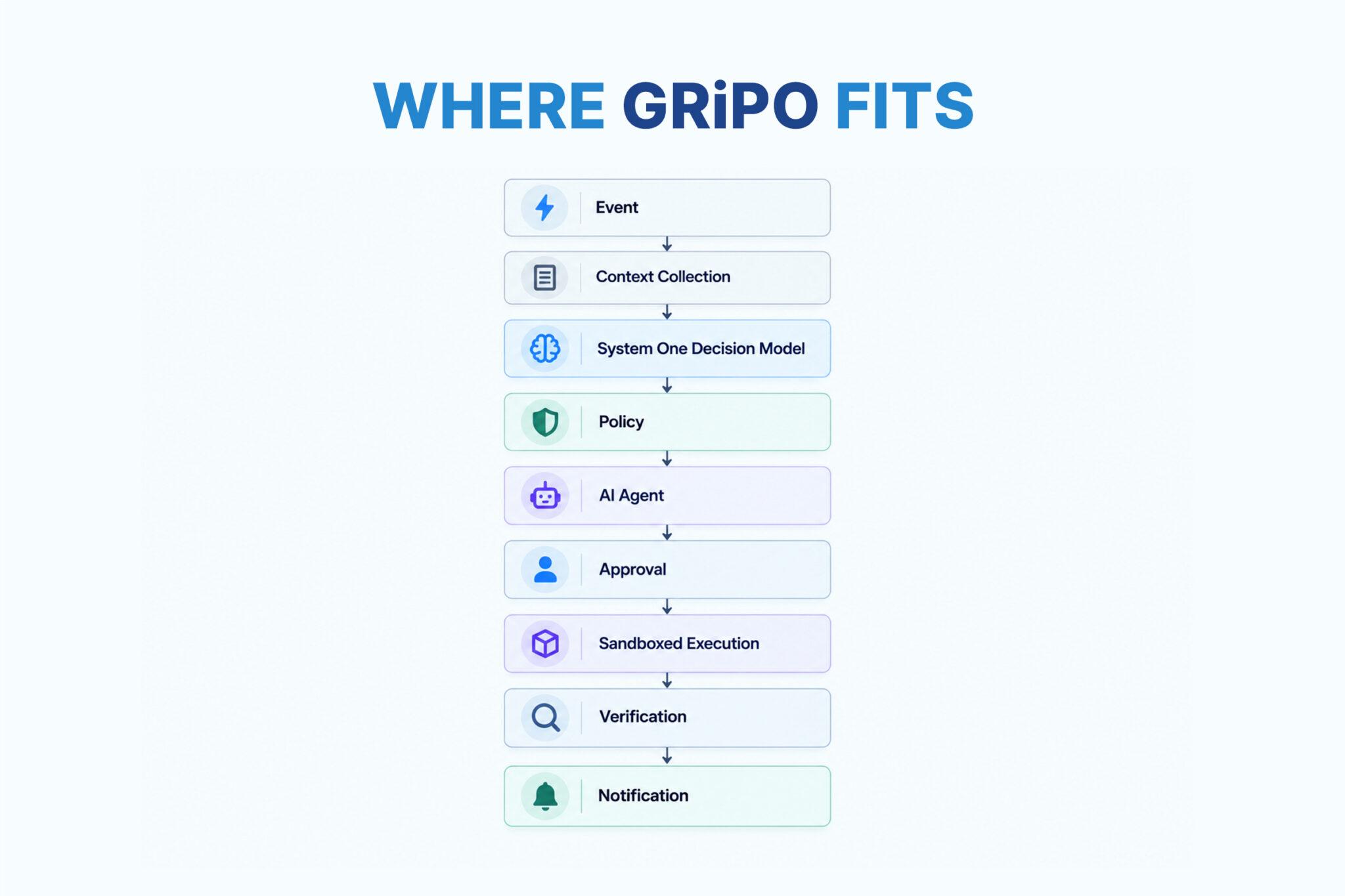
This is where GRiPO can fit into the broader System One architecture.
GRiPO provides visual workflow orchestration, isolated code execution, AI agents, and plugins that connect automation to external systems. Instead of giving a decision model direct authority over production infrastructure, the model can become one controlled decision layer inside a larger workflow.
For example, a Kubernetes incident could trigger a GRiPO workflow that collects cluster information, deployment history, logs, and metrics. A System One model could classify the incident and determine whether human approval is necessary. An AI agent could then investigate further, while GRiPO’s sandbox provides an isolated environment for executing diagnostic commands or approved remediation steps.
The important principle is that the model doesn’t have to own the workflow.
It can provide intelligence to the workflow.
That separation is especially useful for enterprise environments where authorization, auditability, secrets management, and controlled execution matter as much as the model’s accuracy.
A Practical Selection Framework
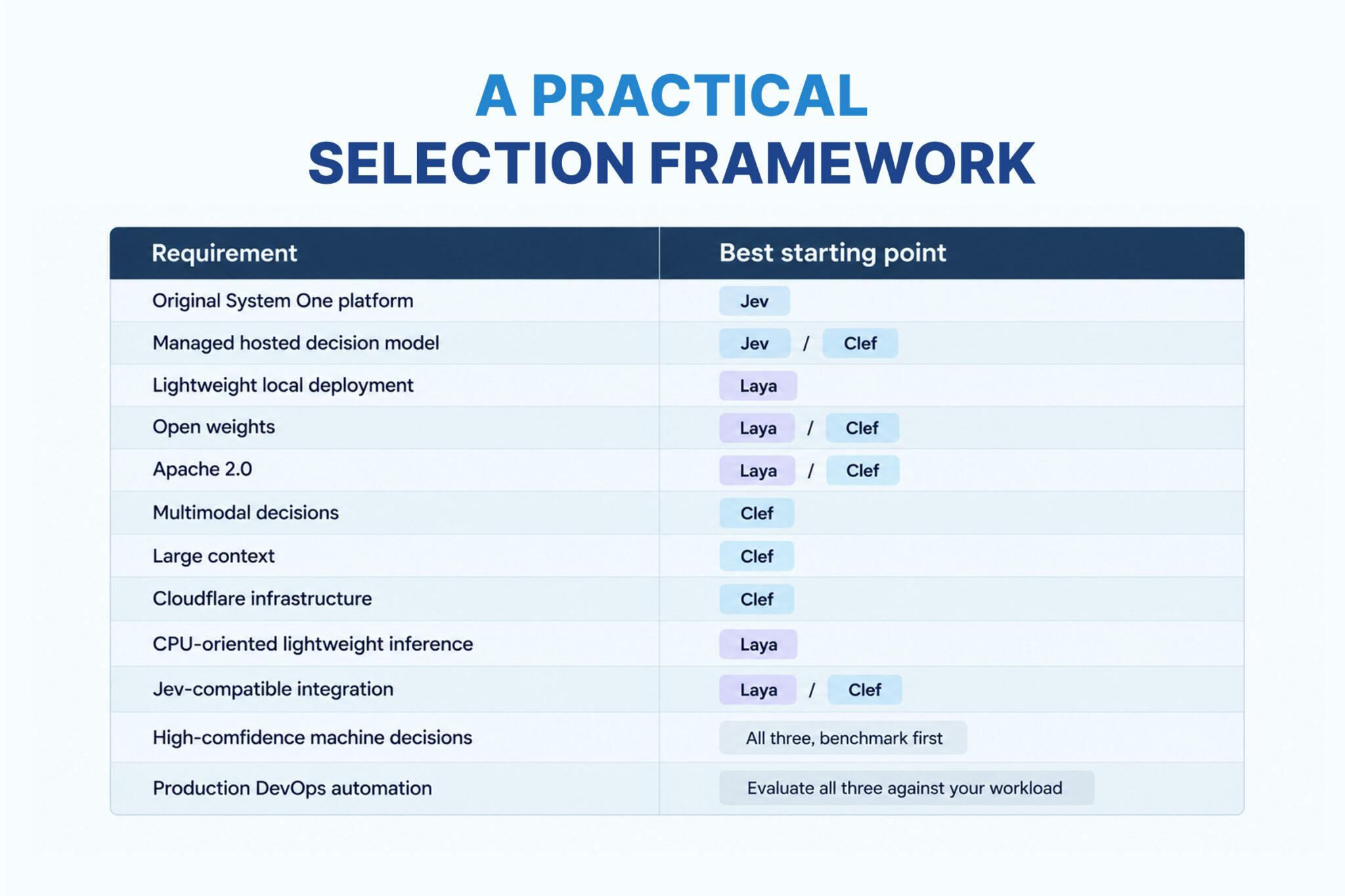
This isn’t a universal ranking. It’s a starting point for architecture evaluation.
How to Evaluate Them for Production
Before putting a System One Decision Model into a production workflow, build an evaluation set from real decisions made by your application. Start with your own data, not generic benchmarks. Public benchmarks can help narrow the options, but they cannot tell you how reliably a model will perform on your specific incidents, policies, infrastructure, and operational constraints.
For example, if you’re building an incident automation system, collect several hundred historical incidents and label each one with its severity, responsible team, likely root-cause category, appropriate remediation path, approval requirements, and final outcome. Include routine incidents alongside ambiguous cases, incomplete records, unusual failure patterns, and incidents that required human judgment. Then evaluate Jev, Laya, and Clef against the same dataset using consistent questions, expected answers, and evaluation criteria.
Start with accuracy: did the model select the correct decision? Next, assess calibration by checking whether predictions assigned a confidence of approximately 90% are correct about 90% of the time across a sufficiently large set of comparable cases. Measure latency at both the median and p95 to understand typical response times and slower decisions under realistic conditions. Evaluate cost using your expected production volume, including inference charges and the infrastructure required to operate a self-hosted model. Finally, test failure behavior by examining how each model responds to incomplete, ambiguous, contradictory, or out-of-scope inputs. A reliable system should have a defined way to handle uncertainty rather than forcing every input into an automatic decision.
Operational control deserves equal attention. Your application should be able to record the decision, model and version, returned probabilities, relevant input references, policy thresholds, approval status, and resulting action. Where sensitive data is involved, logging should follow appropriate access controls, retention limits, and data-minimization practices. This information makes it possible to investigate incorrect decisions, compare model versions, detect performance degradation, and explain why an automated action occurred.
A model is not production-ready simply because it performs well on a benchmark. It is ready for consideration when it performs reliably on representative application data, behaves appropriately when uncertain, meets operational requirements, and fits within a controlled execution architecture. For high-impact decisions, begin in shadow mode or require human approval, compare the model’s recommendations with actual outcomes, and expand automation only after the evidence supports doing so.
The Bigger Idea Behind System One Decision Models
Jev, Laya, and Clef are different implementations, but they represent the same broader architectural shift. For years, developers have primarily interacted with AI through a text-generation interface in which an application sends input to a model and receives a generated response. System One Decision Models introduce a different abstraction that is often more suitable for automation: application state goes in, a focused question is evaluated, and a structured decision comes out.
This is a more natural fit for many software workflows because applications frequently need a specific answer rather than an explanation. A CI/CD pipeline does not need an essay about whether a deployment should proceed; it needs a structured result such as approved: yes. A security gateway does not necessarily need a paragraph explaining an API request; it may need an assessment such as action: block accompanied by a probability of 0.96. Similarly, a FinOps workflow does not need a generated report before every resource-management action. It may need to determine whether a resource appears wasteful, which optimization category applies, and whether human approval is required.
These decisions can become inputs to ordinary application logic, policy checks, and controlled execution. The model assesses the available state, the application interprets the result according to established rules, and authorized workflows carry out the appropriate action. This does not eliminate the need for generative AI, particularly when a system must investigate unfamiliar failures, explain complex situations, or develop remediation plans. Instead, it gives developers another tool that better matches the requirements of bounded decision-making.
That is why System One Decision Models are worth watching. Their significance is not simply that they produce structured outputs faster or more conveniently. They represent an effort to make AI a more predictable, measurable, and useful component inside software systems. As the ecosystem develops, their value will depend on how reliably they perform real decisions, how well their probabilities are calibrated, and how effectively they integrate with the policies and execution controls that enterprise applications require.
The goal is not to make language models better at writing every answer. It is to make AI more useful as a component inside software.
The Bottom Line
Jev, Laya, and Cloudflare Clef are not simply three competing LLMs. They represent different approaches to the emerging System One Decision Model category, which focuses on producing structured, machine-readable decisions rather than free-form text. Jev established the category and emphasizes calibrated, machine-oriented decisions through a managed platform. Laya demonstrates how a similar decision-oriented approach can be implemented with a much smaller open model, making lightweight and local deployment more practical. Cloudflare Clef extends the category toward larger, multimodal decision models, with open weights, a documented 64K-token context window, and integration with Cloudflare’s infrastructure.
The right choice depends on the workload and the constraints surrounding it. Laya may be attractive for lightweight local classification, while Jev is a natural starting point for teams seeking TypeSafe’s managed System One experience. Clef deserves serious evaluation when an application needs multimodal inputs, a larger context window, open model weights, or inference through Cloudflare Workers AI. These are starting points rather than universal recommendations, however. Teams should compare the models using representative production data and assess decision quality, calibration, latency, cost, security, and operational requirements before committing to one.
More importantly, choosing a model should begin with understanding what the software actually needs. If an application needs an explanation, a generative model may be the right tool. If it needs to investigate an unfamiliar incident, an AI agent or LLM can analyze the available evidence and develop possible explanations. If it needs a bounded decision, such as classifying a security event or determining whether a deployment requires approval, a System One Decision Model may provide a more natural interface.
When a decision can trigger a real-world action, the architecture matters just as much as the model. The model should assess the available information, while policy and authorization layers determine which actions are permitted. Controlled execution, appropriate approval requirements, and post-action verification then help ensure that the workflow behaves as intended. This separation reduces the risk of treating a model’s prediction as unrestricted permission to act.
For DevOps, SecOps, FinOps, and enterprise automation teams, that is the most promising aspect of System One Decision Models. They offer another way to integrate AI into software: not only as a system that generates explanations or recommendations, but also as a component that evaluates defined questions and returns decisions that applications can test, govern, and use within controlled workflows.
FAQ Section
What are System One Decision Models?
System One Decision Models are AI models designed to evaluate application state against typed questions and return structured decisions with probabilities instead of generating free-form text. The category was introduced publicly by TypeSafe alongside Jev in September 2026. TypeSafe AI
What is Jev?
Jev is TypeSafe AI’s first System One Decision Model. It is designed to return typed decisions and probabilities that software can use directly instead of generating natural-language responses. TypeSafe AI
What is Laya AI?
Laya is an open-source System One Decision Model based on ModernBERT-large. Its published English checkpoint has approximately 421 million parameters and is released under Apache 2.0. Laya AI
What is Cloudflare Clef?
Cloudflare Clef is an open-weight decision model designed to evaluate application state against typed questions and return probabilities for allowed answers. Cloudflare offers Clef and Clef-flash through Workers AI and has released their weights under Apache 2.0. Cloudflare Blog
Which is better: Jev, Laya, or Clef?
There isn’t a universal winner. Laya is attractive for lightweight open deployment, Jev for the original managed System One platform, and Clef for larger-context and multimodal decision workloads. Teams should benchmark all relevant candidates against their own production data.
Is Clef compatible with Jev?
Yes. Cloudflare says Clef follows the System One API and is compatible with Jev integrations. Existing applications can be migrated by changing the endpoint and model configuration. Cloudflare Docs
Can Laya run locally?
Yes. Laya is released as an open model and is designed for local inference. Its published model information describes deployment options including CPU and GPU environments. Laya AI
Can Clef process images?
Yes. Cloudflare’s current documentation describes Clef as multimodal, supporting text, JSON, images, and video. Cloudflare Docs
Are System One models replacements for LLMs?
No. System One models are specialized for bounded decisions. Generative LLMs remain better suited to open-ended reasoning, explanation, code generation, summarization, and conversational tasks. The two approaches can be combined in the same application.
Why return probabilities instead of only an answer?
Probabilities allow application logic to account for uncertainty. A workflow can automatically execute high-confidence decisions while sending uncertain cases for additional checks or human review.
Are System One models deterministic?
No. Their outputs are bounded and structured, but the underlying models still make probabilistic judgments. Production systems should use confidence thresholds, policies, authorization, testing, and fallback paths.
Are benchmark results enough to choose a decision model?
No. Benchmarks are useful for comparison, but production evaluation should include your own data, latency requirements, calibration, failure modes, cost, and the consequences of incorrect decisions. Cloudflare’s published comparisons, for example, are vendor-run evaluations. Cloudflare Blog
Key Takeaways
- System One Decision Models are designed for machine decisions rather than generated prose.
- Jev introduced the System One terminology publicly with TypeSafe in September 2026. TypeSafe AI
- Laya demonstrates a much smaller, open-source approach using ModernBERT-large. Laya AI
- Cloudflare Clef brings the category to larger multimodal models with open weights and Workers AI hosting. Cloudflare Blog
- Clef and Clef-flash support a 64K context window and multimodal inputs. Cloudflare Docs
- Clef and Laya are open-weight Apache 2.0 projects, while Jev is a proprietary hosted model. Cloudflare Blog
- Clef is Jev/System One API compatible, which can reduce migration friction. Cloudflare Docs
- System One models are especially useful when the application has complex input but bounded output.
- Generative LLMs remain valuable for reasoning, explanation, investigation, and generation.
- The strongest enterprise architecture can combine LLMs + decision models + policy + controlled execution.
- Model benchmarks should be treated as evidence, not as a substitute for testing against real production workloads.
- For DevOps automation, the most important boundary remains: model decision → policy → authorization → controlled execution.