
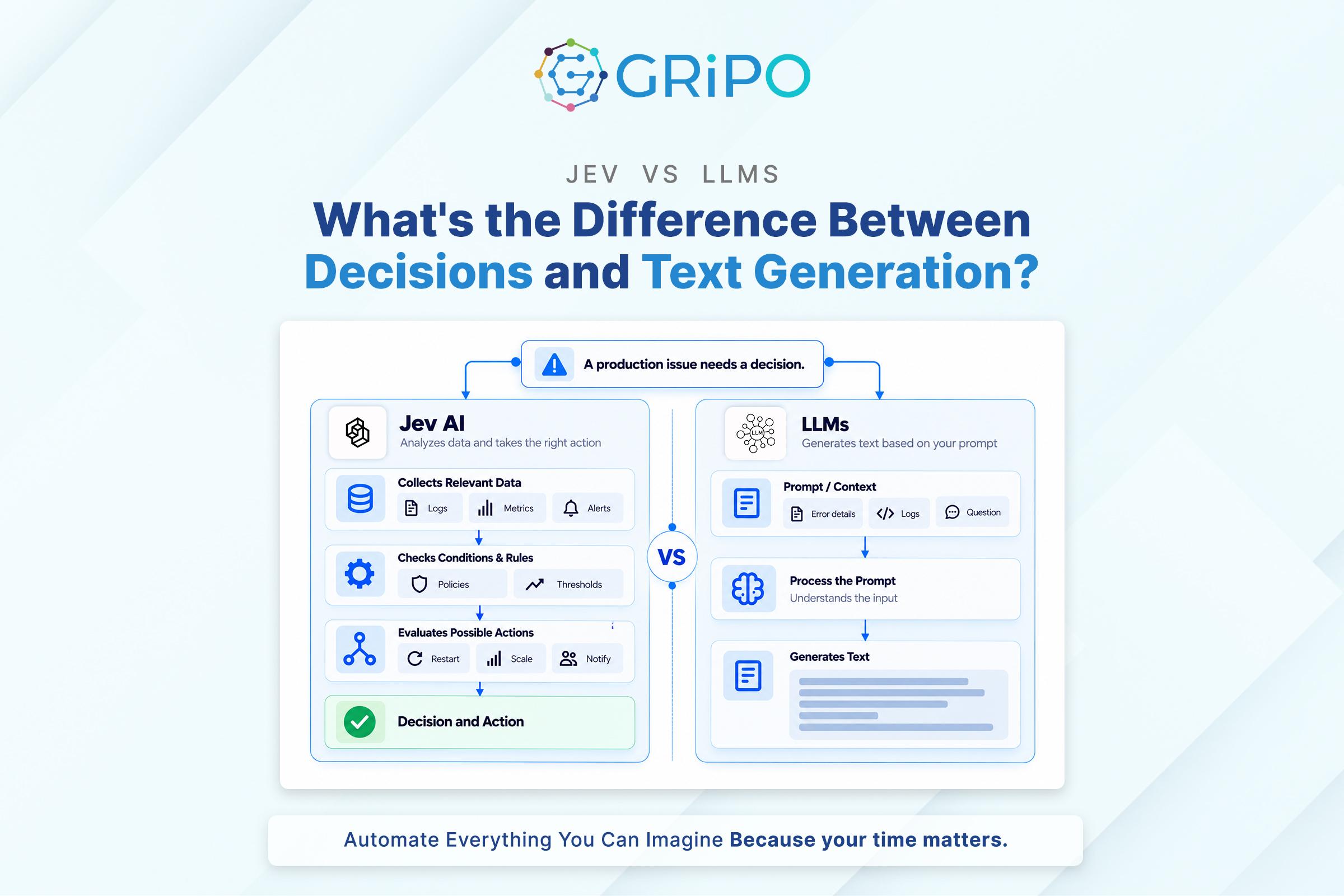
Artificial intelligence systems are increasingly being used to make decisions inside software applications, DevOps workflows, security systems, and automated infrastructure. But not every AI system is designed to solve the same type of problem.
A large language model (LLM) is primarily designed to understand and generate language. It can summarize logs, explain code, write documentation, interpret natural-language instructions, and generate responses based on context.
Jev AI approaches a different problem: structured decision-making. Instead of asking an AI system to generate a paragraph and then trying to interpret that response inside application logic, Jev allows an application to ask a focused question about its current state and receive a structured decision.
This distinction becomes particularly important when AI is used inside production automation. A workflow may need to determine whether a deployment should continue, whether a pull request requires security review, whether an infrastructure resource complies with policy, whether an automated remediation should run, whether an application state satisfies a specific condition, or whether an AI agent should be allowed to continue.
These aren’t necessarily text-generation problems. They’re decision problems, which is where understanding Jev AI vs LLM becomes useful. While the two technologies can work together within the same AI architecture, they serve different roles: LLMs are primarily designed to understand and generate language, while Jev AI is focused on evaluating context and producing structured decisions.
What Is Jev AI?
Jev is a decision-oriented AI system designed to evaluate application state and return structured answers to focused questions. Its basic model can be represented as State → Question → Decision → Action: an application provides relevant state, asks a specific question, receives a decision, and then uses that result as part of its application or workflow logic.
For example, consider a CI/CD pipeline that has collected information about a pull request. The pull request contains 14 changed files, includes security-sensitive files, contains no detected secrets, modifies production configuration, and was submitted by an external contributor.
Instead of asking a generative model, “What do you think about this pull request?”, the application can ask a bounded question such as, “Does this pull request require security review?”
Jev evaluates the available pull request state against that focused question and returns a structured decision. In this example, the result could be Security Review Required: Yes, allowing the workflow to route the pull request to the appropriate security review process.
The flow can therefore be summarized as PR State → Focused Question → Jev AI → Structured Decision → Workflow Action.
This is fundamentally different from generating a natural-language response and then requiring another part of the system to interpret that response before determining what action to take. With a decision-oriented approach, the AI output is designed to become part of the application’s control logic.
What Is an LLM?
A large language model (LLM) is a machine-learning model designed to process and generate human language. Modern LLMs can perform a wide range of tasks, including generating text, summarizing documents, explaining and writing code, translating languages, extracting information, answering questions, analyzing natural-language instructions, generating structured outputs, and assisting with reasoning tasks.
Models such as GPT, Claude, and Gemini are commonly used as general-purpose AI interfaces. For example, an LLM might receive a request such as, “Review this deployment failure and explain what happened.” It could respond with an explanation like, “The deployment appears to have failed because the Kubernetes deployment exceeded its readiness timeout. The application logs suggest that the database connection was not established within the configured period.”
This is useful because the output is primarily intended for a human or another language-processing system. The model is taking complex information and turning it into language that can be understood, reviewed, or processed further.
Production automation, however, often needs something different. A workflow may not need an explanation of what happened; it may need a precise result that can directly influence application logic. Instead of generating a paragraph, the system may need a structured decision such as:
{
  "should_retry": true
}
That’s where the distinction between text generation and structured decisions becomes important. An LLM is often used to understand, generate, and explain information, while a decision-oriented system can be used when application logic needs a clear, structured outcome that can directly drive the next action.
Jev AI vs LLM: The Fundamental Difference
The simplest way to understand the difference is to look at the intended output.
An LLM primarily answers:
“What should I say or generate based on this context?”
A decision-oriented system such as Jev answers:
“What decision should the application make based on this state and question?”
The difference isn’t that one system can reason while the other cannot. The key difference is how the intelligence is incorporated into the application.
An LLM can certainly be used for decision-making, but developers often need additional application logic to interpret the generated response, validate it, and translate it into a reliable action. A decision-oriented system starts with that application-level decision as the core interaction.
The LLM pattern typically uses context to generate a response that must be interpreted before the application can act. The Jev pattern evaluates application state against a focused question and returns a structured decision that application logic can use directly.
This distinction becomes particularly important when the result controls a workflow branch. If the output determines whether a deployment continues, a security review is triggered, a resource is remediated, or an AI agent is allowed to proceed, the application needs a predictable decision rather than a response that must first be interpreted.
Decisions vs Text Generation
Consider a simple infrastructure workflow in which a cloud monitoring system detects an unexpected change. The application needs to determine whether the affected resource should be investigated.
There are several ways to approach this decision.
Traditional Rules
A traditional rule-based system could use a condition such as: if CPU utilization is above 90% and the condition has lasted longer than 15 minutes, then investigate the resource.
This approach is deterministic, predictable, and easy to understand. However, as more factors are introduced such as resource type, deployment activity, environment, ownership, historical behavior, or business impact the number of conditions can grow quickly, making the rules harder to maintain.
LLM Approach
An application could instead provide the resource information to an LLM and ask: “Analyze this resource and determine whether it requires investigation.”
The model might respond: “Based on the CPU utilization, duration, recent deployment activity, and resource type, this resource appears to warrant further investigation.”
That response may be useful for a human, but the application still needs to reliably translate the generated language into a machine-actionable decision. Additional parsing, validation, guardrails, or application logic may be required before the workflow can safely act on the result.
Jev Approach
With Jev, the application can provide the relevant resource state and ask a focused question: “Does this resource require investigation?”
Jev evaluates the available state against the question and returns a structured decision that can directly participate in workflow logic. If the result is Yes, the workflow can branch to an investigation process. If the result is No, the workflow can follow the appropriate alternative path.
The pattern can therefore be summarized as Resource State → Focused Question → Jev Decision → Workflow Branch.
This is the key architectural distinction: traditional rules encode explicit conditions, LLMs generate responses that may require interpretation, while a decision-oriented system such as Jev is designed to evaluate application state and return a structured decision that can directly influence the next step in a workflow.
Jev AI vs LLM Comparison
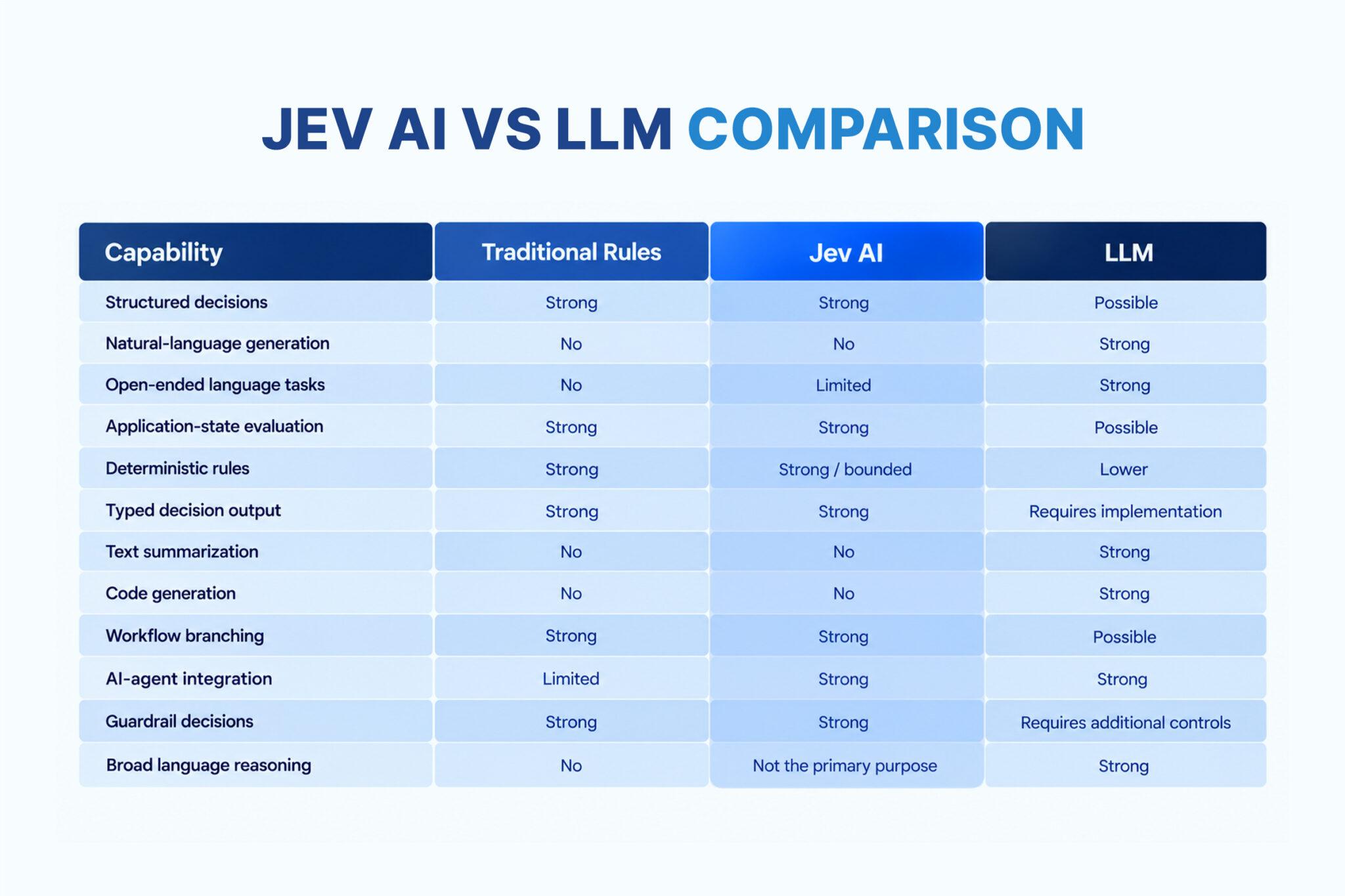
The table highlights an important point:
Jev and LLMs aren’t necessarily competing technologies.
They can occupy different layers of the same system.
Why Use an LLM for Everything Isn’t Always the Best Architecture
LLMs are extremely flexible, and that flexibility is one of their greatest strengths. It is also one of the reasons developers need to think carefully about where and how they are used inside production systems.
Suppose an automated workflow needs to make a simple decision: “Is this deployment approved to continue?”
The workflow could provide the relevant context to an LLM and ask it to determine whether the deployment should proceed. However, once the model’s response becomes part of production control logic, the application needs to account for several questions: What information did the model use? How should its response be interpreted? What happens if the response contains additional text? How should uncertainty be handled? How should the output be validated? What happens if the model produces an unexpected format? Can the decision be reproduced? And how should the application handle changes in model behavior over time?
These concerns do not mean LLMs should not be used for decision-making. LLMs can be valuable when the problem requires language understanding, contextual interpretation, or complex reasoning.
The important point is that decision-making should be treated as an explicit application concern rather than assuming every AI task should be a text-generation task.
A bounded decision layer can make the architecture easier to reason about by separating the process of understanding context from the process of producing a structured outcome that application logic can act on.
Why Jev Isn’t a Replacement for LLMs
It would be a mistake to think of Jev as an alternative to every capability provided by an LLM. Jev isn’t intended to replace the broad language capabilities of generative AI. Instead, the two can complement each other by handling different parts of an AI-powered application.
An LLM is useful when a system needs to understand natural language, generate explanations, write or modify code, summarize incident reports, interpret documentation, communicate with engineers, analyze unstructured text, or produce human-readable reports.
For example, an AI agent investigating an incident might use an LLM to understand logs, correlate information from different sources, and generate an explanation of what happened. Jev can then provide a structured decision layer around that agent, helping determine what the application should do next.
Consider a remediation workflow. Logs, metrics, and deployment state are analyzed by an AI agent or LLM to understand the incident and provide the relevant context. Jev AI then evaluates that context and determines whether remediation should run. If the decision is Yes, the workflow executes the remediation. If the decision is No, the workflow stops or follows an alternative path.
This creates a clear separation of responsibilities: the LLM or AI agent handles understanding and generation, while Jev handles the structured decision that controls the workflow.
This hybrid architecture is often more useful than trying to make a single technology perform every job. Each component can focus on the type of problem it is best suited to solve.
Jev AI and LLMs Can Work Together
A production AI system can separate different responsibilities.
For example:
Layer 1 — Data
The first layer collects the information required to understand the current state of the system. This can include application state, logs, metrics, configuration, Git changes, cloud resources, security findings, and deployment information.
The goal is to gather the relevant context before a decision or analysis is made.
Layer 2 — Decision
The second layer focuses on structured application decisions. Jev can evaluate the available state and answer bounded questions such as:
- Is this deployment safe to continue?
- Is human approval required?
- Does this resource violate policy?
- Should remediation run?
The output of this layer can then determine which branch of the workflow should execute.
Layer 3 — Reasoning
The third layer handles deeper interpretation and generation. An LLM or AI agent can be used when the workflow needs to understand complex information, explain an issue, or generate a potential solution.
For example:
- Why did the deployment fail?
- What changed?
- What remediation should we consider?
- How should this code be modified?
This layer is where language understanding, reasoning, and generation are most useful.
Layer 4 — Execution
The final layer performs the approved action. Workflow automation and controlled execution environments can be used to carry out the result of the previous layers.
Depending on the workflow, execution might involve:
- Running a command
- Updating infrastructure
- Creating a Jira ticket
- Sending a Slack notification
- Opening a pull request
- Running validation
This creates a clear separation of responsibilities: data provides the context, Jev makes the structured decision, LLMs or AI agents provide deeper reasoning when needed, and the execution layer performs the approved action.
Jev AI as a Decision Layer for AI Agents
AI agents introduce another reason to separate decisions from text generation.
An AI agent may have access to:
- Shell commands
- Cloud APIs
- Kubernetes
- Git repositories
- Databases
- Internal services
- Credentials
- Deployment systems
That gives the agent significant operational capabilities.
The question then becomes:
Should the agent be allowed to perform this action?
An LLM can reason about the action, but production systems often need explicit control points around agent behavior. A decision layer can sit between the agent’s proposed action and the execution environment.
An AI agent proposes an action that Jev evaluates against policies and conditions. If approved, the action runs securely in a sandbox and is executed; if rejected, it is stopped or sent for human review.
This pattern is particularly relevant to AI agent security. The agent can remain flexible while the surrounding system establishes explicit decision points.
Jev AI vs LLM for DevOps Automation
DevOps automation contains both language-heavy and decision-heavy tasks. That’s why a hybrid architecture makes sense.
Tasks well suited to LLMs
An LLM can help:
- Explain deployment failures
- Summarize incidents
- Analyze logs
- Generate Terraform
- Write scripts
- Explain Kubernetes errors
- Create incident reports
- Suggest remediation approaches
Tasks suited to structured decision logic
A decision layer can help answer:
- Should the deployment continue?
- Is approval required?
- Is this change inside the allowed scope?
- Does the resource violate a policy?
- Should remediation execute?
- Should an alert be escalated?
- Is the environment eligible for automated changes?
The distinction can be summarized as:
LLM → Understand and generate
Jev → Evaluate and decide
Workflow → Orchestrate
Sandbox → Execute safely
Example: Pull Request Security Decision
Consider a security workflow that is triggered whenever a developer opens a pull request. The workflow collects relevant context, including the changed files, repository information, author information, security scan results, infrastructure changes, authentication-related changes, and existing repository policies.
The workflow then asks a focused question: “Does this pull request require security review?”
Jev can evaluate the available pull request state and provide the structured decision that determines what happens next.
For example, a GitHub pull request can be analyzed by collecting its context and running security scans before Jev AI determines whether a security review is required. If review is needed, the workflow can route the pull request through human review, AI agent analysis, and code sandbox validation. If no review is required, the pull request can continue through the normal workflow. The final outcome can then be reported to the relevant team.
An LLM can still play an important role in this process. Once the workflow determines that a review is required, an AI agent can use an LLM to analyze the changed code, interpret security findings, and explain why the pull request deserves additional attention.
Here, the technologies complement each other rather than competing. Jev determines what the workflow should do, while the LLM or AI agent helps understand and explain why.
Example: Security Header Health Check
Consider a website security workflow that checks HTTP security headers. The workflow retrieves the response headers and evaluates information such as Content-Security-Policy, Strict-Transport-Security, X-Content-Type-Options, Referrer-Policy, and Permissions-Policy.
A traditional system could use fixed rules to check whether each required header is present and configured correctly. An LLM could analyze the findings and explain potential security issues in natural language. A decision layer, meanwhile, can determine whether the application’s current state satisfies the required security condition.
For example, the workflow can collect a website’s security headers through an HTTP request and provide the relevant state to Jev. Jev evaluates that state against the focused compliance question and returns a structured decision. If the website is compliant, the workflow marks it as passing. If it is not compliant, the workflow can create an alert or ticket, with optional AI analysis providing additional context for investigation.
This separation makes the workflow easier to understand and maintain. The system doesn’t need an LLM to generate a paragraph simply to determine whether a specific workflow condition is satisfied. Instead, language generation can be used where explanation or analysis is valuable, while the decision layer handles the structured outcome that controls the workflow.
Jev AI vs Traditional Rules vs LLMs
There are really three approaches worth understanding.
Traditional Rules
Rules are excellent when the condition is explicitly known and can be expressed deterministically. For example, a workflow could define a rule such as:
IF environment = production AND change_type = database THEN require approval.The main advantage of this approach is predictability. The same inputs produce the same outcome, making rules easy to understand, test, and audit.
The limitation is that complex real-world conditions can become difficult to represent as static rules. As the number of variables and exceptions grows, rule sets can become increasingly large, interconnected, and difficult to maintain.
Jev AI
Jev provides a structured decision layer for questions about application state. Instead of generating a natural-language explanation, it focuses on the specific decision the application needs to make.
This can be useful when workflows require bounded, structured decisions without turning every possible branch into a large collection of manually maintained rules. By separating decision-making from language generation, the application can use AI where contextual evaluation is needed while keeping workflow behavior explicit and easier to control.
LLMs
LLMs are useful when a problem involves language, interpretation, generation, or broader reasoning. For example, a system might ask:
“Explain why this deployment failed and suggest three possible remediation approaches.”
This is primarily a reasoning and generation problem. The system needs to interpret the available information, explain what happened, and generate possible solutions.
That is fundamentally different from asking:
“Should this deployment continue?”
Here, the application needs a clear outcome that can determine the next step in a workflow. The first is primarily a reasoning and generation problem; the second is a workflow decision.
A Hybrid AI Architecture
The strongest architecture isn’t necessarily:
Jev vs LLM
It can instead be:
Jev + LLM + Workflow Automation
Each component handles the problem it is designed to solve.
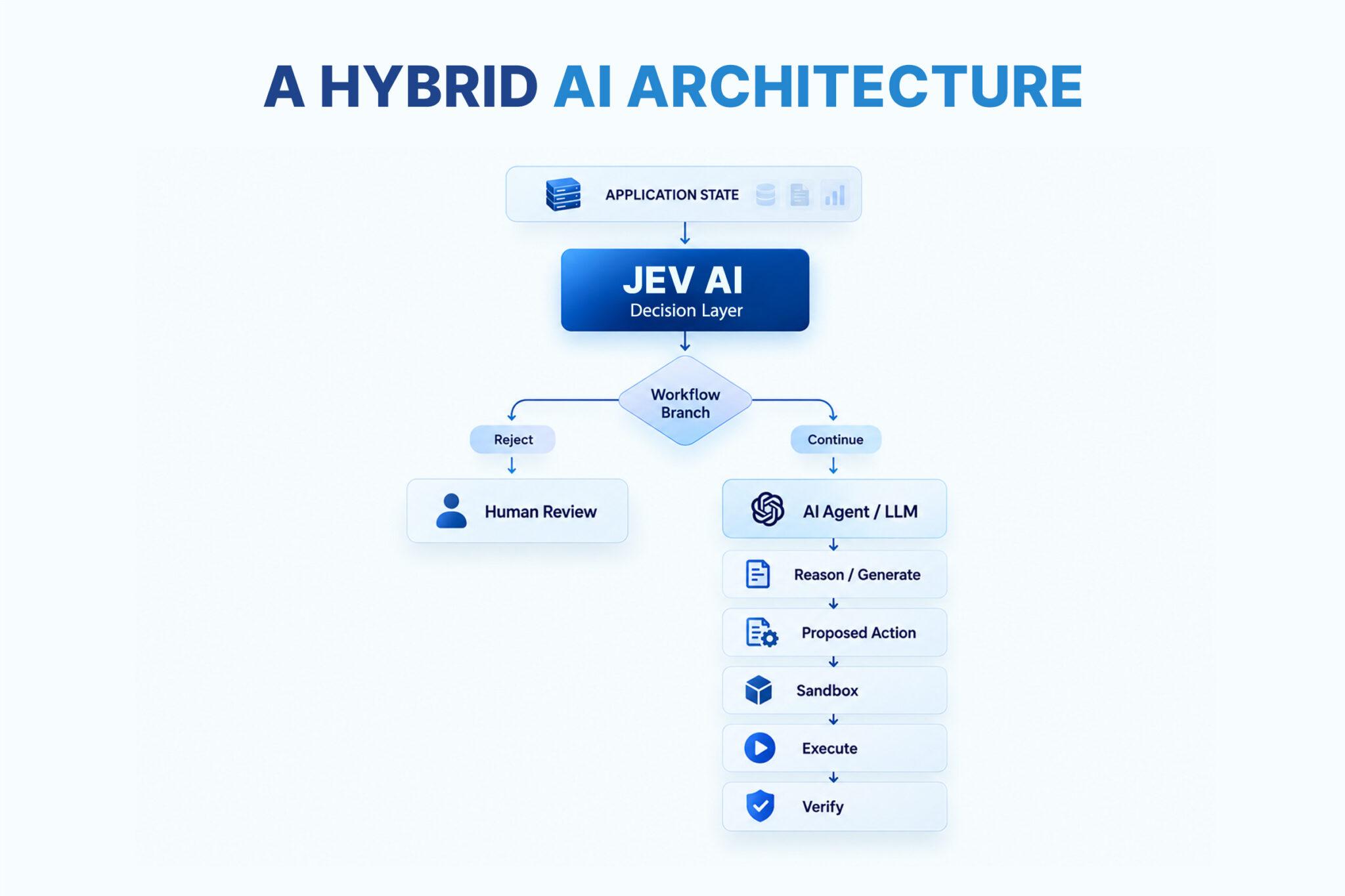
This architecture separates three different concerns:
Decision: Should we do something?
Reasoning: What should we do and why?
Execution: How should the action be performed safely?
That’s an important distinction for enterprise AI systems.
Jev AI for AI Agent Guardrails
As AI agents become more capable, the question isn’t only what an agent can do.
It’s also: Under what conditions should it be allowed to do it?
For example, an agent may want to execute:
kubectl delete deployment production-api
The surrounding system could evaluate conditions before allowing execution:
- Is the environment production?
- Is the deployment inside the agent’s permitted scope?
- Is there an active incident?
- Has approval been granted?
- Does the action match the workflow policy?
A decision layer can evaluate those conditions before execution. The action then moves through a controlled execution environment.
An AI agent requests an action, which passes through a decision, guardrail, and policy check. If approved, the action runs in a secure sandbox, where it is executed and then verified. This pattern is especially valuable when AI agents interact with infrastructure. The goal isn’t to make the agent incapable. The goal is to put explicit controls around what the agent is allowed to execute.
Where Jev AI Doesn’t Fit
Jev shouldn’t be forced into tasks where generative AI is the natural solution. Different AI components are better suited to different types of problems.
For example, if the requirement is “Write a detailed incident report from these logs,” an LLM is a natural fit because the task requires understanding information and generating human-readable text.
Similarly, if the requirement is “Explain this Terraform configuration to a new engineer,” an LLM is appropriate because the primary goal is explanation. If the requirement is “Generate a remediation script,” an AI coding agent or LLM can help create the required code.
Jev becomes more relevant when the application needs to make a structured decision based on application state.
For example: “Should this remediation script be allowed to execute?”
That is a different problem. The system needs to evaluate the available state, apply the relevant decision logic, and return an outcome that can control the workflow.
The key is therefore not to choose one technology for everything. Instead, choose the right component for each task: use LLMs for understanding and generation, decision-oriented systems for structured decisions, and controlled execution mechanisms for carrying out approved actions.
This approach produces AI architectures that are easier to reason about, govern, and maintain.
How GRiPO Can Orchestrate Jev, LLMs, and Secure Execution
The distinction becomes especially useful inside an automation platform.
GRiPO can provide the orchestration layer around AI decisions, AI agents, secure execution, and enterprise integrations.
A workflow can connect:
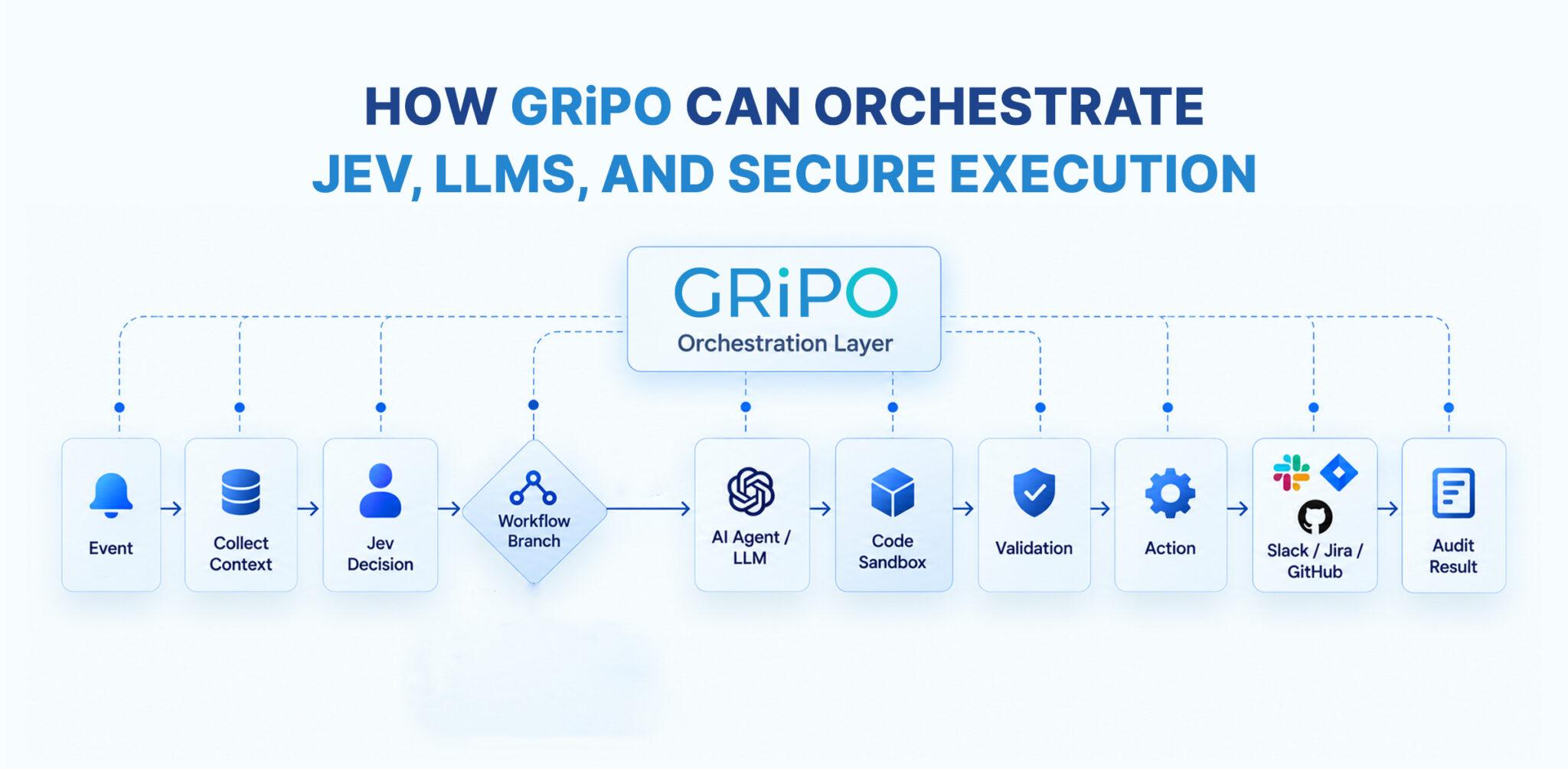
The architecture separates the responsibilities:
| Layer | Responsibility |
| Jev AI | Structured decision |
| LLM / AI Agent | Reasoning and generation |
| GRiPO Workflow | Orchestration |
| Code Sandbox | Controlled execution |
| Plugins | Enterprise integrations |
| Human | Approval for sensitive actions |
This is where AI workflow automation becomes more than simply calling an LLM API. The system has to manage context, decisions, permissions, execution, verification, and communication.
A code sandbox can provide an isolated environment for running generated code or commands without giving an AI agent unrestricted access to the host environment.
For DevOps teams, this distinction matters because an AI agent isn’t only producing text. It may be producing commands, modifying infrastructure, interacting with repositories, or calling cloud APIs.
A Practical Jev AI + LLM Implementation Pattern
When designing a workflow, start by separating the questions.
Step 1: Identify the decision
Ask: What exact decision does the application need to make?
For example: “Should this infrastructure change require approval?”
Step 2: Define the state
Collect only the information relevant to the decision.
- Environment
- Change Type
- Resource Type
- Risk Classification
- Approval Status
Step 3: Use Jev for the decision
The decision becomes a structured workflow input.
Approval Required = Yes
Step 4: Use an LLM when deeper reasoning is needed
If approval is required, an AI agent can analyze the change and prepare a human-readable explanation.
Step 5: Control execution
If an action is approved, execute it through a controlled environment such as a sandbox.
Step 6: Verify the result
Don’t stop after execution.
Check:
- Did the command succeed?
- Did the expected state change?
- Did security checks pass?
- Did the deployment become healthy?
- Was the result recorded?
This creates a complete automation loop:
Decide → Reason → Execute → Verify
The Bigger Idea: AI Systems Need More Than Generation
The growth of generative AI has made text generation highly accessible. But production AI systems need more than generated text. They also need decisions, policies, guardrails, workflow branches, execution controls, verification, auditability, human approval, and integration with existing systems.
That’s why the distinction between Jev AI vs LLM matters. An LLM can provide broad language understanding and generation. Jev can provide a structured decision layer. A workflow engine can coordinate the process, while a sandbox can isolate and control execution.
Together, these components can form a more controlled architecture for AI-powered automation, with each component responsible for a different part of the workflow.
The important question isn’t: “Should we use Jev or an LLM?”
A better architectural question is:
“Which parts of this workflow require generation, which require decisions, and which require controlled execution?”
Once these responsibilities are separated, AI systems become easier to design, test, govern, and operate. LLMs can focus on understanding and generation, decision systems can handle structured outcomes, and controlled execution environments can determine how and where actions are carried out.
This separation is especially important when AI moves from assisting humans to directly influencing production systems.
Key Takeaways
- Jev AI and LLMs solve different classes of problems.
- LLMs are primarily useful for language understanding, reasoning, and text generation.
- Jev focuses on structured decisions based on application state and focused questions.
- A decision doesn’t always require generating natural-language text.
- LLMs can participate in decision-making, but production systems may need additional validation and control around generated outputs.
- Jev isn’t a replacement for generative AI; the two can complement each other.
- AI agents can use LLMs for reasoning while a decision layer provides explicit workflow controls.
- DevOps automation can separate decision, reasoning, execution, and verification.
- A sandbox can provide controlled execution for AI-generated commands and code.
- Enterprise AI workflows benefit from clear boundaries between what the system decides, what the AI generates, and what the system executes.
Frequently Asked Questions
Is Jev AI the same as an LLM?
No. Jev AI and LLMs serve different purposes. LLMs are designed for broad language understanding and generation, while Jev focuses on structured decision-making based on application state and focused questions.
Is Jev AI a replacement for ChatGPT or Claude?
No. Jev is not intended to replace general-purpose language models. An LLM can handle tasks such as writing, summarization, explanation, and broad language reasoning, while Jev can provide a structured decision layer inside an application.
Can Jev AI and an LLM be used together?
Yes. A system can use an LLM for analysis or generation and Jev for structured decisions that control workflow branches.
When should I use Jev instead of an LLM?
Consider a decision-oriented approach when the application needs a structured answer to a specific question about its current state, particularly when that answer directly controls workflow behavior.
Can an LLM make decisions?
Yes. LLMs can be used for decision-making. However, when the decision directly controls production workflows, developers may need additional validation, output constraints, and control mechanisms.
Is Jev AI deterministic?
Jev is designed around structured, bounded decision-making rather than open-ended text generation. The exact behavior and guarantees should be evaluated against the specific Jev implementation and use case.
Can Jev AI be used with AI agents?
Yes. Jev can serve as a decision layer around an AI agent, helping evaluate whether an agent’s proposed action should proceed under defined workflow conditions.
Can Jev AI be used for DevOps?
Yes. Decision-oriented AI can be applied to DevOps workflows where systems need to evaluate deployment state, security conditions, infrastructure changes, approvals, or remediation conditions.
How does Jev AI fit into AI agent security?
A decision layer can be placed between an AI agent’s proposed action and the execution environment. This allows the workflow to evaluate conditions before allowing an action to proceed.
Does Jev generate text?
Text generation is not the primary purpose of Jev. Its role is centered on structured decisions rather than producing general-purpose natural-language responses.
Why not use traditional rules for everything?
Traditional rules work well for explicit, deterministic conditions. As workflows become more complex, teams may need additional decision mechanisms alongside rules. The appropriate choice depends on the type of decision and the application’s requirements.
Can GRiPO use Jev and LLMs together?
GRiPO can provide the workflow orchestration around AI agents, secure execution environments, integrations, and automation steps. This allows teams to design workflows where decision logic, AI reasoning, execution, and verification are separate stages.