
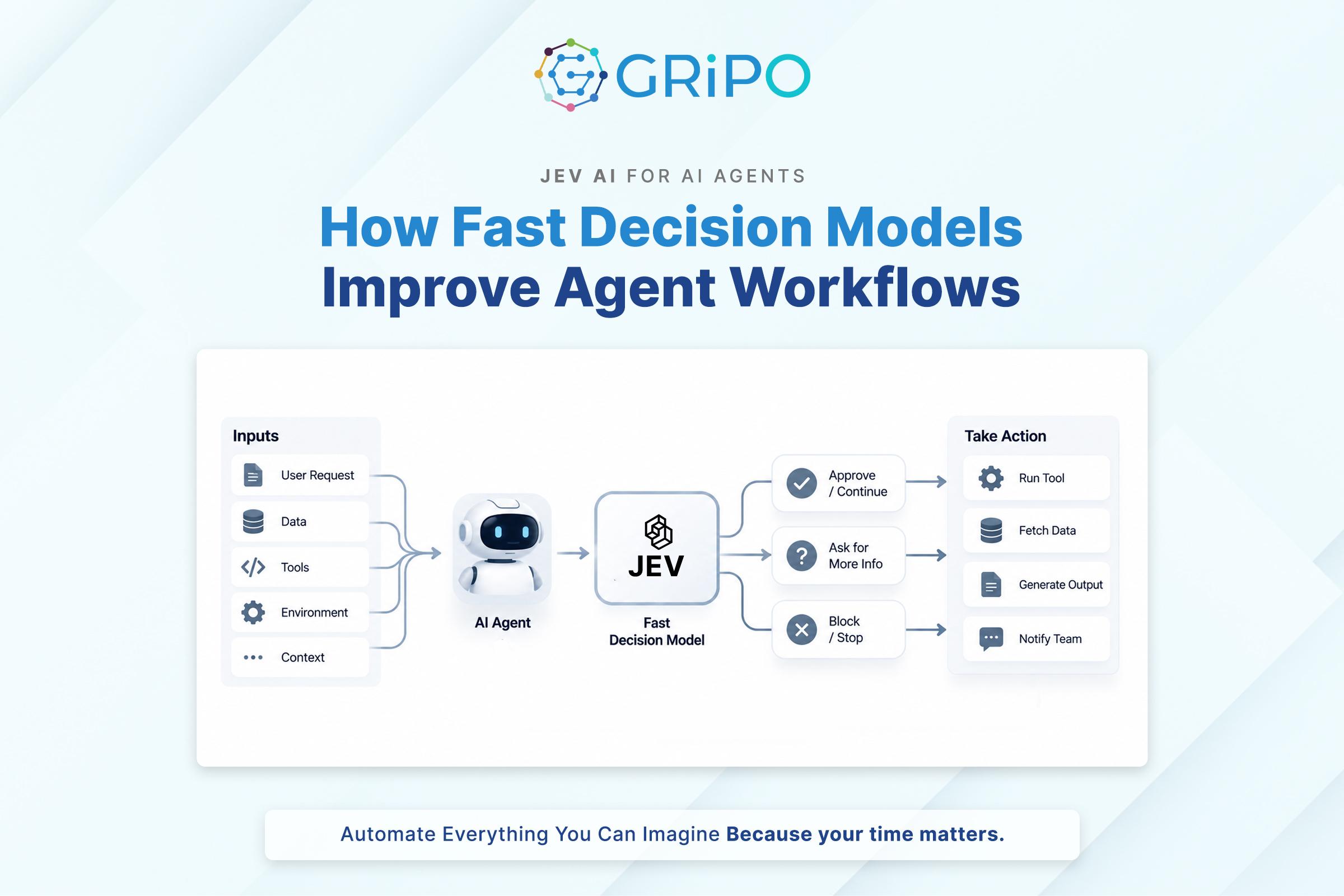
AI agents are becoming increasingly capable of handling complex engineering tasks. They can inspect repositories, analyze logs, write code, execute commands, investigate incidents, and coordinate work across multiple tools. Models powering agents such as Claude Code and Codex can work through multi-step problems that previously required substantial manual effort from developers and operations teams.
However, not every step in an agent workflow requires the same level of reasoning. An agent investigating a production incident might need to understand hundreds of lines of logs, compare recent deployments, and identify a possible root cause. Once that investigation is complete, the workflow may need to answer a much narrower question: Should this incident be escalated to the infrastructure team? Generating another lengthy response for that decision may be unnecessary when the application needs a structured result that determines what happens next.
This is where Jev becomes relevant. Jev is a decision model from TypeSafe AI designed to evaluate supplied information against defined questions and return structured answers with probability information. Rather than serving as a general-purpose conversational assistant, it focuses on bounded decisions that applications can use for classification, routing, scoring, and workflow control. You can explore its capabilities in the official Jev AI documentation.
For developers, the opportunity is not to replace capable generative models with a smaller or more specialized system. It is to assign each component the work it handles best. A generative model can investigate a problem and propose a solution, Jev can evaluate a specific decision, and the surrounding workflow can enforce policies and determine the next action. This approach can help make AI agent workflows more structured, easier to evaluate, and potentially more efficient when applied to the right tasks.
What Is Jev AI, and How Does It Work?
Jev is designed for applications that need a decision rather than a conversation. A conventional large language model can explain a problem, generate code, or reason through a complex situation, but a decision model receives a defined state and evaluates specific questions about it. The result is structured data that application logic can consume without having to extract the answer from a paragraph of generated text. According to the official Jev documentation, the API supports three main question types: Noul, Choice, and Score.
- Noul: Evaluates a yes-or-no question and returns a value between 0 and 1 representing the probability that the answer is yes. An example is, “Does this incident require escalation?”
- Choice: Selects from predefined options, making it useful for classifying support tickets, routing incidents, or choosing a workflow.
- Score: Evaluates information against an ordered scale, such as low, medium, and high operational risk, and returns a probability-weighted score.
The important difference is that developers define the question and, where appropriate, the possible answers or scoring criteria. This gives the application a more predictable structure for handling the result. Jev’s documentation also describes sending multiple questions against the same state in one API request, allowing an application to classify an incident, assess its severity, and check whether escalation is needed without necessarily making a separate model call for each question. The current API documentation specifies support for up to 20 questions per request, although teams should confirm the applicable limits and model behavior before deployment.
For example, an incident-response application might provide a single state containing the alert description, affected service, recent deployment information, and relevant monitoring signals. It could then ask three questions: which team should investigate the incident, what severity level should be assigned, and whether human escalation is required. Jev returns structured answers, and the workflow uses those results to route the incident, prioritize the queue, and trigger the appropriate escalation process.
This is where a decision model becomes useful to agent developers: it can handle well-defined judgments around a larger task, while a generative model remains available for investigation, explanation, and problem-solving.
Why AI Agent Workflows Need a Decision Layer
An AI agent rarely performs just one operation. A production workflow might involve collecting information from several systems, interpreting the results, selecting a tool, executing a command, checking the outcome, and deciding whether further action is necessary. Some of these stages require substantial reasoning, but others are relatively narrow decisions that can be expressed using a defined set of outputs.
Consider an AI agent investigating a Kubernetes deployment failure. It reads pod events, inspects recent configuration changes, queries monitoring data, and checks the deployment history. A capable generative model can help correlate those signals and identify possible causes. But once the evidence is collected, the workflow may only need to determine whether the incident should go to the application team, the infrastructure team, or the security team.
Without a dedicated decision layer, the application might make another generative call, ask for a response in a particular format, and parse the returned text. That approach can work, but it adds another generation-and-interpretation step even when the answer belongs to a small, predefined set of options. A structured decision interface gives the application a direct way to request the result it needs.
The same principle applies when an agent decides whether to retry a failed operation, request human approval, escalate an incident, or send a task to another specialized agent. Jev can evaluate the relevant state against a narrowly defined question, while application code remains responsible for interpreting the result and enforcing the rules governing the next action.
This does not mean every decision should be delegated to Jev. A straightforward condition, such as checking whether a required field exists, should usually remain ordinary application logic. A complex investigation may still require a generative model. The decision layer is most useful when the application needs a bounded judgment that is difficult to express as a simple deterministic rule but doesn’t require another open-ended reasoning or generation task.
How Faster Decisions Can Improve Agent Workflows
The benefit of a specialized decision model is not simply that it produces shorter answers. It is that the application can use a purpose-built decision interface at stages where structured results are more useful than generated prose. This can simplify orchestration and reduce unnecessary work, provided the model is accurate enough for the task.
1. Reduce Unnecessary Generative Model Calls
Suppose an AI coding agent has completed its analysis of a pull request. The workflow needs to classify the changes, determine whether they affect authentication, and identify whether security review is required. If those decisions can be handled through a suitable decision model, the application may avoid invoking a larger generative model solely to answer each narrow question.
The coding agent can still perform the substantive work: inspect the repository, analyze the diff, run tests, and explain the implications of the changes. Jev evaluates the prepared state against the required decision questions, and the workflow determines what happens next. Where a decision is ambiguous or the evidence is incomplete, the system can send the case back for deeper reasoning or human review.
This design can reduce unnecessary generation calls, but the actual savings depend on the original architecture. Teams should measure the complete workflow including state preparation, API latency, retries, validation, and downstream work rather than assuming that adding a decision model automatically makes the system faster or cheaper.
2. Make Routing More Consistent
Multi-agent systems often contain specialized agents for infrastructure, application development, security, databases, and incident response. Choosing the correct destination is a small but important part of the workflow: a misrouted task can introduce delays, duplicate investigation, or unnecessary tool usage.
A Choice question can classify an incoming task against predefined destinations. The workflow can then route the request to the relevant agent or team, while retaining an explicit fallback for ambiguous cases. This is especially useful when many requests follow similar patterns and routing decisions need to be handled consistently across automated workflows.
3. Support More Efficient Triage
CI/CD pipelines and monitoring systems can generate large volumes of alerts, test failures, and operational events. Sending every event to a powerful reasoning model for a complete investigation can be wasteful when many events only need initial classification.
A decision layer can help separate routine cases from those requiring deeper investigation. For example, a workflow might classify a test failure as a possible regression, a likely flaky test, or an environment-related issue. Claude Code or Codex can then investigate the cases that need code-level reasoning, while the pipeline retains validation steps to avoid overlooking genuine failures.
The key is to use classification to prioritize investigation, not to treat the initial result as proof. A decision model can help organize the workload, but the workflow should preserve the checks necessary to establish whether a failure is safe to ignore, retry, or escalate.
Practical Use Cases for Jev in AI Agent Systems
The strongest use cases are those in which an agent gathers or generates information, but the surrounding application needs a specific decision before continuing. This pattern applies across software engineering, DevOps, security operations, and cloud cost management.
DevOps and Incident Response
An incident-response agent might collect service metrics, Kubernetes events, recent deployment history, and relevant runbook instructions before evaluating an incident. Jev can help classify the incident, assess its severity against a defined scale, or determine whether escalation is warranted. The workflow can then route the incident to the appropriate team, create a ticket in Jira, or notify engineers through Slack.
For high-impact remediation, the decision should be only one input into the execution process. A recommendation to restart a production service, for example, should not bypass access controls, change-management requirements, or safeguards designed to prevent further disruption.
AI Coding Agents and CI/CD
A coding agent such as Claude Code or Codex can inspect a repository, modify files, execute tests, and prepare a proposed patch. Once that work is complete, the workflow may need to classify the change, identify whether it introduces a database migration, or determine whether it should be routed for additional review.
Jev can evaluate those bounded questions using the state prepared by the agent or surrounding tools. The workflow can then request additional tests, create a review request, or continue the pipeline after mandatory checks have passed. This separates code generation from decision evaluation and policy enforcement, making the workflow easier to test and maintain.
Security Operations
Security workflows often need to prioritize findings, classify incoming alerts, and decide which cases require escalation. A decision model can help categorize findings based on supplied evidence and defined criteria, while a security agent performs deeper investigation when necessary.
However, a model’s classification should not replace deterministic controls such as access restrictions, approved security policies, or required incident-response procedures. For sensitive decisions, the workflow should include conservative thresholds, audit records, and a clear path to human review.
FinOps and Cloud Cost Management
Cloud cost workflows can use the same architecture to prioritize unusual spending patterns. An agent can collect billing data, resource metadata, recent infrastructure changes, and historical usage information. Jev can then evaluate a bounded question, such as whether a resource’s spending pattern warrants investigation or which predefined category best describes the anomaly.
The workflow can create a ticket, notify the FinOps team, or request further analysis. Any action that changes or terminates cloud resources should remain subject to the organization’s approval rules and resource-governance policies. A model’s classification can help prioritize investigation, but it should not be treated as definitive proof that a resource is unnecessary.
A Practical Architecture: Agent, Jev, and Workflow Automation
A reliable implementation separates reasoning, decision-making, and execution instead of asking one component to handle everything. The agent gathers context and performs the complex task, Jev evaluates a bounded question, and the workflow controls the transition to the next stage.
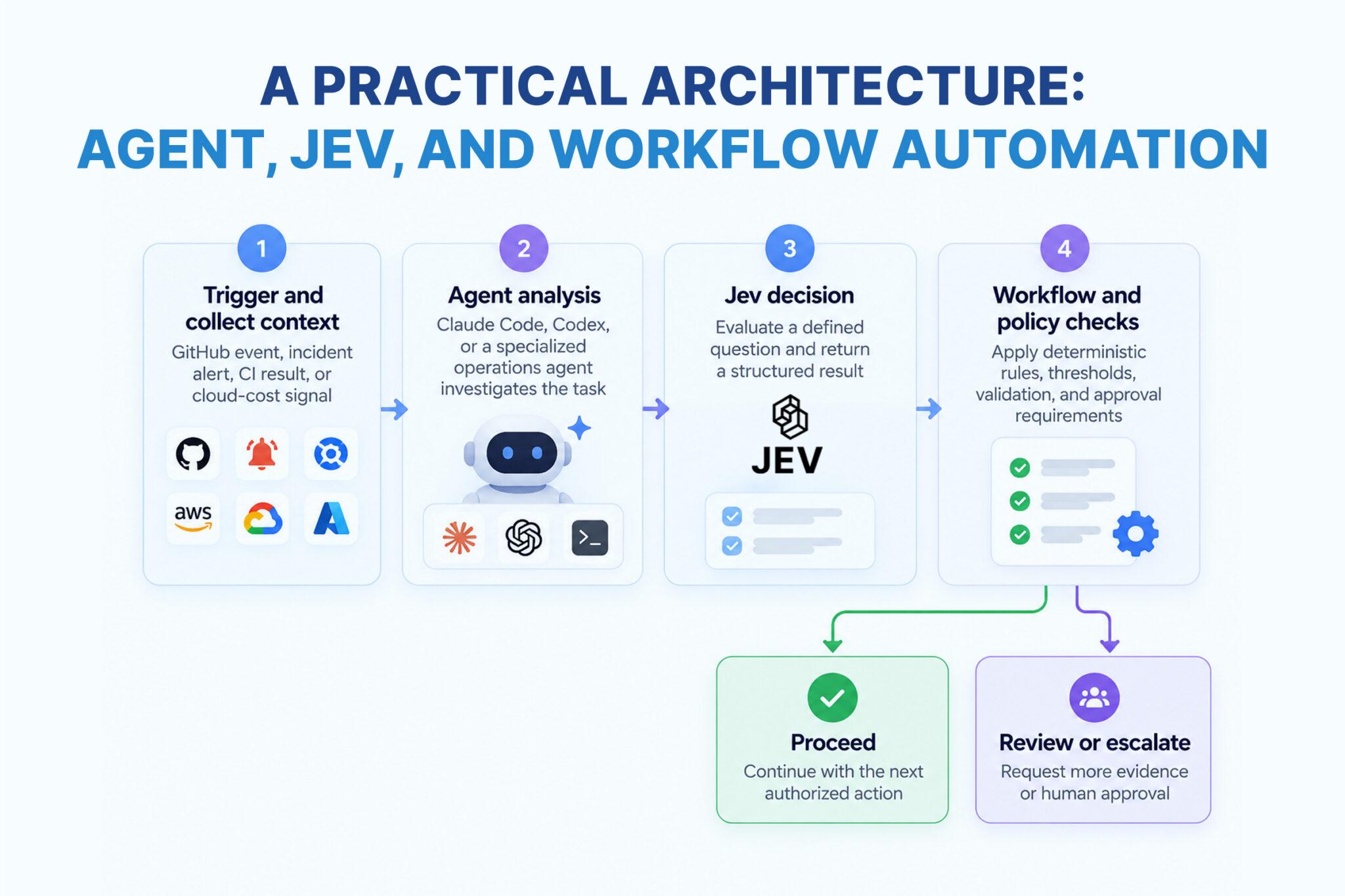
Consider a pull-request workflow. A GitHub event triggers the workflow, which launches a coding agent in an isolated sandbox to inspect the diff and run the relevant tests. The workflow prepares a concise state containing the changed files, test results, infrastructure changes, and relevant security findings, then sends that state to Jev with a question such as, “Does this change require security review?”
Jev returns a structured result, which the workflow evaluates alongside mandatory rules. If review is required, the workflow creates a Jira ticket and notifies the security team. Otherwise, the pipeline can proceed to its next authorized validation stage. A low-risk result must not bypass required checks, and an uncertain or unavailable decision should follow an explicit fallback path.
This is also where a platform such as GRiPO can be useful. GRiPO combines visual workflow automation, isolated code execution, AI agents, and plugin integrations, allowing teams to connect repository events, sandboxed agent execution, external decision APIs, and downstream actions in one operational workflow. Its code sandbox supports execution of tools such as Python, kubectl, and Terraform, while its AI agent capabilities let teams use agents as workflow steps.
Jev can be integrated as an external decision service through the appropriate API and workflow configuration; it should not be assumed to be a built-in GRiPO integration. The architectural benefit is the ability to connect specialized decisions to controlled execution, rather than leaving an agent to operate as an isolated chatbot.
How to Measure Whether Jev Actually Makes an Agent Faster
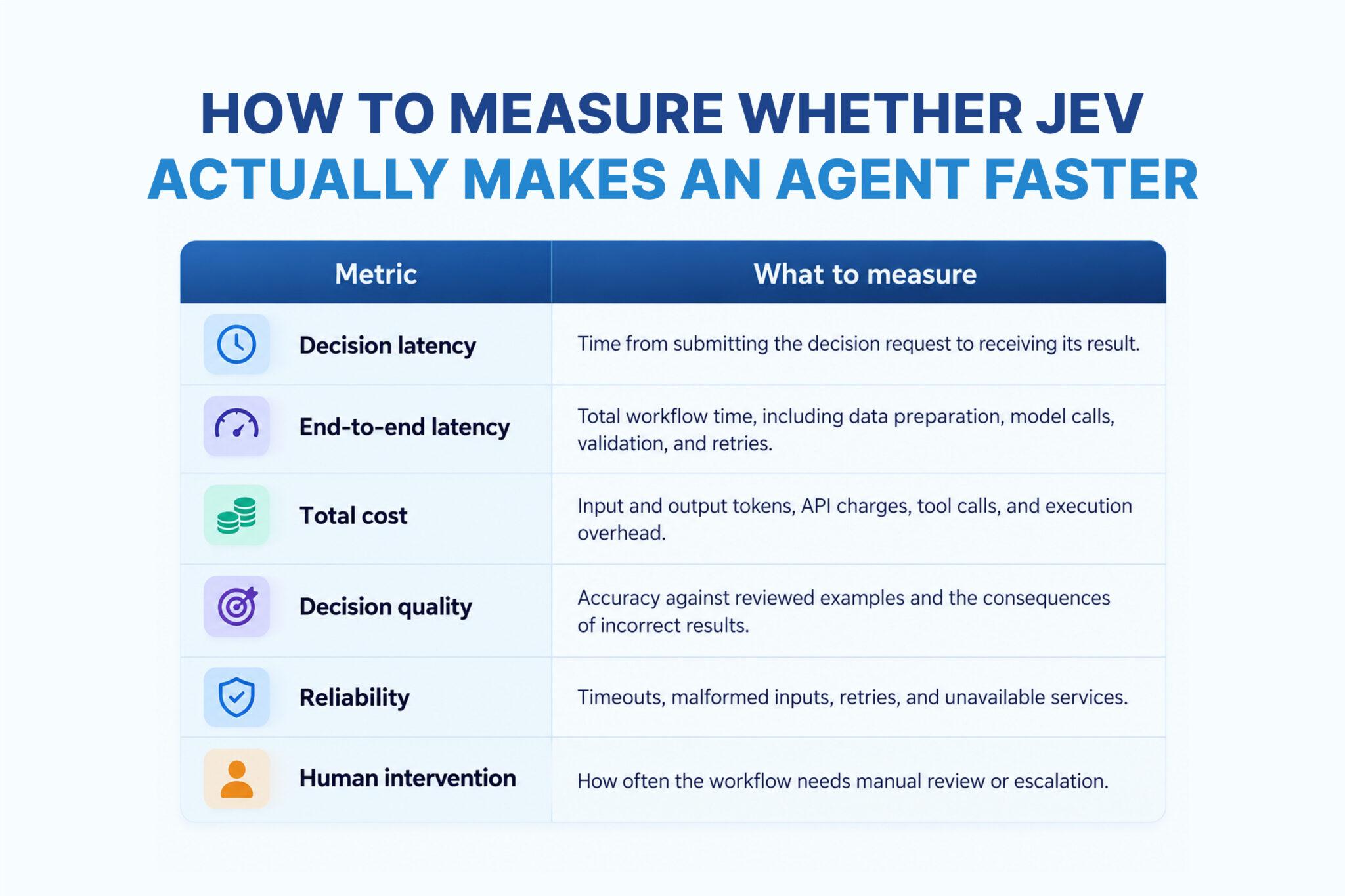
A decision model can reduce unnecessary generation work, but teams should verify the improvement using a representative workload rather than relying on model speed claims alone. The relevant metric is the performance of the complete workflow, not just the time required for one decision API call.
Jev’s official documentation describes typical upstream latency of approximately 0.2 seconds and states that output tokens are not billed. These figures are useful starting points, but actual latency and cost depend on the request size, network conditions, model behavior, and the surrounding application. They should be verified against the current service documentation and measured from the environment where the workflow will run.
A practical benchmark should compare two versions of the same workflow: one that uses a generative model for every decision and another that uses Jev for suitable bounded questions while retaining the generative model for complex reasoning. Use the same test cases and compare the results across the following dimensions.
For example, if an agent makes several separate generative calls just to classify, prioritize, and route an incident, a decision API that supports multiple questions against the same state may reduce the number of calls needed. Jev’s documented API supports up to 20 questions in a single request, subject to the current API limits. However, batching only helps when the questions can be evaluated independently against the same state. If one decision depends on the result of another, the workflow may need separate stages.
The most meaningful outcome is not simply a lower average response time. It is a workflow that reaches the correct operational outcome with less unnecessary processing, without increasing the rate of missed incidents, incorrect routing, or unsafe actions.
Implementation Best Practices and Common Mistakes
The quality of a decision workflow depends heavily on how the decision is defined and how the result is handled. A model cannot reliably compensate for missing evidence, ambiguous questions, or poorly designed application logic.
Start with a narrow decision. Instead of asking, “What should we do about this deployment?”, ask, “Does this deployment require human approval?” Define the possible outcomes and criteria clearly so that the result has an explicit meaning in the application.
Prepare relevant state. Include the facts needed to answer the question, such as test results, changed files, security findings, or service health. Avoid passing a large, unfiltered transcript when a concise, structured representation is sufficient. Preserve the original evidence elsewhere when it is needed for audit or further investigation.
Validate against real examples. Build a test set from representative production cases and have qualified reviewers establish the expected outcomes. Measure false positives and false negatives, especially where missed escalation or an incorrect classification could cause operational harm. Re-evaluate performance when the workload, prompts, criteria, or model version changes.
Treat probabilities as signals, not guarantees. A high probability does not prove that a decision is correct. Choose thresholds based on measured performance and the cost of different errors. For sensitive workflows, route uncertain cases to a human or a more capable reasoning agent.
Keep mandatory policies deterministic. Requirements such as approved production change tickets, restricted cloud regions, and required access controls should be enforced independently. A decision model may evaluate risk, but it must not override a hard policy or grant itself permission to execute an action.
Design explicit failure handling. Decide what the workflow should do when Jev times out, receives incomplete state, returns an unexpected result, or is unavailable. For high-impact actions, fail closed or escalate where appropriate instead of assuming that a missing decision means approval.
These practices turn a decision model from an experimental API call into a component that can be evaluated, monitored, and governed as part of an operational system.
Limitations: When Jev Is Not the Right Tool
Jev is not a replacement for every capability of a general-purpose language model. It is intended for structured decision tasks, not for writing substantial code, explaining a complicated incident in detail, designing an application architecture, or carrying out an open-ended investigation. Those tasks are better handled by a generative model capable of producing detailed reasoning and content.
It is also not the right tool for every simple condition. If a workflow can determine the answer by checking a known field, comparing a value against a threshold, or enforcing a fixed rule, deterministic code is usually simpler and more predictable. Adding a model introduces latency, service dependencies, evaluation requirements, and another possible failure point.
Decision models also depend on the quality of their input state and the definitions of their questions. Ambiguous criteria can produce results that are difficult to interpret, while missing context can lead to incorrect classifications. Before using Jev in production, developers should evaluate its performance on the actual workload and verify that its input types, supported languages, request limits, and output contract fit the application.
The strongest design is therefore a hybrid one: use generative models for complex reasoning and generation, decision models for bounded judgments, and deterministic logic for exact requirements. This combination provides flexibility without treating any model output as inherently authoritative.
Frequently Asked Questions
What is Jev AI used for in agent workflows?
Jev evaluates supplied information against defined questions and returns structured decisions with probability information. It can support classification, routing, scoring, and other bounded judgments within AI agent workflows.
How is Jev different from Claude Code or Codex?
Claude Code and Codex are designed for broader software engineering tasks, including code analysis, generation, and iterative problem-solving. Jev focuses on structured decisions. They can complement one another: the coding agent performs the engineering work, while Jev evaluates specific questions that guide the workflow.
Can Jev make AI agents faster?
It can help reduce unnecessary generative model calls when a workflow only needs a bounded decision. Actual speed improvements depend on the existing architecture, network latency, input size, decision quality, and how much additional processing the workflow requires.
Can Jev answer multiple questions in one request?
Yes. Jev’s documented API supports multiple questions against the same state in a single request, with a current documented limit of up to 20 questions. This can reduce repeated calls when the questions can be evaluated independently.
Does Jev replace traditional business rules?
No. Exact requirements should remain in deterministic application logic. Jev can help evaluate ambiguous situations, but it should not override mandatory security controls, approval requirements, or compliance policies.
Can Jev be used for DevOps automation?
Yes, it can be applied to bounded decisions in incident routing, deployment-risk assessment, test-failure classification, and escalation workflows. Teams should validate its accuracy on representative operational data before relying on it in production.
Is Jev suitable for autonomous production deployments?
Jev can contribute to deployment decisions, but its output alone should not authorize high-impact actions. Production workflows should independently enforce mandatory checks, access controls, validation requirements, and human approval where appropriate.
How can GRiPO support workflows using Jev?
GRiPO provides visual workflow automation, isolated code execution, AI agents, and plugin integrations. Teams can use these capabilities to connect engineering tasks with an external Jev API, apply workflow rules, and coordinate subsequent actions. The Jev connection must be configured as an integration rather than assumed to be built in.
How should developers evaluate Jev before production use?
Test it against representative examples with reviewed expected outcomes. Measure accuracy, calibration, latency, cost, and failure behavior, paying particular attention to false positives and false negatives. Establish thresholds and fallback procedures that reflect the consequences of incorrect decisions.
Does every AI agent need a decision model?
No. A decision model is useful when the application repeatedly needs structured judgments that are difficult to express as simple rules. Straightforward checks belong in deterministic code, while complex investigations and open-ended tasks may be better handled by a generative model.
Conclusion: Build Agents Around the Decisions They Need to Make
AI agents are becoming more capable, but improving an agent workflow does not always mean using a larger model or asking for more detailed reasoning. Many workflows contain small, repeatable decisions that determine whether a task should be routed, escalated, retried, reviewed, or continued. These decisions deserve an explicit place in the architecture.
Jev offers a specialized way to evaluate bounded questions and return structured results. Combined with generative models, deterministic policy enforcement, and well-designed workflow orchestration, it can help developers build systems that are easier to evaluate and control. The benefits should be established through workload-specific benchmarks rather than assumed from the model’s design alone.
For engineering teams, the goal is to build workflows in which each component has a clear responsibility: agents investigate and generate, decision models evaluate defined questions, and workflow logic controls execution. GRiPO helps bring these components together through visual workflows, sandboxed code execution, AI agents, and integrations with external systems. Explore GRiPO to see how these capabilities can support practical DevOps and AI automation workflows.