
AI applications have become very good at generating things: text, code, summaries, images, and explanations.
But production software often needs something different.
It needs a decision.
Should this support ticket go to billing or engineering?
Is this incident urgent?
Should an AI agent execute a particular tool call?
Does a code change require human review?
Should a workflow continue, stop, or escalate?
This is where Jev AI takes a different approach.
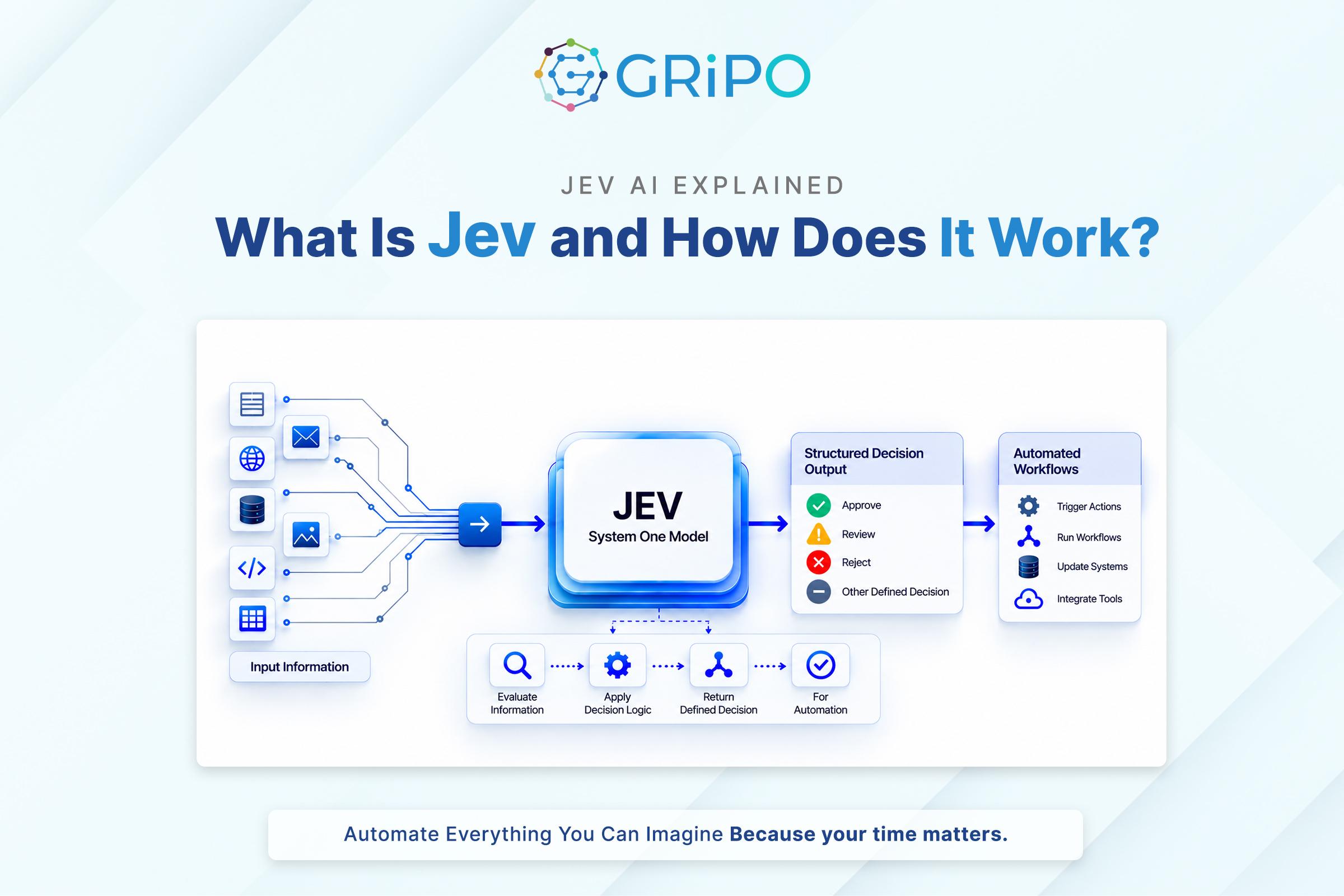
Jev is TypeSafe AI’s first public System One model, designed for structured decision-making rather than open-ended text generation. Instead of asking a model to produce a paragraph and then parsing that response, applications can provide relevant state and a focused question and receive a structured decision that software can use.
The basic idea is:
State → Question → Decision → Action
That makes Jev particularly interesting for AI agents, workflow automation, DevOps automation, and enterprise software where small decisions can determine what happens next.
Jev isn’t designed to replace every generative AI model. Instead, it addresses a different part of the AI application stack: bounded decisions that software needs to consume directly.
What Is Jev AI?
Jev AI is a decision-oriented AI model from TypeSafe AI designed to make fast, structured judgments inside software.
In practical terms, Jev acts as a decision layer between application context and application logic. The application provides the information that matters, asks a defined question, and specifies the type of answer it needs. Jev then returns a structured result that the surrounding software can evaluate.
The basic concept can be represented as:
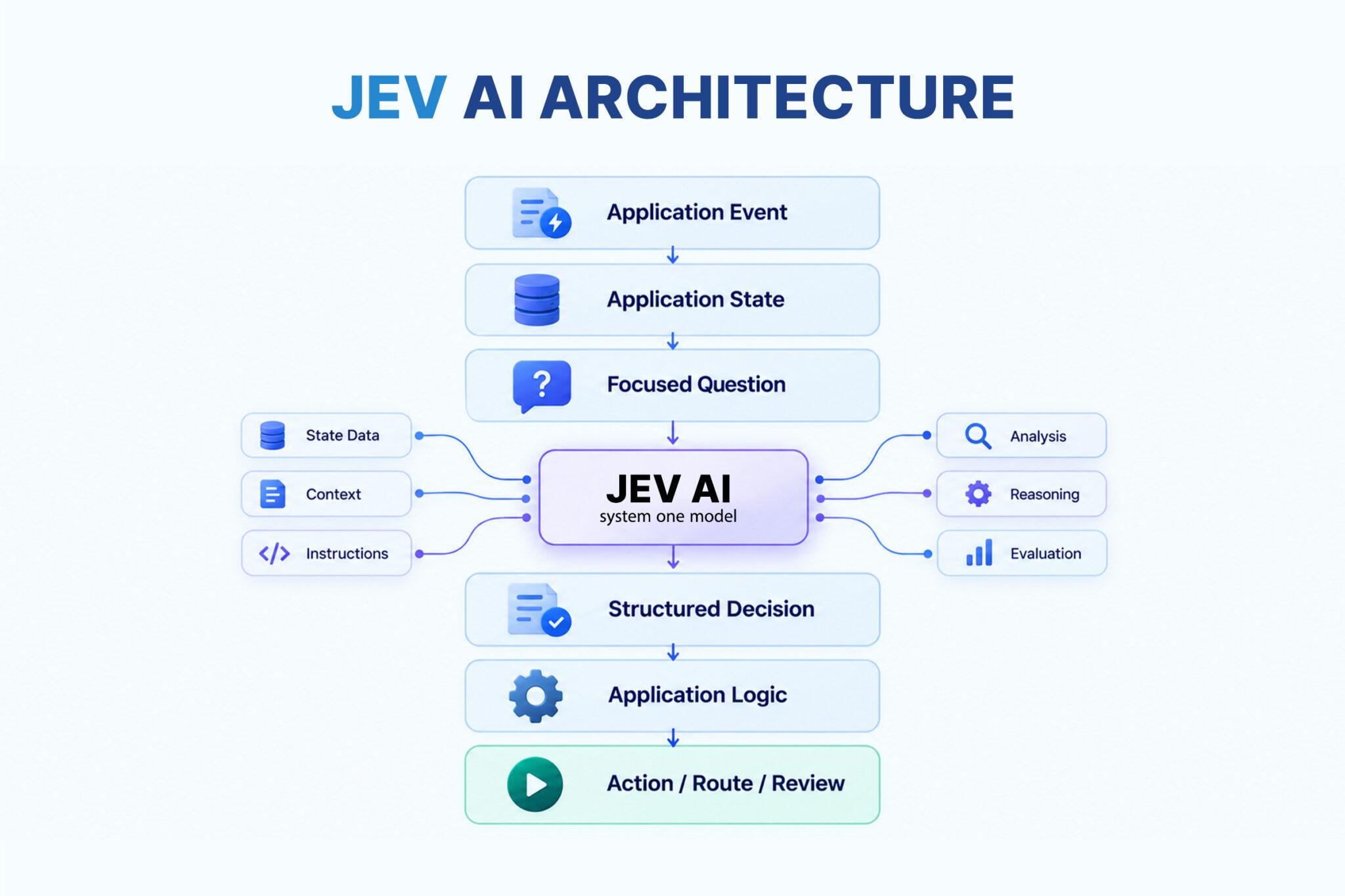
The application state is evaluated against a focused question by Jev, which produces a structured decision. That decision is then passed to the application logic to determine the appropriate action, routing, or human review.
The model isn’t primarily designed to have a conversation with a user.
Instead, an application provides the relevant state and defines what kind of answer it needs.
For example:
State:
“Customer reports that their Stripe integration
has stopped processing payments.”
Question:
Which team should handle this?
Allowed answers:
– Billing
– Technical
– Account
Jev can return a structured choice rather than writing an explanation that another piece of software has to parse.
TypeSafe describes the basic pattern as state → question → decision → action.
That’s the fundamental idea behind Jev.
Why Was Jev Created?
There’s a recurring problem in software automation.
LLMs are extremely capable, but they’re fundamentally optimized around language generation.
Suppose an application needs one of three answers:
approve
review
reject
A traditional LLM might return:
“Based on the available information, I would recommend sending this request for review because…”
A human can understand that.
Software doesn’t want the paragraph.
It wants:
{
“decision”: “review”
}
Developers can use structured-output features and schemas to make LLM responses easier to consume. But the model is still fundamentally operating in a generative interface.
Jev approaches the problem differently.
The possible answer space is defined as part of the decision.
That means the application knows what kind of result it will receive before the model runs.
TypeSafe describes this as a model designed to produce typed probabilistic decisions rather than free-form strings.
This is useful when AI becomes part of application control flow.
Jev AI Is Not a Traditional Chatbot
This distinction is important.
You don’t use Jev in the same way you use ChatGPT or Claude.
A conventional generative AI model is designed for tasks such as:
- Writing
- Summarization
- Code generation
- Open-ended reasoning
- Conversation
- Content transformation
Jev is designed for tasks such as:
- Classification
- Routing
- Scoring
- Filtering
- Guardrails
- Tool selection
- Decision support
TypeSafe itself positions Jev as a System One model for structured decisions rather than open-ended generation.
That means asking:
“Write a deployment script for Kubernetes.”
is not the natural use case for Jev.
But asking:
“Should this deployment change require human review?”
is much closer to its intended role.
How Does Jev AI Work?
The easiest way to understand Jev is to break a request into four parts.
1. Provide the State
The state is the information the model needs to evaluate.
It could be:
- A support ticket
- An incident
- A customer message
- A document
- A database record
- A tool result
- A browser state
- A proposed action
- A piece of application context
For example:
State:
“Production API latency increased by 42%.
The increase started immediately after deployment
v2.4.7. Error rate is currently 8%.”
The application supplies this context.
2. Ask a Focused Question
Next, define what you want Jev to decide.
For example:
Question:
How should this incident be handled?
Options:
– Monitor
– Investigate
– Escalate
This is different from asking an LLM:
“What do you think about this incident?”
The Jev question has a defined decision space.
3. Receive a Typed Result
Jev returns a structured result that the application can consume.
The documented question types include Choice, Score, and Noul.
Conceptually:
Choice: “Escalate”
Probability: 0.91
Confidence: High
The exact response format depends on the API and integration, but the important idea is that your application receives a machine-consumable decision rather than a paragraph.
4. Let Your Application Decide What Happens Next
This is one of the most important parts of the architecture.
Jev doesn’t own the entire workflow.
Your software does.
For example:
A Jev decision first goes through a confidence check. If the confidence is high, the decision is automated; if the confidence is low, it is sent for human review.
This allows developers to define their own thresholds, fallbacks, permissions, and business rules.
TypeSafe’s documentation specifically emphasizes that the surrounding application remains responsible for deciding what happens after Jev’s result.
Jev AI Architecture: State → Question → Decision → Action
The easiest way to understand Jev’s architecture is to think of it as a decision layer inside a larger software system.
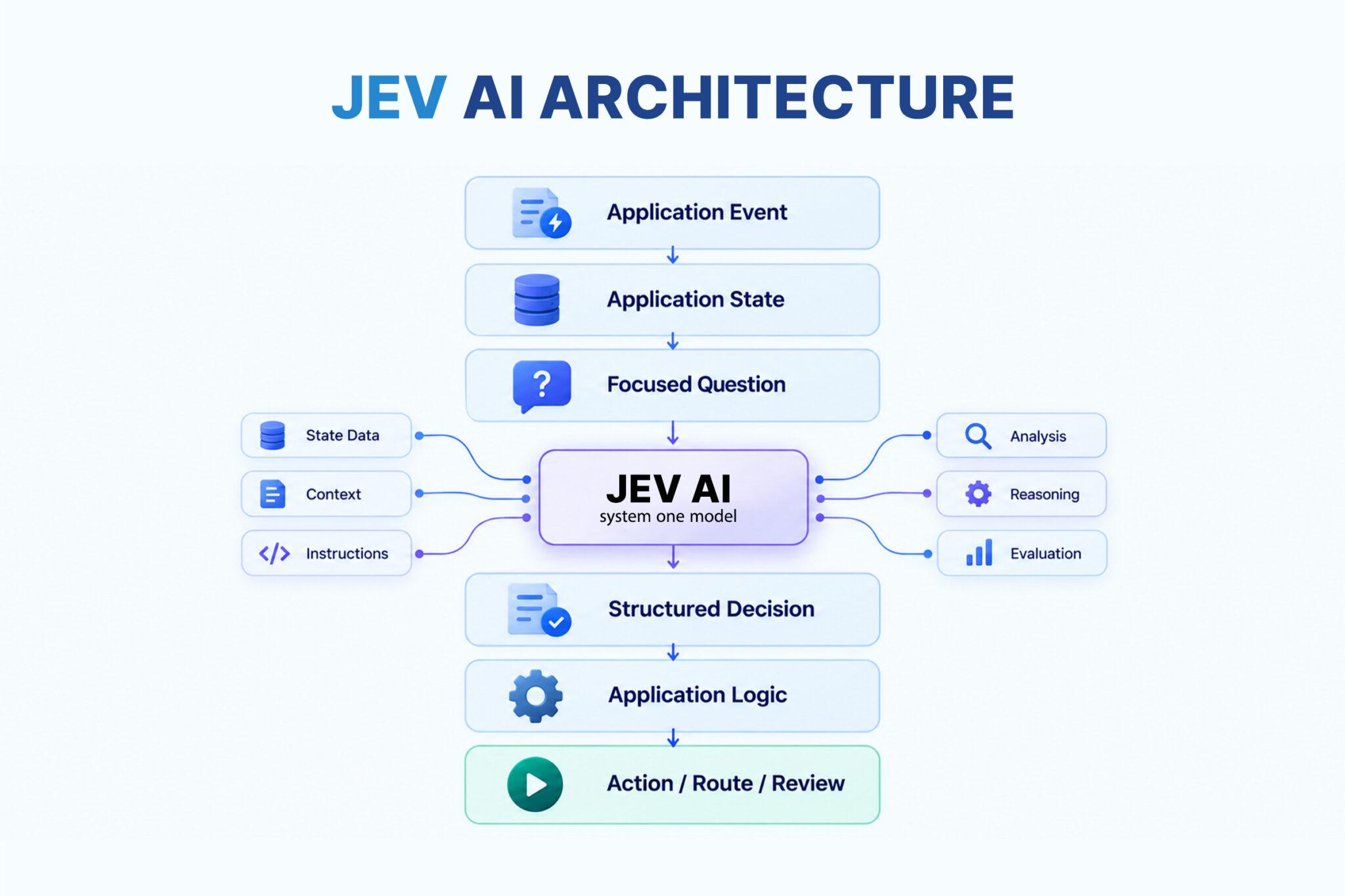
Each component has a different responsibility.
Application State
The application first collects the information required to make the decision.
This might include an incident description, a pull request diff, a customer request, an API response, a security event, or the result of another tool.
Focused Question
The application then defines the decision it needs.
For example:
Does this pull request require security review?
The question should have a clearly defined decision space rather than asking for an unrestricted explanation.
Jev AI
Jev evaluates the supplied state against the question and returns a structured result.
This is where Jev differs from a traditional generative AI workflow. The application is asking for a decision rather than a block of text that must later be interpreted.
Application Logic
The surrounding application remains responsible for determining what happens next.
For example:
A Jev decision goes through confidence and validation checks before action. Validated decisions are automated, while uncertain decisions are sent for human review.
This separation is important for enterprise systems. The model can provide a judgment, while deterministic software continues to control permissions, policies, approvals, and execution.
Action
Finally, the application performs the appropriate action.
That could mean routing a ticket, opening a Jira issue, requesting approval, triggering an AI agent, starting a sandboxed workflow, or simply recording the decision.
This makes Jev easier to understand as one component of a broader AI architecture rather than as a standalone chatbot.
What Are Jev’s Question Types?
Jev’s interface is based around typed questions.
The three documented types are:
| Question Type | Purpose | Example |
| Choice | Select from predefined options | Which team should handle this? |
| Score | Assign a score within a defined range | How urgent is this incident? |
| Noul | Yes/no-style decision | Should this request be reviewed? |
This constraint is deliberate.
The application defines the decision space first.
That makes Jev useful for software that needs predictable output structures.
What Makes Jev Different From an LLM?
The biggest difference is the output contract.
Consider an LLM:
An input is processed by an LLM, which generates tokens and produces text. A parser then interprets the generated text and converts it into an application decision.
With Jev:
State and a typed question are evaluated by Jev, which produces a typed decision. The application logic then uses that structured decision to determine the next action.
There is less translation between the model and the application.
That can matter in high-volume systems.
A customer-support application might process thousands of tickets every day.
A security system might evaluate thousands of events.
An AI agent might make dozens of small decisions during a single workflow.
Using a full generative model for every tiny decision may not always be the most appropriate architecture.
Jev AI vs LLM
The two approaches are better understood as complementary rather than direct replacements.
| Capability | Generative LLM | Jev AI |
| Open-ended text generation | Strong fit | Not its purpose |
| Code generation | Strong fit | Not its purpose |
| Conversation | Strong fit | Not its purpose |
| Classification | Possible | Core use case |
| Routing | Possible | Core use case |
| Scoring | Possible | Core use case |
| Structured decisions | Possible with schemas | Core design |
| Tool selection | Possible | Strong fit |
| Agent guardrails | Possible | Strong fit |
| Creative writing | Strong fit | Poor fit |
| Long-form explanation | Strong fit | Poor fit |
| Workflow branching | Possible | Strong fit |
This is why replacing every LLM with Jev would be the wrong mental model.
A better architecture may use both.
Jev AI vs Rules vs Generative LLM
A useful way to choose between these approaches is to ask what type of problem you’re solving.
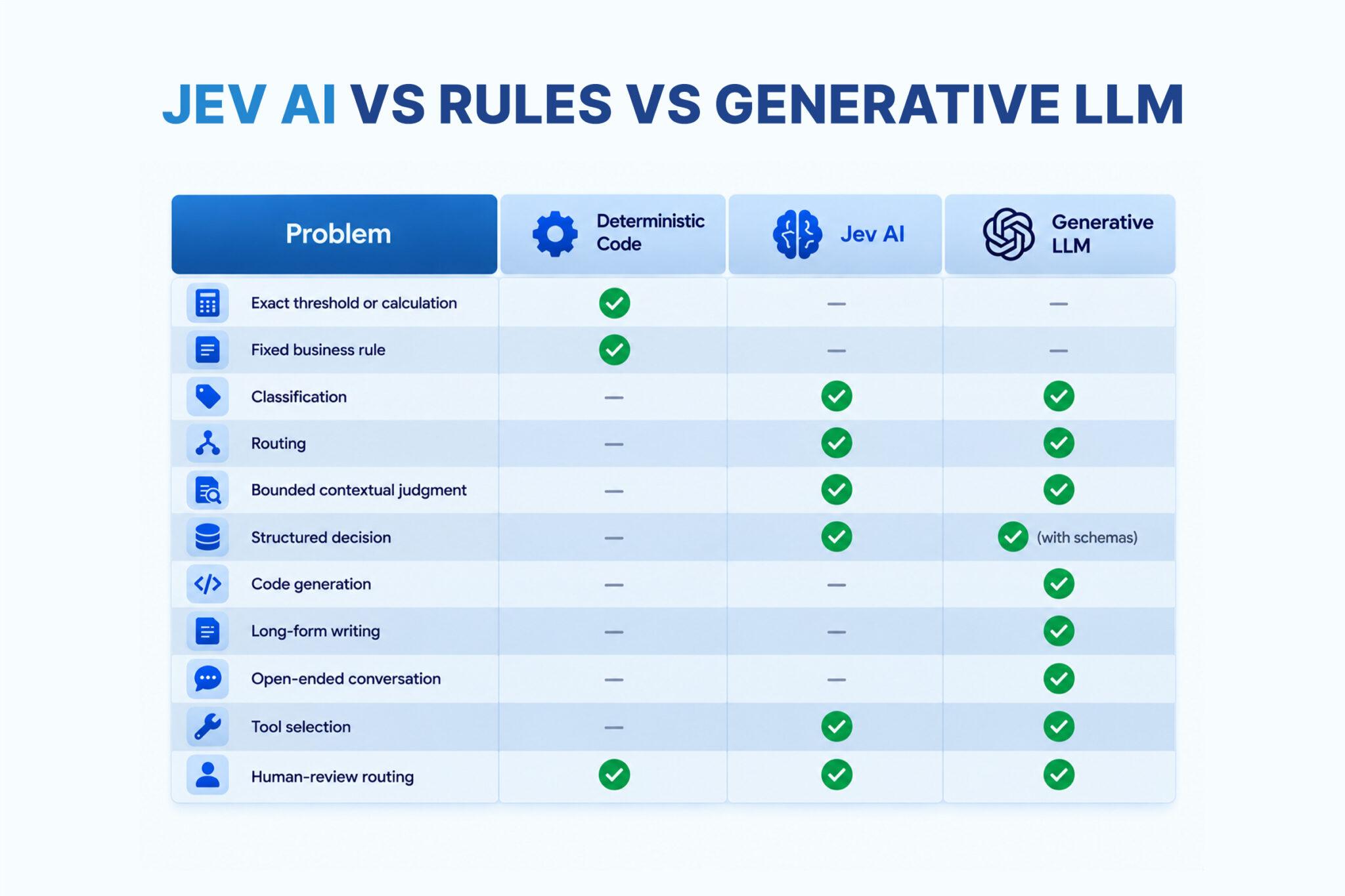
The goal isn’t to choose one technology for everything.
A practical architecture often uses all three:
Code for deterministic rules.
Jev for bounded judgments.
Generative models for language and broader reasoning.
The surrounding workflow then determines how those outputs are combined.
A Hybrid AI Architecture
Imagine an AI customer-support workflow.
You receive a customer message:
“Our production payment integration has been failing since this morning.”
You could use Jev to make the initial decisions.
A customer message is analyzed by Jev to determine the appropriate team, urgency, and whether a review is required. It can route the request to the technical team, identify high-priority issues, and flag cases for review.
Then a generative model can handle the parts that require language.
Jev routes the request to Technical Support, where a Generative LLM analyzes the issue and generates an appropriate response.
This division of labor makes sense.
Jev decides.
The generative model creates.
Your application controls the workflow.
Jev AI for AI Agents
AI agents are particularly interesting because they make many small decisions during execution.
An agent might need to decide:
- Which tool should I use?
- Is this tool call safe?
- Do I need more information?
- Is the task complete?
- Should I retry?
- Should I ask for human approval?
- Which model should handle the next step?
A traditional architecture might ask a large language model to make every one of these decisions.
Jev can potentially sit inside that loop as a specialized decision layer.
For example:
An AI agent provides the current state to Jev, which makes the decision on what to do next. Jev can then select Tool A, select Tool B, or request human review.
Jev isn’t the entire agent.
It’s the decision component inside the agent.
This distinction matters.
An agent needs orchestration, tools, state management, permissions, execution environments, and often a generative model.
Jev addresses one part of that architecture.
Jev as a Decision Layer Inside an AI Agent
A useful way to think about this architecture is:
An AI agent provides the current state to Jev, which makes the decision on the next action. Jev can then select Tool A, select Tool B, or send the case for human review.
Do you like this personality?
The agent remains responsible for the broader task, while Jev handles a bounded decision inside the loop.
This separation can make agent workflows easier to reason about because tool execution, permissions, human approval, and decision-making don’t have to be handled by the same model.
Jev AI vs Traditional Rules
It may seem easier to write an if/else statement.
Sometimes it is.
For example:
if status_code >= 500:
alert = True
Don’t use AI for that.
The rule is deterministic.
But consider:
Does this incident description indicate that the service is likely experiencing a customer-impacting production issue?
That can involve messy language and contextual judgment.
A decision model becomes more useful there.
The practical rule is:
Use code for rules. Use AI for judgment.
That’s a useful design principle for Jev and AI automation generally.
Jev AI for DevOps Automation
This is where Jev becomes particularly relevant to engineering teams.
DevOps workflows contain countless decisions.
Consider a security workflow.
A pull request changes infrastructure code.
The workflow needs to decide:
Does this change require security review?
A Jev-based decision could look like:
A PR diff is analyzed with its security context by Jev to determine whether a review is required. With a 92% probability of requiring review, the change is sent for security review.
The actual enforcement should remain in your workflow or application.
Jev supplies the judgment.
Your system supplies the policy.
That separation is valuable.
Jev AI for AI Agent Guardrails
One of the more interesting applications is using Jev before an agent performs a sensitive action.
Imagine an AI agent wants to execute:
kubectl delete deployment payments-api
Instead of allowing the agent to execute the command immediately, the workflow could first evaluate the proposed action.
The important security principle is that Jev should not become the sole authorization mechanism.
Permissions still belong in deterministic application controls.
RBAC, IAM, network policies, policy engines, and approval workflows should continue to enforce access.
Jev can provide an additional decision layer.
That is a much safer architecture than treating an AI model’s confidence as equivalent to authorization.
Jev AI and Confidence Scores
Confidence is one of the interesting parts of the Jev model.
A decision can include a confidence signal that application code can use when determining what to do next. TypeSafe’s own material emphasizes using thresholds and review paths around uncertainty.
For example:
Confidence >= 0.90
↓
Automatic action
Confidence 0.70–0.89
↓
Additional validation
Confidence < 0.70
↓
Human review
These numbers are only an example.
They should not be treated as universal thresholds.
An engineering team should calibrate thresholds against its own data, risk tolerance, and failure costs.
A 90% confidence decision about routing a low-risk support ticket isn’t equivalent to a 90% confidence decision about deleting a production resource.
Risk matters.
Confidence Does Not Mean Correctness
This is an important limitation.
A model can be highly confident and still be wrong.
A structured answer doesn’t magically make the underlying judgment correct.
For example:
Decision:
“Safe”
Confidence:
0.98
That doesn’t prove that the action is safe.
It means the model has high confidence in its decision.
The application still needs:
- Validation
- Policy enforcement
- Permission checks
- Testing
- Monitoring
- Human escalation for high-risk actions
TypeSafe’s own material distinguishes the model’s uncertainty signal from deterministic controls and application logic.
That distinction should remain clear in production architectures.
How Fast Is Jev AI?
Jev was designed around fast decision-making rather than token-by-token text generation.
TypeSafe publishes a latency range in the tens to hundreds of milliseconds and describes Jev as substantially faster and more efficient for its target System One tasks than conventional LLM workflows.
However, benchmark numbers should always be treated carefully.
Actual application latency depends on:
- Network distance
- API overhead
- Request size
- Concurrent traffic
- Integration architecture
- Application processing
- Downstream tools
A model being fast in isolation doesn’t automatically make an entire workflow fast.
If your workflow spends five seconds waiting for a Kubernetes API call, shaving 200 milliseconds from a decision step may not materially change the user experience.
Measure the complete workflow.
Jev AI in Enterprise AI Architecture
Enterprise systems often contain many different types of automation.
A mature architecture could look like this:
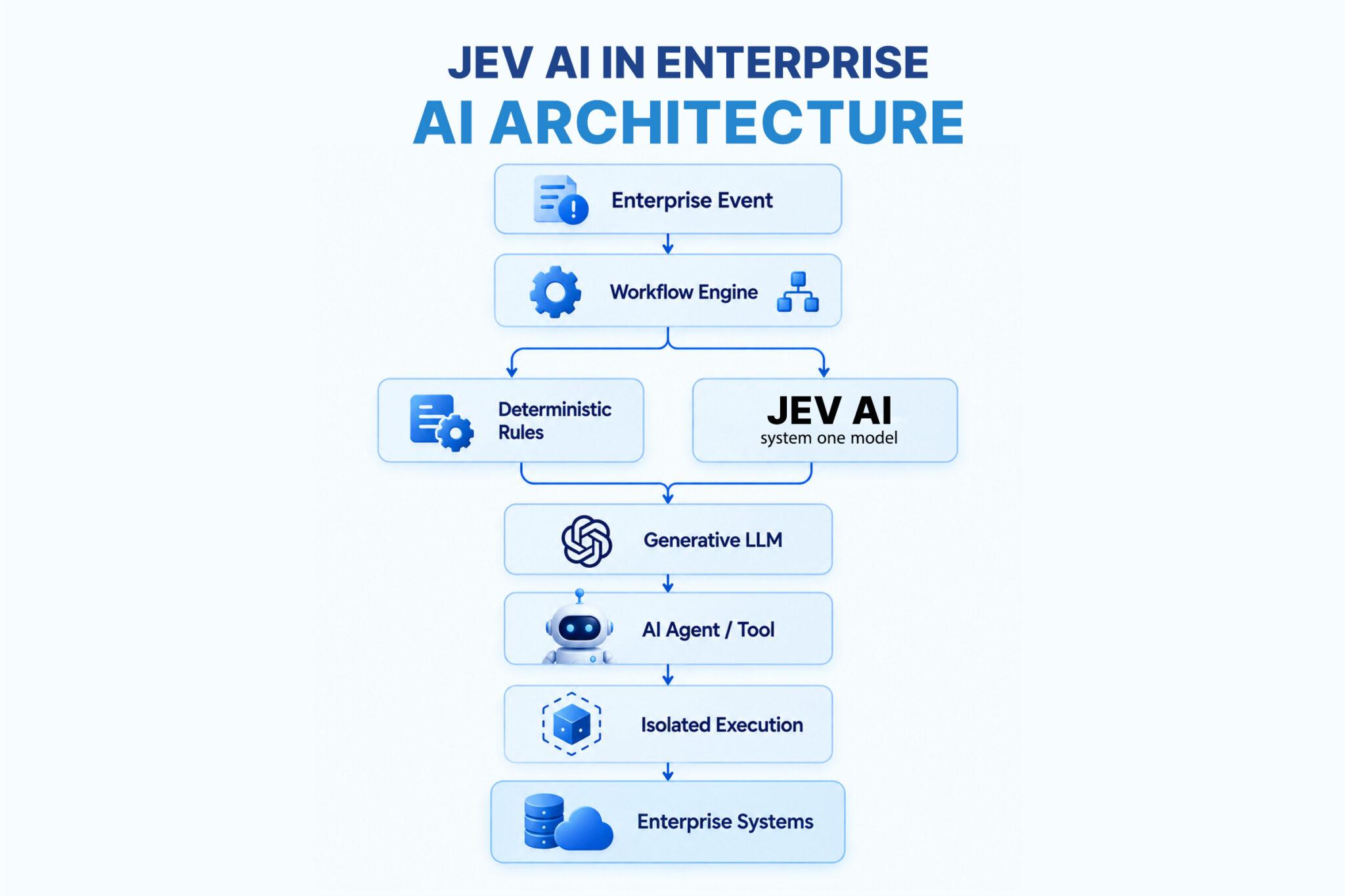
Each component has a defined responsibility.
Code
Handles deterministic rules and permissions.
Jev
Handles bounded judgments.
LLM
Handles generation and broader reasoning.
Agent
Coordinates tools and tasks.
Sandbox
Provides controlled execution.
Workflow
Connects everything together.
This architecture is more practical than trying to force one model to do everything.
How JEV Can Fit Into a GRiPO Workflow
This is where Jev becomes especially relevant to AI workflow automation.
GRIPO is designed around workflows, AI agents, isolated execution environments, and integrations.
A workflow could use Jev as a decision layer before an AI agent performs an action.
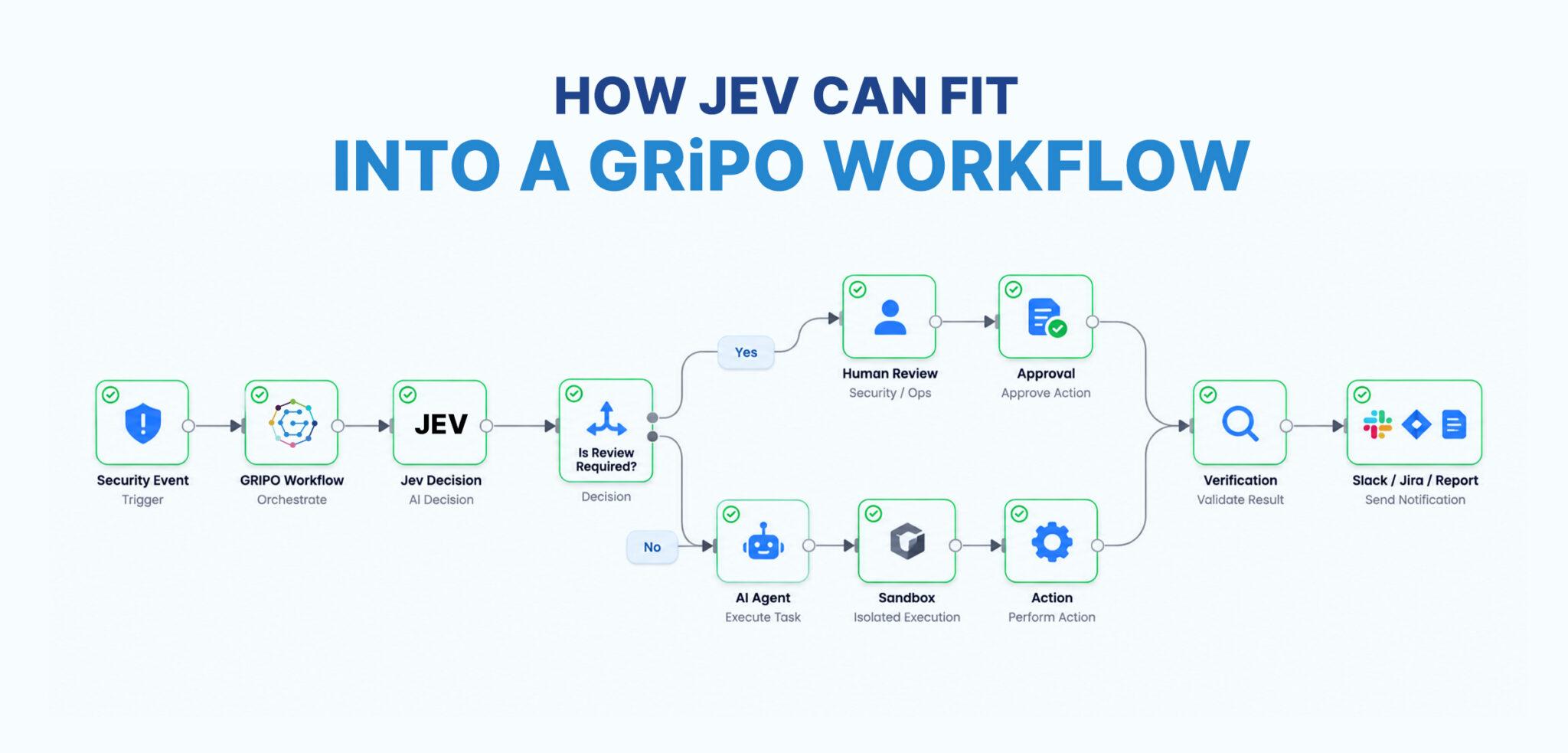
The benefit is architectural separation.
Example: Jev AI + GRIPO Security Automation
Consider a pull request that modifies infrastructure code.
Instead of allowing an AI agent to immediately decide and execute an action, the workflow can separate decision-making from execution:
A pull request is security-scanned and its context is collected before Jev decides whether a security review is required. If no review is needed, the PR proceeds to an AI agent and code sandbox for validation; if review is required, it goes through human approval and sandbox-based remediation. Both paths are then re-tested, with the final result reported to Slack or Jira.
In this architecture, each component has a defined role.
- Jev provides the bounded decision.
- GRIPO orchestrates the workflow.
- The AI agent handles reasoning or task execution.
- The sandbox provides an isolated environment for code or commands.
- Human approval handles higher-risk decisions.
- Plugins and integrations connect the workflow to systems such as Slack and Jira.
This is the type of architecture where a decision model becomes useful: the AI decision isn’t the entire automation. It’s one controlled step inside a larger workflow.
GRIPO can orchestrate the workflow.
Jev can provide a structured decision.
The AI agent can perform reasoning or automation.
The sandbox can isolate execution.
Plugins can connect services such as Slack, Jira, cloud platforms, monitoring systems, and other APIs.
This approach becomes useful when AI decisions need to be connected to real operational systems rather than existing only as a chatbot response.
Example: Security Header Health Check
Consider a workflow that checks whether a web application has appropriate HTTP security headers.
The workflow could collect:
HTTP Response
↓
Headers
↓
Security Context
Jev could evaluate a bounded question such as:
Does this result require remediation?
Options:
– No action
– Monitor
– Remediate
The workflow then decides what happens.
Jev evaluates the situation and chooses one of three actions: take no action, monitor, or remediate. If remediation is required, the GRiPO workflow executes the approved action.
The important point is that Jev isn’t performing the remediation itself.
The workflow controls the action.
That creates a clear separation between decision and execution.
A Practical Jev AI Implementation Pattern
When introducing Jev into an existing system, don’t start by replacing your entire AI architecture.
Start with one decision.
Step 1: Identify a repeated decision
Find a workflow where humans or an LLM repeatedly answer the same bounded question.
Step 2: Define the possible outputs
Keep the answer space small and meaningful.
Step 3: Gather representative examples
Use real historical cases where possible.
Step 4: Test the model
Measure accuracy, confidence, false positives, and false negatives.
Step 5: Define fallback behavior
Decide what happens when confidence is low.
Step 6: Add deterministic controls
Never replace authorization or safety controls with model confidence.
Step 7: Monitor production behavior
Track outcomes and review incorrect decisions.
Step 8: Expand carefully
Once one decision works reliably, identify the next suitable decision.
This approach reduces risk and makes the value easier to measure.
The Bigger Idea Behind Jev
The most interesting part of Jev isn’t necessarily that it’s another AI model.
It’s the architectural idea behind it.
For years, developers have treated AI models as text-generation engines.
But software doesn’t always need text.
Software needs:
true / false
category
score
route
priority
tool
approval
next step
Those are decisions.
Jev is designed around that interface.
TypeSafe describes System One models as intelligence designed to make fast, structured decisions directly usable by software.
That creates a different way to think about AI architecture.
Instead of:
AI → text → parser → logic
you can build:
AI → typed decision → logic
The second model can be cleaner for bounded automation tasks.
External Reference Suggestions
Use authoritative sources to support technical claims:
- TypeSafe AI — Introducing System One Models & Jev — Primary source for Jev’s architecture and TypeSafe’s positioning.
- TypeSafe AI — What is Jev? — Primary overview of Jev’s state → question → decision → action model.
- TypeSafe AI — Current product information, pricing claims, and System One overview.
- TypeSafe AI developer documentation — Useful for API and SDK implementation references.
For a production article, prioritize TypeSafe’s own documentation over independent Jev explainer sites when describing the model itself.
FAQ Section
What is Jev AI?
Jev AI is TypeSafe AI’s first public System One model. It is designed to make structured decisions from application state rather than generate open-ended text.
What is Jev AI?Is Jev AI an LLM?
No. TypeSafe positions Jev as a System One model rather than a conventional generative LLM. Its primary interface is structured decision-making rather than free-form text generation.
What does Jev AI do?
Jev can be used for bounded decisions such as classification, routing, scoring, filtering, and other decisions that software can act on directly.
How does Jev AI work?
An application provides relevant state and focused typed questions. Jev evaluates the state and returns structured answers, such as a choice, score, or yes/no probability. Application code then determines what happens next.
Can Jev AI replace ChatGPT or Claude?
No. Jev is designed for a different role. Generative models remain better suited to open-ended writing, code generation, conversation, and many forms of broad reasoning. Jev is designed around structured decisions.
Can Jev AI work with AI agents?
Yes. Jev can serve as a decision component inside an AI-agent architecture, such as for routing, tool selection, safety checks, scoring, or escalation.
What are Jev AI’s question types?
The documented question types are Choice, Score, and Noul, which support different forms of structured decision-making.
Does Jev AI hallucinate?
Jev’s bounded output format prevents it from producing arbitrary free-form answers outside the defined result structure. However, a structured decision can still be wrong. Developers should therefore use validation, monitoring, fallbacks, and deterministic controls.
Does Jev AI provide confidence?
Yes. Jev provides confidence information with its decision results, which can be used to design thresholds and escalation paths. Confidence should not be treated as proof that a decision is correct.
What is Jev AI useful for in DevOps?
Potential applications include incident classification, alert routing, change-review decisions, security workflow triage, tool selection, and determining when an AI-driven workflow should escalate to a human.
Can Jev AI replace deterministic rules?
No. Deterministic rules remain preferable when a condition can be expressed precisely in code. Jev is more useful where the input is messy and a contextual judgment is required.
Can Jev AI work together with an LLM?
Yes. A hybrid architecture can use Jev for bounded decisions and a generative LLM for tasks such as writing, summarization, code generation, or open-ended reasoning.
Can Jev AI be used for DevOps automation?
Yes. Jev can potentially be used for bounded decisions inside DevOps workflows, such as incident classification, alert routing, change-review decisions, security triage, tool selection, and determining when a workflow should request human approval. The actual execution and authorization should remain controlled by the surrounding workflow and deterministic application policies.
Key Takeaways
- Jev AI is designed for structured decisions rather than open-ended text generation.
- Its core architecture can be understood as state → question → decision → action.
- Jev supports bounded decision types such as Choice, Score, and Noul.
- Jev can complement generative LLMs rather than replacing them.
- AI agents can use Jev as a decision layer for routing, tool selection, escalation, and guardrails.
- Code should handle deterministic rules; AI should handle contextual judgment.
- Model confidence should never replace authorization, RBAC, IAM, policy enforcement, or human approval for high-risk actions.
- In enterprise DevOps environments, Jev can become one decision component inside a larger workflow involving AI agents, sandboxes, integrations, and human approval.